


On May 15, 2011, young people occupied the squares of the cities in Spain. They called themselves the “Indignados” — the indignant. I met them in Madrid where I was attending the meeting of the scientific committee that advises the Spanish Prime Minister, Jose Luis Rodriguez Zapatero. Their declaration states: “Who are we? We are the people; we have come here freely as volunteers. Why are we here? We are here because we want a new society that gives more priority to life than to economic interest.”
In the US the ongoing “Occupy movement” is also called “We are the 99 percent.” This people’s protest, inspired by the Arab Spring, is directed against unequal distribution of wealth; the “99 percent” here refers to “the difference in wealth between the top one percent and all the remaining citizens”.
The fact that they were supported by action around the world when they were to be evicted from Wall Street on October 14 shows that everywhere people are fed up with the current system. They are fed up with the power of corporations. They are fed up with the destruction of democracy and peoples’ right. They refuse to give their consent to the bailouts of banks by squeezing people of their lives and livelihoods. The contest, as “the 99 percent” describe it, is between life and economic interests, between people and corporations, between democracy and economic dictatorship.
The organising style of the people’s movements worldwide is based on the deepest and the most direct democracy. This is self-organisation. This is how life and democracy work. This is what Mahatma Gandhi called swaraj.
Those from the dominant system, used to hierarchy and domination do not understand the horizontal organising and call these movements “leaderless”.
Gandhi had said: “Life will not be a pyramid with the apex sustained by the bottom. But it will be an oceanic circle whose centre will be the individual always ready to perish for the village, the latter ready to perish for the circle of villages till at last the whole becomes one life composed of individuals, never aggressive in their arrogance, but ever humble, sharing the majesty of the oceanic circle of which they are integral units. Therefore, the outermost circumference will not wield power to crush the inner circle, but will give strength to all within and will derive its own strength from it.”
The general assemblies in cities around the world are living examples of these “ever expanding, never ascending” oceanic circles. When everyone has to be included in decision-making, consensus is the only way. This is how indigenous cultures have practised democracy throughout history. Future generations are reconnecting to this ancient tradition of shaping real freedom because corporate rule has displaced democracy, and people’s representatives have mutated into corporate representatives.
Today, worldwide, representative democracy has reached its democratic limits. From being “by the people, for the people, of the people”, it has become “by the corporations, of the corporations, for the corporations”. Money drives elections, and money runs government.
Gandhi identified “modern civilisation” as the real cause for loss of freedom: “Let us first consider what state of things is described by the word ‘civilisation’. Its true test lies in the fact that people living in it make bodily welfare the object of life… Civilisation seeks to increase bodily comforts and it fails miserably even in doing so… This civilisation is such that one has only to be patient and it will be self-destroyed.”
his I believe is at the heart of Gandhi’s foresight. The ecological crisis which is a result of the intense resource appetite and pollution caused by industrialisation is the most important aspect of the self-destruction of civilisation. Industrialisation is based on fossil fuels, and fossil fuel civilisation has given us climate chaos and is threatening us with climate catastrophe. It has also given us unemployment.
Gandhi also refers to the fact that the sole objective of “civilisation” is bodily welfare and it fails miserably even in this objective and it fails in its own measure.
The new movements of the future generations are movements of the excluded who have been deprived of every right — political, economic and social. They have nothing to lose but their disposability and dispensability.
In spite of being the victims of brutal injustice and exclusion, non-violence is a deep commitment of these new movements. “Occupy” is in fact a reclaiming of the commons. The park is the physical commons in every town. Today the parks are places for announcing to Wall Street, to banks, to governments, that the 99 percent is withdrawing its consent from the present disorder which has pushed millions to homelessness, joblessness and hunger.
Freedom in our times has been sold as “free market democracy”. “Free markets” mean freedom for corporations to exploit whom and what they want, where they want, how they want. It means the end of freedom for people and nature everywhere. “Free market democracy” is in fact an oxymoron which has deluded us into believing that deregulation of corporations means freedom for us.
Just as the illusion of growth and the fiction of finance has made the economy volatile and unpredictable, the fiction of the corporation as a legal person has replaced citizens and made society unstable and non-sustainable. Humans as earth citizens, with duties and rights, have been replaced by corporations, with no duties to either the earth or society, only limitless rights to exploit both the earth and people. Corporations have been assigned legal personhood, and corporate rights, premised on maximisation of profits, are now extinguishing the rights of the earth, and the rights of people to the earth’s gifts and resources.
The new movements understand this. And that is why they are indignant and are occupying the political and economic spaces to create a living democracy with people and the earth at the centre instead of corporations and greed.

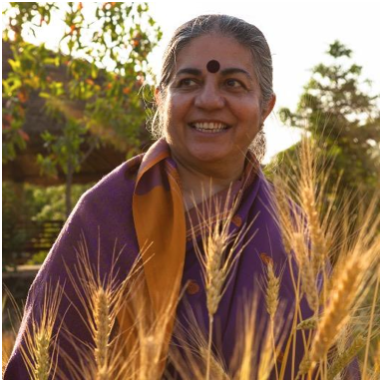
Vandana Shiva (born 5 November 1952) is an Indian scholar, environmental activist, food sovereignty advocate, ecofeminist, and anti-globalisation author. Based in Delhi, she has written more than 20 books. Shiva is one of the leaders and board members of the International Forum on Globalization, and a figure of the anti-globalisation movement. She has argued in favor of many traditional practices, as in her interview in the book Vedic Ecology (Ranchor Prime). She is a member of the scientific committee of the Fundacion IDEAS, Spain's Socialist Party's think tank, a member of the International Organization for a Participatory Society, and the founder of Navdanya, a movement for biodiversity conservation and farmers’ rights. She is also the founder and director of the Research Foundation for Science, Technology and Natural Resource Policy. Shiva fights for changes in the practice and paradigms of agriculture and food. She received the Right Livelihood Award in 1993, an award established by Swedish-German philanthropist Jakob von Uexkull, and regarded as an "Alternative Nobel Prize”.




