


Noam Chomsky
Taking
into account the results of the recent test, should President Clinton ask the
Pentagon to go ahead with the national missile defense system?
I
would prefer to respond to a slight reformulation of the question. The most
hopeful prospect for the NMD [National Missile Defense], I think, is that the
tests fail; and very clearly, because in the domain of nuclear strategy,
appearance is likely to be interpreted as reality, for familiar reasons. If a
system is developed that seems feasible, China will respond by strengthening its
deterrent, which will impel India to do the same, and Pakistan, and . . .
According
to press reports, a new National Intelligence Estimate predicts that NMD
deployment will trigger buildup of nuclear-armed missiles by China, India, and
Pakistan, with a further spread into the Middle East. Russia will assume that
such a system can be quickly upgraded and will therefore also regard it as a
first-strike threat. As many have observed, Russia’s "only rational
response to the NMD system would be to maintain, and strengthen, the existing
Russian nuclear force" (Michael Byers), undermining hopes for nuclear
disarmament.
The
president of the Stimson Center, Michael Krepon, comments that the difference
between Russian and U.S. stockpiles is so great that "the Russians are
looking at a U.S. breakout level" and will be likely to react accordingly.
U.S. negotiators have encouraged Russia to adopt a launch-on-warning strategy to
alleviate their concerns and to induce them to accept the NMD and revision of
the ABM treaty, a proposal that is "pretty bizarre," one expert
commented, because "we know their warning system is full of holes"
(John Steinbruner). At the UN [United Nations] conference on the
Nonproliferation Treaty (NPT) in May, there was broad condemnation of the NMD on
the grounds that it would undermine decades of arms control agreements and
provoke a new weapons race.
The
threat to the United States, and the world, seems clear and intolerably high.
Global concerns are not alleviated by other U.S. stands. Last November the
United States blocked a UN General Assembly resolution opposing space-based
weapons. It passed 138-0, with the United States and Israel alone abstaining. It
was recently announced that the United States is renovating more than 6,000
nuclear warheads, almost double what it is allowed to deploy under Start II,
rejecting Russian initiatives to reduce the number of warheads to 1,500 in
future talks. Currently the United States maintains a launch-on-warning posture
with the option of first-strike even against nonnuclear states that have signed
the NPT.
Other
recent decisions are also surely regarded as ominous in most of the world: for
example, resumption of tritium production using civilian facilities for the
first time, breaching the barrier between civilian and military use — another
blow to the NPT. Few, including allies, take seriously the alleged concern about
"rogue states." Canadian military planners advised last November that
the goal of the NMD is "arguably more in order to preserve U.S./NATO
freedom of action than because U.S. really fears North Korean or Iranian
threat," according to briefing documents obtained under Canada’s Access to
Information Act. The best hope for the world seems to me unambiguous test
failure.
This
piece was first published on the American Prospect Online at www.prospect.org.
It was a contribution to an American Prospect symposium on the National
Missile Defense.

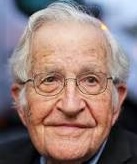
Noam Chomsky (born on December 7, 1928, in Philadelphia, Pennsylvania) is an American linguist, philosopher, cognitive scientist, historical essayist, social critic, and political activist. Sometimes called "the father of modern linguistics", Chomsky is also a major figure in analytic philosophy and one of the founders of the field of cognitive science. He is a Laureate Professor of Linguistics at the University of Arizona and an Institute Professor Emeritus at the Massachusetts Institute of Technology (MIT), and is the author of more than 150 books. He has written and lectured widely on linguistics, philosophy, intellectual history, contemporary issues, and particularly international affairs and U.S. foreign policy. Chomsky has been a writer for Z projects since their earliest inception, and is a tireless supporter of our operations.




