


Written for teleSUR English, which will launch on July 24
Albert: Some pundits are commenting that the current chaos in Iraq is a result of U.S. forces having left that country too soon. How do you address that argument?
Chomsky: Virtually without exception, the US sledgehammer has severely harmed Iraqi society, going back 50 years to when direct US intervention began with support for a military coup. In the 1980s, Washington strongly supported Saddam’s invasion of Iran, which was highly destructive for both countries. A peculiarly sadistic kind of “dual containment.” US admiration for Saddam was so strong that when the war ended, President Bush I even invited Iraqi nuclear engineers to the US for advanced training in nuclear weapons production, and in April 1990, sent a high-level senatorial delegation, headed by future Republican presidential candidate Bob Dole, to convey his warm regards to his friend Saddam and to assure him that he should disregard hostile comments that appear in the US press. The transcript is available, and is pretty astonishing, which I suppose is why it’s hardly known.
A few months later, Saddam made his first error: disregarding or perhaps misunderstanding orders, and invading Kuwait. Saddam quickly understood his error and sought to find some way to withdraw without being crushed by US attack. Bush was having none of that. As Chief-of-Staff Colin Powell explained in internal discussion, if the US lets Saddam withdraw, he’ll leave a puppet regime, and the Arab states will all be happy. In short, he would do just what the US had done in Panama a few months earlier, except that Latin Americans were very far from happy.
The US then launched a devastating war, destroying much of Iraq, far beyond anything that had to do with driving Saddam from Kuwait – which quite probably could have been achieved through negotiations, though the media were careful to suppress the negotiating options, which were unwelcome to Washington. After the grand triumph, accomplished by such devices as burying poor Iraqi recruits into the sands with bulldozers, Bush was able to triumphantly declare that “What We Say Goes,” and the world had better understand it.
Then came Clinton’s sanctions, which devastated the civilian society further. It had a “humanitarian” component: the Oil for Food program. This program was administered (under UN auspices) by highly regarded international diplomats, Dennis Halliday and Hans von Sponeck. Both resigned in protest, describing the sanctions as “genocidal.” Von Sponeck’s very important book on the topic, A Different Kind of War, is under an effective ban in the US (and UK). The sanctions devastated the civilian society, strengthened the dictator, compelled the population to rely on his distribution system for survival, and probably saved him from the fate of a long string of other US-supported monsters who were overthrown from within: Somoza, Marcos, Duvalier, Mobutu, Suharto, and other pleasant characters – more recently Mubarak and others.
Then came the US-UK invasion, which destroyed much of what was left, and also created a Sunni-Shiite conflict that is now tearing Iraq to shreds and has spread the poison throughout the region. The army that was armed and trained by the US for a decade collapsed when faced with a few thousand insurgents and their local support. Saddam was doubtless a monster, much like others supported by the US when they were useful. But under his rule the society not only functioned, but was advancing considerably, well beyond others in the Arab world.
It’s hard to avoid the conclusion of Marine Commandant David Shoup in 1966, referring to the US war in Vietnam: “I believe that if we had and would keep our dirty bloody dollar crooked fingers out of the business of these nations so full of depressed exploited people, they will arrive at a solution of their own design and want, that they fight and work for.”
Albert: The mainstream media make ISIS (the Islamic State of Iraq and the Levant) in Iraq seem pretty horrendous, with mass executions taking place. How do you assess these claims?
I think they are pretty accurate.
Albert: What is your view of various actual or proposed U.S. policies in Iraq: sending military trainers, providing arms to the Iraqi government, pressuring the Iraqi government to broaden its base, using drones or air power to support the Iraqi government, and sending in U.S. ground forces?
Iraqis often describe the US invasion as reminiscent of the horrendous Mongol invasions of the 13th century – and with reason. Like many others around the world, the country itself is largely a creation of European imperialism, its boundaries drawn to grant Britain (not Turkey) control of the oil fields in the north, and to block easy access to the Persian Gulf (the reason for establishing the British-run principality of Kuwait). But for better or worse, an Iraqi nationality was forged, and most Arab Iraqis seem to want to keep the country together (the Kurds are a different story). It’s now in really desperate straits. Without some kind of internal political settlement, however tentative and patched together, it’s hard to think of any constructive policy, particularly by those who have wielded the sledgehammer to such destructive effect for many years.
Albert: Obama has announced that he is seeking $500 million in military aid and training for vetted oppositionists in Syria. What is your view of this?
Syria is lurching towards catastrophe. The likely outcome is some kind of partition: a region run by Assad, a Kurdish breakaway region with some degree of autonomy, perhaps linking ultimately to Iraqi Kurdistan, and a region run by warring militias, perhaps with ISIS establishing some measure of control. It’s hard to see how US military involvement can make the horrendous disaster any better, to put it mildly.
If the US (and Israel) had had any real interest in supporting the opposition to Assad, there were some simple measures they could have taken. For example, if Israel had just mobilized forces in the Golan Heights (Syrian territory, annexed by Israel in violation of Security Council orders), Assad would have been compelled to deploy forces to the border, relieving pressure on the rebels. There’s no indication that such thoughts were ever considered.
Israel seems to have no objection to Arabs slaughtering one another. It weakens any regional opposition to Israel’s criminal expansionism in the occupied territories, and also contributes to the treasured image of “a villa in the jungle.” The US probably also has regarded the Assad regime as about the best it could anticipate.

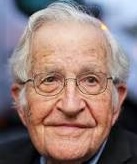
Noam Chomsky (born on December 7, 1928, in Philadelphia, Pennsylvania) is an American linguist, philosopher, cognitive scientist, historical essayist, social critic, and political activist. Sometimes called "the father of modern linguistics", Chomsky is also a major figure in analytic philosophy and one of the founders of the field of cognitive science. He is a Laureate Professor of Linguistics at the University of Arizona and an Institute Professor Emeritus at the Massachusetts Institute of Technology (MIT), and is the author of more than 150 books. He has written and lectured widely on linguistics, philosophy, intellectual history, contemporary issues, and particularly international affairs and U.S. foreign policy. Chomsky has been a writer for Z projects since their earliest inception, and is a tireless supporter of our operations.





1 Comment
This is a very valid, thoughtful, insightful, and astute critical analysis of Noam Chomsky in his interview with Albert about the tragedy of Iraq and Syria that the US and UK have caused and their use of Israel as a junior imperial power partner to perpetuate and accentuate the mayhem and disaster. As usual, Chomsky is at his very best with realism, logic, and pragmatism balanced by his idealism. He’s ingenious at exposing the hypocrisy, manipulation, and deceit
of imperial powers like the US, UK, and Israel.