


Noam Chomsky
The
events of the past weeks in East Timor should elicit shame as well as horror.
The crimes could easily have been stopped. That has been true since Indonesia
invaded in December 1975, relying on U.S. arms and diplomatic support. It would
have sufficed for the U.S. and its allies to withdraw their active
participation, and to inform the Indonesian military command that the territory
must be granted the right of self-determination that has been upheld by the
United Nations and the World Court.
The
latest chapter in this sordid tale opened after the referendum of August 30,
when the population voted overwhelmingly for independence. At once, atrocities
mounted sharply, organized and directed by the Indonesian military, who reduced
the capital city of Dili to ashes and subjected virtually the entire population
to terror and expulsion. The UN Mission (UNAMET) reported on September 11 that
the "direct link between the militia and the military is beyond any dispute
and has been overwhelmingly documented by UNAMET over the last four
months," warning that "the worst may be yet to come," even a
"genocidal campaign to stamp out the East Timorese problem by force."
Indonesia
historian John Roosa, an official observer of the vote, described the situation
starkly on September 15 in the New York Times: "Given that the pogrom was
so predictable, it was easily preventable… But in the weeks before the ballot,
the Clinton Administration refused to discuss with Australia and other countries
the formation of [an international force]. Even after the violence erupted, the
Administration dithered for days," until compelled by international
(primarily Australian) and domestic pressure to make some gestures. These
sufficed to induce the Indonesian generals to reverse course, illustrating the
latent power that has always been at hand.
The
latest events evoke bitter memories from 20 years ago. After carrying out a huge
slaughter in 1977-78, Indonesia permitted a brief visit by members of the
Jakarta diplomatic corps, among them U.S. Ambassador Edward Masters. They
witnessed an enormous humanitarian catastrophe. The aftermath was described by
the pre-eminent Indonesia scholar Benedict Anderson, in testimony at the United
Nations: "For nine long months" of starvation and terror,
"Ambassador Masters deliberately refrained, even within the walls of the
State Department, from proposing humanitarian aid to East Timor," waiting
"until the generals in Jakarta gave him the green light" — until they
felt "secure enough to permit foreign visitors," as an internal State
Department document recorded. Only then did Washington consider taking some
steps to deal with the consequences of its actions.
The
reasons have sometimes been honestly recognized. During the latest phase of
atrocities, a senior diplomat in Jakarta described "the dilemma" faced
by the great powers: "Indonesia matters and East Timor doesn’t." The
reasoning was spelled out more fully by two Asia specialists of the New York
Times: the Clinton Administration, they wrote on September 14, "has made
the calculation that the United States must put its relationship with Indonesia,
a mineral-rich nation of more than 200 million people, ahead of its concern over
the political fate of East Timor, a tiny impoverished territory of 800,000
people that is seeking independence."
The
operative principles had been articulated years earlier by Senator Daniel
Patrick Moynihan, who was UN Ambassador at the time of the U.S.-backed
Indonesian invasion. The Security Council ordered Indonesia to withdraw, but to
no avail. In his 1978 memoirs, Moynihan explains why: "The United States
wished things to turn out as they did, and worked to bring this about. The
Department of State desired that the United Nations prove utterly ineffective in
whatever measures it undertook. This task was given to me, and I carried it
forward with no inconsiderable success."
In
the next few months, Moynihan reports, 60,000 people were killed, ten percent of
the population. Atrocities peaked as his memoirs appeared. Relying on a new flow
of advanced weapons from the Carter Administration, the Indonesian military
carried out a devastating attack against the hundreds of thousands who had fled
to the mountains, driving the survivors to army control. It was then that Church
sources in East Timor sought to make public the estimates of 200,000 deaths that
came to be accepted years later, after constant denial. Washington’s reaction
has already been described.
As
the slaughter approached genocidal levels, Britain and France joined in with
arms and diplomatic support. Other powers too sought to participate, always
following the principles that have been lucidly enunciated.
This
year opened with a moment of hope. Indonesia’s interim president Habibie called
for a referendum with a choice between incorporation within Indonesia
("autonomy") or independence. The army moved at once to control the
outcome by terror. In the months leading to the August referendum, 3-5000 were
killed according to highly credible Church sources — twice the number of deaths
prior to the NATO bombing in Kosovo, with more than twice the population of East
Timor. The terror was widespread and sadistic, intended as a warning of the
consequences of refusal to obey the orders of the army of occupation, which
announced that "if the pro-independents do win, all will be destroyed"
— the grim words of the Indonesian commander in Dili.
In
an awe-inspiring display of courage and dedication, almost the entire population
voted, many emerging from hiding to do so, choosing independence. Then followed
the latest phase of army atrocities — exactly as had been proclaimed, loud and
clear. Within two weeks, more than 10,000 might have been killed, according to
Nobel Laureate Bishop Belo, who fled under a hail of bullets. Hundreds of
thousands have been driven to an unknown fate under army rule in Indonesia,
while most of the survivors face starvation in the mountains. The one country
that could easily have sent extensive humanitarian aid, including air drops,
refuses to do so, preferring that others shoulder the burdens of its years of
betrayal and complicity.
We
cannot undo the past, but should be willing to face it honestly, to accept the
moral responsibility of saving the remnants, and to provide ample reparations as
at least a gesture of compensation for terrible crimes. _

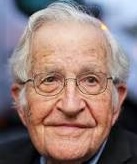
Noam Chomsky (born on December 7, 1928, in Philadelphia, Pennsylvania) is an American linguist, philosopher, cognitive scientist, historical essayist, social critic, and political activist. Sometimes called "the father of modern linguistics", Chomsky is also a major figure in analytic philosophy and one of the founders of the field of cognitive science. He is a Laureate Professor of Linguistics at the University of Arizona and an Institute Professor Emeritus at the Massachusetts Institute of Technology (MIT), and is the author of more than 150 books. He has written and lectured widely on linguistics, philosophy, intellectual history, contemporary issues, and particularly international affairs and U.S. foreign policy. Chomsky has been a writer for Z projects since their earliest inception, and is a tireless supporter of our operations.




