


Noam Chomsky
In
1999, Colombia became the leading recipient of US military and police
assistance, replacing Turkey (Israel and Egypt are in a separate category). The
figure is scheduled to increase sharply for the next two years. Through the
1990s, Colombia has been the leading recipient of US military aid in Latin
America, and has also compiled the worst human rights record, in accord with a
well-established correlation.
We
can often learn from systematic patterns, so let us tarry for a moment on the
previous champion, Turkey. It has received substantial military aid from the
origins of the Cold War, as a major US outpost. But arms deliveries began to
increase sharply in 1984, with no Cold War connection at all. Rather, that was
the year when Turkey began a large-scale counterinsurgency campaign in the
largely Kurdish southeast. Arms deliveries peaked in 1997, exceeding the total
from the entire period 1950-1983 (fiscal years), amounting to about 80% of
Turkish military equipment, including heavy armaments (jet planes, tanks, etc).
By 1999, Turkey had largely suppressed Kurdish resistance by terror and ethnic
cleansing, leaving some 2-3 million refugees, 3500 villages destroyed (7 times
Kosovo under NATO bombs), and tens of thousands killed. A huge flow of arms from
the Clinton administration was no longer needed to accomplish these objectives.
Nevertheless,
despite the great success achieved by some of the most extreme state terror of
the 1990s, military operations continue while Kurdish citizens are still
deprived of even minimal rights (again, a regime much harsher than Kosovo under
Milosevic). On April 1, 10,000 Turkish troops began new ground sweeps in regions
that had been devastated by the US-Turkish terror campaigns of the preceding
years, also launching another offensive into northern Iraq to attack Kurdish
guerrilla forces — in a no-fly zone where Kurds are protected by the US air
force from the (temporarily) wrong oppressor. As these new campaigns were
beginning, Secretary of Defense William Cohen addressed the American-Turkish
Council, a festive occasion with much laughter and applause, according to the
government report. He praised Turkey for taking part in the humanitarian bombing
of Yugoslavia, apparently without embarrassment, and announced that Turkey had
been invited to join in co-production of the new Joint Strike Aircraft, just as
it has been co-producing the F-16s that it used to such good effect in approved
varieties of ethnic cleansing and atrocities within its own territory, as a
loyal member of NATO.
In
Colombia, however, the military armed and trained by the US has not crushed
domestic resistance, though it continues to produce its regular annual toll of
atrocities. Each year, some 300,000 new refugees are driven from their homes,
with a death toll of about 3000 and many horrible massacres. The great majority
of atrocities are attributed to the paramilitary forces that are closely linked
to the military, as documented once again by Human Rights Watch (February 2000).
The Colombian Commission of Jurists reported last September that the rate of
killings had increased by almost 20% over the preceding year, and that the
proportion attributable to the paramilitaries had risen from 46% in 1995 to
almost 80% in 1998, continuing through 1999. Forced displacement in 1998 was 20%
above 1997, and increased in 1999 in some regions according to Human Rights
Watch. Colombia now has the largest displaced population in the world, after
Sudan and Angola. Prominent human rights activists continue to flee abroad under
death threats, including now the courageous head of the Church-based human
rights group Justice and Peace, Fr. Javier Giraldo, who has played an
outstanding role in defending human rights. The AFL-CIO reports (Feb. 2000) that
several trade unionists are murdered every week, mostly by paramilitaries
supported by the government security forces. Hailed as a leading democracy by
Clinton and other US leaders, Colombia permitted a challenge to the elite system
of power-sharing by an independent political party, which, however, faced
certain difficulties, such as the assassination of about 3000 activists,
including presidential candidates, mayors, and legislators. Meanwhile, shameful
socioeconomic conditions persist and may even have intensified, leaving much of
the population in misery in a rich country with concentration of wealth and
land-ownership that is high even by outrageous Latin American standards.
The
president of the Colombian Permanent Committee for Human Rights, former Minister
of Foreign Affairs Alfredo Vasquez Carrizosa, writes that it is "poverty
and insufficient land reform" that "have made Colombia one of the most
tragic countries of Latin America," though as elsewhere, "violence has
been exacerbated by external factors," primarily the initiatives of the
Kennedy Administration, which "took great pains to transform our regular
armies into counterinsurgency brigades," ushering in "what is known in
Latin America as the National Security Doctrine," which is not concerned
with "defense against an external enemy" but rather "the internal
enemy." The new "strategy of the death squads" accords the
military "the right to fight and to exterminate social workers, trade
unionists, men and women who are not supportive of the establishment, and who
are assumed to be communist extremists."
As
part of its strategy of converting the Latin American military from
"hemispheric defense" to "internal security" — meaning war
against the domestic population — Kennedy dispatched a military mission to
Colombia in 1962 headed by Special Forces General William Yarborough. He
proposed "reforms" to enable the security forces to "as necessary
execute paramilitary, sabotage and/or terrorist activities against known
communist proponents" — the "communist extremists" to whom
Vasquez Carrizosa alludes.
In
Colombia, a governmental commission concluded that "the criminalization of
social protest" is one of the "principal factors which permit and
encourage violations of human rights" by the military and police
authorities and their paramilitary collaborators. Ten years ago, as US-backed
state terror was increasing sharply, the Minister of Defense called for
"total war in the political, economic, and social arenas," while
another high military official explained that guerrillas were of secondary
importance: "the real danger" is "what the insurgents have called
the political and psychological war," the war "to control the popular
elements" and "to manipulate the masses." The
"subversives" hope to influence unions, universities, media, and so
on. "Every individual who in one or another manner supports the goals of
the enemy must be considered a traitor and treated in that manner," a 1963
military manual prescribed, as the Kennedy initiatives were moving into high
gear. Since the official goals of the guerrillas are social democratic (whatever
their actual goals may be), the circle of treachery targeted for terror
operations is wide.
The
Kennedy-Yarborough strategy was developed and applied broadly in the years that
followed. Violent repression spread throughout the hemisphere, reaching its
awesome peak in Central America in the 1980s. Colombia’s advance to first-rank
among the criminal states south of the border is in part the result of the
decline in US-backed state terror in Central America. As in Turkey ten years
later, its primary aims were achieved, leaving in its wake a "culture of
terror" that "domesticates the expectations of the majority" and
undermines any aspiration towards "alternatives that differ from those of
the powerful" in the words of Salvadoran Jesuits who learned the lessons
from bitter experience; those who survived the US assault, that is. In Colombia,
the problem of establishing approved forms of "stability" remains, and
is even becoming more severe. The correlation with increasing arms shipments is
familiar.

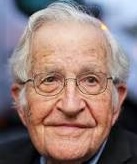
Noam Chomsky (born on December 7, 1928, in Philadelphia, Pennsylvania) is an American linguist, philosopher, cognitive scientist, historical essayist, social critic, and political activist. Sometimes called "the father of modern linguistics", Chomsky is also a major figure in analytic philosophy and one of the founders of the field of cognitive science. He is a Laureate Professor of Linguistics at the University of Arizona and an Institute Professor Emeritus at the Massachusetts Institute of Technology (MIT), and is the author of more than 150 books. He has written and lectured widely on linguistics, philosophy, intellectual history, contemporary issues, and particularly international affairs and U.S. foreign policy. Chomsky has been a writer for Z projects since their earliest inception, and is a tireless supporter of our operations.




