


Noam Chomsky
A
number of people in the ZNet forum system and elsewhere have raised questions
about the prominent role they see assigned to US-NATO in the flood of commentary
on recent events in Yugoslavia, "gloating over the victory of the
opposition in Yugoslavia–as if that affirms the NATO bombing" (as one puts
it). Others have noticed a similar focus with an opposite emphasis:
denunciations of US violence and subversion for the overthrow of an independent
Serb government in favor of Western clients. I’ve been asked for my own
reaction. What follows is an amalgam of several forum and other responses.
It’s
surely right that publicly the Clinton-Blair administrations are
"gloating" over the outcome, and that the usual cheerleaders are doing
their duty as well. That is commonly the case whatever the outcome. But we
should not overlook the fact that more serious observers — as anti-Milosevic as
you can find — are telling quite a different story. For example, the senior
news analyst of UPI, Martin Sieff, described the outcome of the election as
"an unpleasant shock to both incumbent Slobodan Milosevic and the Clinton
administration (Sept. 25), pointing out that Kostunica "regularly denounces
the NATO bombing of Yugoslavia last year as `criminal’," "implacably
opposes having Milosevic or any other prominent Serb tried as a war
criminal," and worse still from the Clinton-Blair point of view, "does
appear to accurately express the democratic aspirations of the Serbian
people."
That’s
correct across the board, and Sieff is not alone in reporting it. In his
campaign throughout the country and on state TV, Kostunica "condemned
"NATO’s criminal bombing of Yugoslavia" and denounced the
International Criminal Tribunal on Yugoslavia (ICTY) as "an American
tribunal — not a court, but a political instrument" (Steven Erlanger and
Carlotta Gall, NYT, Sept. 21). Speaking on state TV after taking office, he
reiterated that while he sought normalization of relations with the West,
"the crimes during the NATO aggression, nor the war damages, could not be
forgotten," and he again described the ICTY as a "tool of political
pressure of the US administration" (Oct 5, 6).
In
the British press, some prominent (and bitterly anti-Milosevic) correspondents
have pointed out that "The West’s self-satisfaction cannot disguise the
reality of the Balkans…it was not the bombing, the sanctions and the posturing
of NATO politicians" that got rid of Milosevic. Rather "he was toppled
by a self-inflicted, democratic miscalculation," and if anything his fall
was impeded by Western intervention: the rotten situation in the Balkans
"has been made worse by intervention,… NATO’s actions escalated the
nastiness, prolonged the resolution and increased the cost." "At the
very least, outsiders such as [British Foreign Secretary] Mr Cook should stop
rewriting history to their own gain. They did not topple Mr Milosevic. They did
not bomb democracy into the last Communist dictatorship in Europe. They merely
blocked the Danube and sent Serb politics back to the Dark Ages of autocracy. It
was not sanctions that induced the army to switch sides; generals did well from
the black market. The fall of Mr Milosevic began with an election that he called
and then denied, spurring the electors to demand that the army respect their
decision and protect their sovereignty. For that, Yugoslavia’s democracy
deserves the credit, not Nato’s Tomahawk missiles" (Simon Jenkins, London
Times, Oct. 7). "The kind of people who made last Thursday’s
revolution" were those who were "depressed in equal measure by the
careless savagery of the Nato bombing and the sheer nastiness of the Milosevic
regime" (John Simpson, world affairs editor of BBC, Sunday Telegraph, Oct.
8).
Serb
dissidents, to the extent that their voices are heard here, are saying pretty
much the same thing. In a fairly typical comment on BBC, a Belgrade university
student said: "We did it on our own. Please do not help us again with your
bombs." Reaffirming these conclusions, a correspondent for the opposition
daily Blic writes that "Serbs felt oppressed by their regime from the
inside and by the West from the outside; she condemns the US for having
"ignored the democratic movement in Yugoslavia and failing to aid numerous
Serbian refugees" — by far the largest refugee population in the region. A
prominent dissident scholar, in a letter of remembrance for a leading human
rights activist who recently died, asks whether "the ones who said they
imposed sanctions `against Milosevic’ knew or cared how they impoverished you
and the other people like you, and turned our lives into misery while helping
him and his smuggling allies to become richer and richer," enabling him to
"do whatever he wanted"; and instead of realizing "the stupidity
of isolating a whole nation, of tarring all the people with the same broad brush
under the pretense that they are striking a blow against a tyrannical
leader," are now saying — self-righteously and absurdly — "that all
that is happening in Serbia today was the result of their wise policy, and their
help" (Ana Trbovich, Jasmina Teodosijevic, Boston Globe, Oct. 8).
These
comments, I think, are on target. What happened was a very impressive
demonstration of popular mobilization and courage. The removal of the brutal and
corrupt regimes of Serbia and Croatia (Milosevic and Tudjman were partners in
crime throughout) is an important step forward for the region, and the mass
movements in Serbia — miners, students, innumerable others — merit great
admiration, and provide an inspiring example of what united and dedicated people
can achieve. Right now workers’ committees are taking control of many companies
and state institutions, "revolting against their Milosevic-era managers and
taking over the directors’ suites," as "workers took full advantage of
Yugoslav’s social ownership traditions." "With Milosevic’s rule
crumbling, the workers have taken the communist rhetoric literally and taken
charge of their enterprises," instituting various forms of "worker
management" (London Financial Times, Oct. 11). What has taken place, and
where it will go, is in the hands of the people of Serbia, though as always,
international solidarity and support — not least in the US — can make a
substantial difference.
On
the elections themselves, there is plenty of valid criticism: there was
extensive interference by the West and by Milosevic’s harshly repressive (but by
no means "totalitarian") apparatus. But I think the Belgrade student
is right: they did it on their own, and deserve plenty of credit for that. It’s
an outcome that the left should welcome and applaud, in my opinion.
It
could have happened before. There is good reason to take seriously the judgment
of Balkans historian Miranda Vickers (again, as anti-Milosevic as they come)
that Milosevic would have been ousted years earlier if the Kosovar Albanians had
voted against him in 1992 (they were hoping he would win, just as they did this
September). And the mass popular demonstrations after opposition victories in
local elections in 1996 might have toppled him if the opposition hadn’t
fractured. Milosevic was bad enough, but nothing like the rulers of totalitarian
states, or the murderous gangsters the US has been placing and keeping in power
for years all over the world.
But
ridding the country of Milosevic doesn’t in itself herald a final victory for
the people of Serbia, who are responsible for the achievement. There’s plenty of
historical evidence to the contrary, including very recent evidence. It’s hard
to think of a more spectacular recent achievement than the overthrow of South
Africa’s Apartheid horror, but the outcome is far from delightful, as Patrick
Bond has been documenting impressively on ZNet, and as is obvious even to the
observer or visitor with limited information. The US and Europe will doubtless
continue their (to an extent, competing) efforts to incorporate Serbia along
with the rest of the Balkans into the Western-run neoliberal system, with the
cooperation of elite elements that will benefit by linkage to Western power and
with the likely effects of undermining independent economic development and
functioning democracy, and harming a good part (probably considerable majority)
of the population, with the countries expected to provide cheap human and
material resources and markets and investment opportunities, subordinated to
Western power interests. Serious struggles are barely beginning, as elsewhere.

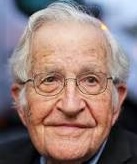
Noam Chomsky (born on December 7, 1928, in Philadelphia, Pennsylvania) is an American linguist, philosopher, cognitive scientist, historical essayist, social critic, and political activist. Sometimes called "the father of modern linguistics", Chomsky is also a major figure in analytic philosophy and one of the founders of the field of cognitive science. He is a Laureate Professor of Linguistics at the University of Arizona and an Institute Professor Emeritus at the Massachusetts Institute of Technology (MIT), and is the author of more than 150 books. He has written and lectured widely on linguistics, philosophy, intellectual history, contemporary issues, and particularly international affairs and U.S. foreign policy. Chomsky has been a writer for Z projects since their earliest inception, and is a tireless supporter of our operations.




