


Various questions are circulating among people worried about war. On Sept 1, 2002, Michael Albert put a dozen of these to Noam Chomsky, via email. Here are the first three questions and his responses…the whole interview will appear in the October issue of Z Magazine.
1. Has Saddam Hussein been as evil as mainstream media says? Domestically? Internationally?
He is as evil as they come, ranking with Suharto and other monsters of the modern era. No one would want to be within his reach. But fortunately, his reach does not extend very far.
Internationally, Saddam invaded Iran (with Western support), and when that war was going badly turned to chemical weapons (also with Western support). He invaded Kuwait and was quickly driven out.
A major concern in Washington right after the invasion was that Saddam would quickly withdraw, putting “his puppet in [and] everyone in the Arab world will be happy” (Colin Powell, then Chief of Staff). President Bush was concerned that Saudi Arabia might “bug out at the last minute and accept a puppet regime in Kuwait” unless the US prevented Iraqi withdrawal.
The concern, in brief, was that Saddam would pretty much duplicate what the US had just done in Panama (except that Latin Americans were anything but happy). From the first moment the US sought to avert this “nightmare scenario.” A story that should be looked at with some care.
Saddam’s worst crimes, by far, have been domestic, including the use of chemical weapons against Kurds and a huge slaughter of Kurds in the late 80s, barbaric torture, and every other ugly crime you can imagine. These are at the top of the list of terrible crimes for which he is now condemned, rightly. It’s useful to ask how frequently the impassioned denunciations and eloquent expressions of outrage are accompanied by three little words: “with our help.”
The crimes were well known at once, but of no particular concern to the West. Saddam received some mild reprimands; harsh congressional condemnation was considered too extreme by prominent commentators. The Reaganites and Bush #1 continued to welcome the monster as an ally and valued trading partner right through his worst atrocities and well beyond.
Bush authorized loan guarantees and sale of advanced technology with clear applications for weapons of mass destruction (WMD) right up to the day of the Kuwait invasion, sometimes overriding congressional efforts to prevent what he was doing. Britain was still authorizing export of military equipment and radioactive materials a few days after the invasion.
When ABC correspondent and now ZNet Commentator Charles Glass discovered biological weapons facilities (using commercial satellites and defector testimony), his revelations were immediately denied by the Pentagon and the story disappeared. It was resurrected when Saddam committed his first real crime, disobeying US orders (or perhaps misinterpreting them) by invading Kuwait, and switched instantly from friend to reincarnation of Attila the Hun.
The same facilities were then used to demonstrate his innately evil nature. When Bush #1 announced new gifts to his friend in December 1989 (also gifts to US agribusiness and industry), it was considered too insignificant even to report, though one could read about it in Z magazine at the time, maybe nowhere else.
A few months later, shortly before he invaded Kuwait, a high-level Senate delegation, headed by (later) Republican presidential candidate Bob Dole, visited Saddam, conveying the President’s greetings and assuring the brutal mass murderer that he should disregard the criticism he hears from maverick reporters here.
Saddam had even been able to get away with attacking a US naval vessel, the USS Stark, killing several dozen crewmen. That is a mark of real esteem. The only other country to have been granted that privilege was Israel, in 1967. In deference to Saddam, the State Department banned all contacts with the Iraqi democratic opposition, maintaining this policy even after the Gulf war, while Washington effectively authorized Saddam to crush a Shi’ite rebellion that might well have overthrown him — in the interest of preserving “stability,” the press explained, nodding sagely.
That he’s a major criminal is not in doubt. That’s not changed by the fact that the US and Britain regarded his major atrocities as insignificant in the light of higher “reasons of state,” before the Gulf war and even after — facts best forgotten.
2. Looking into the future, is Saddam Hussein as dangerous as mainstream media says?
The world would be better off if he weren’t there, no doubt about that. Surely Iraqis would. But he can’t be anywhere near as dangerous as he was when the US and Britain were supporting him, even providing him with dual-use technology that he could use for nuclear and chemical weapons development, as he presumably did.
10 years ago the Senate Banking Committee hearings revealed that the Bush administration was granting licences for dual use technology and “materials which were later utilized by the Iraq regime for nuclear missile and chemical purposes.” Later hearings added more, and there are press reports and a mainstream scholarly literature on the topic (as well as dissident literature).
The 1991 war was extremely destructive, and since then Iraq has been devastated by a decade of sanctions, which probably strengthened Saddam himself (by weakening possible resistance in a shattered society), but surely reduced very significantly his capacity for war-making or support for terror.
Furthermore, since 1991 his regime has been constrained by “no fly zones,” regular overflights and bombing, and very tight surveillance. Chances are that the events of Sept. 11 weakened him still further. If there are any links between Saddam and al-Qaeda, they would be far more difficult to maintain now because of the sharply intensified surveillance and controls.
That aside, links are not very likely. Despite enormous efforts to tie Saddam to the 9-11 attacks, nothing has been found, which is not too surprising. Saddam and bin Laden were bitter enemies, and there’s no particular reason to suppose that there have been any changes in that regard.
The rational conclusion is that Saddam is probably less of a danger now than before 9-11, and far less of a threat than when he was enjoying substantial support from the US-UK (and many others). That raises a few questions. If Saddam is such a threat to the survival of civilization today that the global enforcer has to resort to war, why wasn’t that true a year ago? And much more dramatically, in early 1990?
3. How should the problem of the existence and use of weapons of mass destruction in the world today be dealt with?
They should be eliminated. The non-proliferation treaty commits countries with nuclear weapons to take steps towards eliminating them. The biological and chemical weapons treaties have the same goals. The main Security Council resolution concerning Iraq (687, 1991) calls for eliminating weapons of mass destruction and delivery systems from the Middle East, and working towards a global ban on chemical weapons. Good advice.
Iraq is nowhere near the lead in this regard. We might recall the warning of General Lee Butler, head of Clinton’s Strategic Command in the early 90s, that “it is dangerous in the extreme that in the cauldron of animosities that we call the Middle East, one nation has armed itself, ostensibly, with stockpiles of nuclear weapons, perhaps numbering in the hundreds, and that inspires other nations to do so.”
He’s talking about Israel of course. The Israeli military authorities claim to have air and armored forces that are larger and more advanced than those of any European NATO power (Yitzhak ben Israel, Ha’aretz, 4-16-02, Hebrew). They also announce that 12% of their bombers and fighter aircraft are permanently stationed in Eastern Turkey, along with comparable naval and submarine forces in Turkish bases, and armored forces as well, in case it becomes necessary to resort to extreme violence once again to subdue Turkey’s Kurdish population, as in the Clinton years.
Israeli aircraft based in Turkey are reported to be flying reconnaisance flights along Iran’s borders, part of a general US-Israel-Turkey policy of threatening Iran with attack and perhaps forceful partitioning. Israeli analysts also report that joint US-Israel-Turkey air exercises are intended as a threat and warning to Iran. And of course to Iraq (Robert Olson, Middle East Policy, June 2002). Israel is doubtless using the huge US air bases in Eastern Turkey, where the US bombers are presumably nuclear-armed. By now Israel is virtually an offshore US military base.
And the rest of the area is armed to the teeth as well. If Iraq were governed by Gandhi, it would be developing weapons systems if it could, probably well beyond what it can today. That would very likely continue, perhaps even accelerate, if the US takes control of Iraq. India and Pakistan are US allies, but are marching forward with the development of WMD and repeatedly have come agonizingly close to using nuclear weapons. The same is true of other US allies and clients.
That is likely to continue unless there is a general reduction of armaments in the area.
Would Saddam agree to that? Actually, we don’t know. In early January 1991, Iraq apparently offered to withdraw from Kuwait in the context of regional negotiations on reduction of armaments, an offer that State Department officials described as serious and negotiable. But we know no more about it, because the US rejected it without response and the press reported virtually nothing.
It is, however, of some interest that at that time — right before the bombing — polls revealed that by 2-1 the US public supported the proposal that Saddam had apparently made, preferring it to bombing. Had people been allowed to know any of this, the majority would surely have been far greater. Suppressing the facts was an important service to the cause of state violence.
Could such negotiations have gotten anywhere? Only fanatical ideologues can be confident. Could such ideas be revived? Same answer. One way to find out is to try.

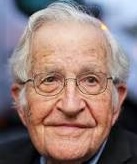
Noam Chomsky (born on December 7, 1928, in Philadelphia, Pennsylvania) is an American linguist, philosopher, cognitive scientist, historical essayist, social critic, and political activist. Sometimes called "the father of modern linguistics", Chomsky is also a major figure in analytic philosophy and one of the founders of the field of cognitive science. He is a Laureate Professor of Linguistics at the University of Arizona and an Institute Professor Emeritus at the Massachusetts Institute of Technology (MIT), and is the author of more than 150 books. He has written and lectured widely on linguistics, philosophy, intellectual history, contemporary issues, and particularly international affairs and U.S. foreign policy. Chomsky has been a writer for Z projects since their earliest inception, and is a tireless supporter of our operations.




