


Many British might prefer fish & chips, Australians meat pie, Italians pizza, the Danish røde pølser, and Americans burgers—but Germany’s heart is with kebab.
Germans have adopted the Turkish word “Döner,” meaning dönmek, or “to turn” and “to rotate.” The Turkish name “döner kebap” literally means “rotating roast”—as in “Bayramoğlu Döner” or “Tur Döner Shawarma” in Istanbul, for example.
Back in Germany, Döner consumption amounts to about 550 metric tons per day—a whopping 200,000 tons per year. Every German eats an average of 2.25 kilograms of Döner annually. About half is made from poultry, the rest from beef or veal.
Last year, 44% of all Germans enjoyed a Döner about once a month, buying it from one of the 18,500 Döner restaurants or take-away spots. Germany’s Döner industry generates more revenue than McDonald’s, Burger King, and Germany’s most popular fish outlet “Nordsee”—combined.
Even though Germany’s deeply racist AfD party may hate it, the Döner story begins with migration—from Turkey to Germany. Today, people joke that even German Neo-Nazis secretly enjoy a Döner.
At first, Berlin diners—traditionally used to Currywurst – were unfamiliar with the rising star in Berlin’s gastro sky.
In the early 1970s, the Döner was primarily appreciated within Germany’s vibrant migrant community. But soon, the humble Döner began its triumphal procession.
It was no coincidence that the still proletarian Berlin suburb of Kreuzberg became “the” location for this culinary newcomer.
Local workers in search of a hearty meal, students seeking something cheap, and even middle-class professionals quickly developed a taste for the Döner lunchtime meal.
Today, the Döner is Germany’s most popular snack. There are 1,600 Döner places in Berlin alone. Most of these are still family businesses. Yet, “House of Doner Kebab” was the first franchise—with over 100 branches.
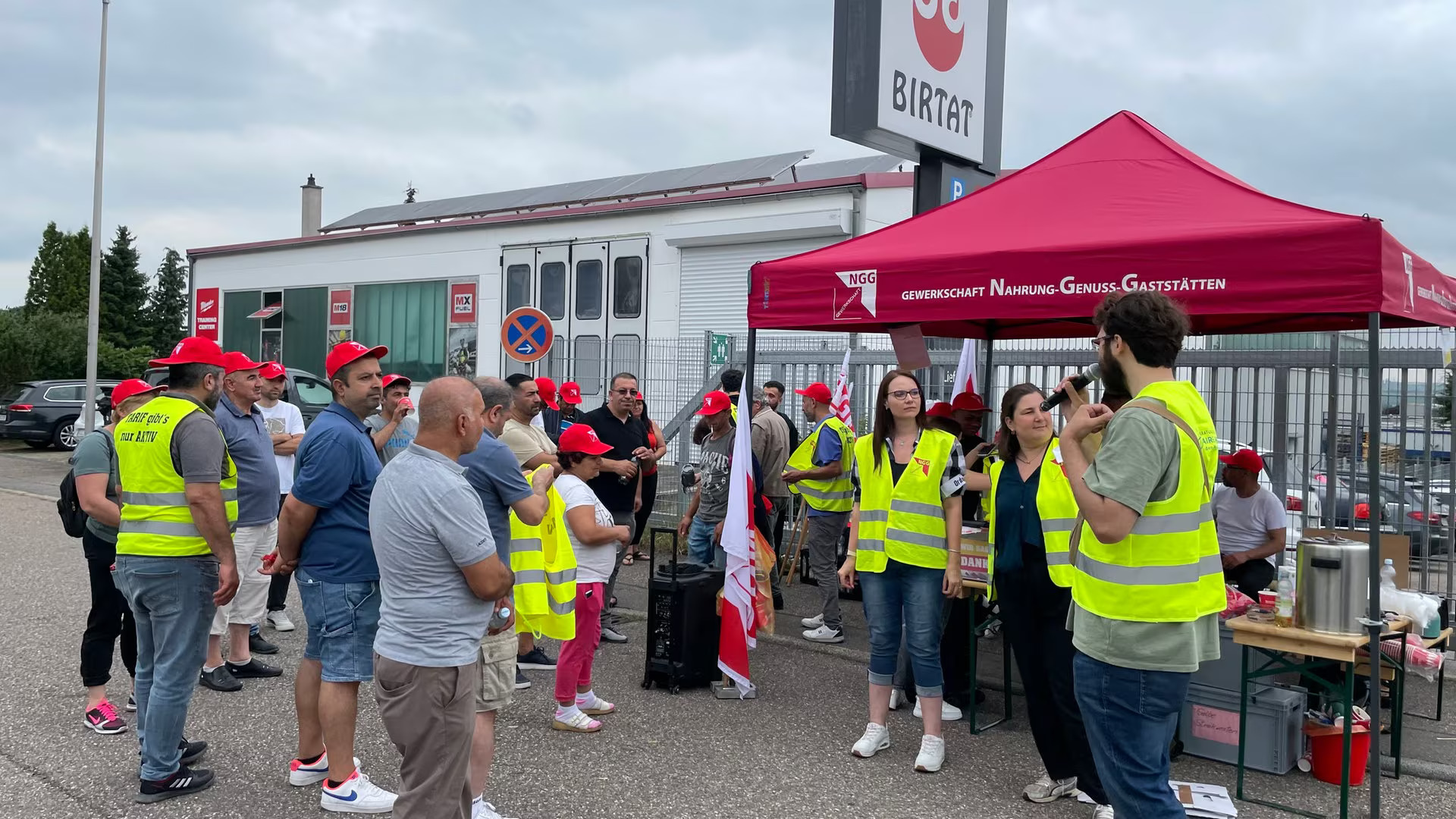
Meanwhile, supplying Germany’s 18,500 Döner outlets with 200,000 tons of Döner meat per year requires factory-style production. The Döner meat manufacturer Birtat, near the southern city of Ludwigsburg, is one such factory.
In 2025, for several weeks, workers at Birtat took to the streets – with drums, whistles, and high-visibility vests. They were fighting for more money, better working conditions, and a collective agreement.
According to Germany’s “Association of Döner Producers,” there are about 400 manufacturers. For them, Germany’s food, beverages and catering union – the NGG – collective agreement would mark a turning point.
The NGG-Birtat agreement was a pilot project. For a long time, Birtat’s management ignored the union’s demands. But workers steadily increased the pressure – for higher wages and an end to unsustainable working conditions.
Work at Birtat is assembly-line based, high-intensity, and under constant time pressure. “Work is really hard,” said the head of the works council.
Shredding meat, marinating it, skewering it – all done at low temperatures – makes production (read: designed by management) backbreaking. The company produces between 35 and 40 tons of Döner skewers every day.
Workers also demanded a reduction in the sheer weight of each Döner skewer – some weighing up to 100 kilograms. Work is dangerous. “We always work with sharp knives,” said one worker. Safety measures – such as protective gloves – are in place, but the danger remains.
Birtat is part of “Meat World SE,” the largest manufacturer of kebab skewers in Baden-Württemberg – and one of the leading suppliers in Germany.
Birtat supplies over 13 million consumers every month. The company claims that its products can be tasted in nearly every major city in Europe.
Meat World has an annual turnover of around €200 million [$232 million]. Yet many Birtat workers found that wage payments were often delayed. “There is a mess… it’s completely arbitrary,” said a union official.
Criteria for bonuses, overtime, and shift allowances were opaque. Before the union agreement, personal favouritism, nepotism, and so-called “individual negotiations” ruled wage decisions.
As one worker noted, “I’ve only been employed for a few weeks—but I get more money than some colleagues who’ve been here for years.”
Around 18 months before the strike, Birtat workers began organizing in a union. A works council was also formed.
Communication wasn’t easy. In addition to German, most workers spoke Turkish, Bulgarian, or Romanian – among other languages.
Since February 2025, the workforce had been demanding higher pay. Ten short-term strikes were organized, each with strong participation.
By mid-July, the NGG union launched a five-day strike. A union member ballot showed unanimous support to continue the action.
For the approximately 115 workers, the NGG demanded a monthly wage increase of €375 [$435].
Without significant wage hikes, the pressure on workers’ wallets was intense. The union aimed for a transparent, non-discriminatory pay scale, and a starting salary of €3,000 [$3,500] per month.
That may sound like a lot – but in high-tax Germany, with soaring living and housing costs, it’s barely enough to get by.
In March 2025, the first negotiation between union and management took place. However, in July, management cancelled a scheduled collective bargaining meeting.
Birtat’s management made it clear: it “categorically” rejected any collective agreement. In doing so, they blocked negotiations.
A company spokesperson called the union’s demand “very high” – not exactly a new line. For management, wages are always “too high.” As Birtat refused to engage, production was largely shut down for a day – a warning to management.
Longer strikes, some feared, might jeopardize the supply of Döner meat. At the time, so-called “experts” warned that higher wages could push Döner prices over the “magical” €10.
An idle threat. In the end, unfounded. A Döner at Kebabchi Rüsselsheim, for example, still costs between €7.50 and €8.50.
In reality, a collective agreement would simply ensure that more of the profit goes to those who generate it – rather than those who cash in: the bosses.
And then came the breakthrough. After 13 days of strikes, on the evening of August 7, 2025, NGG secured a collective agreement with Birtat.
The result: a retroactive starting salary increase to €2,600 [$3,013], and a wage hike of up to 17%, in two stages, to be completed by the end of 2026. The first collective agreement in Germany’s Döner industry had been won.
Whether the Birtat strike will remain an isolated event—or inspire a broader, industry-wide agreement—remains to be seen. The latter would align with Germany’s long-standing model of industry-based labor relations.
From Germany’s most official news, Tagesschau, to the neoliberal, reactionary, and ideologically zealous FAZ, it was announced – as always – that a win for workers would come with “consequences for consumers.”
Worse, hundreds of commentators and videos flooded the internet – sometimes daily – warning against the strike. Yet, despite the might of Germany’s pro-business media apparatus, the workers won.
Recent Döner price increases are partly due to broader cost hikes – white bread to tomatoes. Between July 2023 and March 2025, ingredient prices rose 3.6%.
The Verband der Dönerproduzenten Deutschlands e.V. (VDD), an employers’ association, cites several reasons: stricter EU livestock regulations, animal diseases, inflation, and high energy and rental costs – not to mention delivery fees. All of these factor into the Döner’s price.
Meanwhile, the labor dispute turned individual workers into a community – a community that, after 12 days of strike, had achieved a major success.
Beyond the factory gates, the conflict brought together previously isolated groups – into one tightly-knit collective.
Not everyone could speak the same language—but they all spoke the language of solidarity. Workers and supporters danced, made music, played soccer. From strike day to strike day, the team spirit of workers’ solidarity grew.
People enjoyed the strike. Turkish and Kurdish workers danced Halay. After a few days, Romanian workers brought their music and taught others to dance to it.
On other days, there was chess or soccer. Doing something new from time to time kept morale high. One day, the strikers weren’t directly in front of the factory – but received pastoral care from a local priest.
Rallies were also key. It didn’t matter whether workers were walking through a deserted commercial area – it mattered that they were walking together.
Larger rallies in downtown Ludwigsburg gave a visible face to their struggle. Often, strikers shared homemade food – a communal lunch that became a symbol of solidarity.
In other words: beyond securing a collective agreement, the true victory was the sense of solidarity – and the community of workers it created. Solidarity was the real win for the striking workers of the Döner factory.
ZNetwork is funded solely through the generosity of its readers.
Donate

