

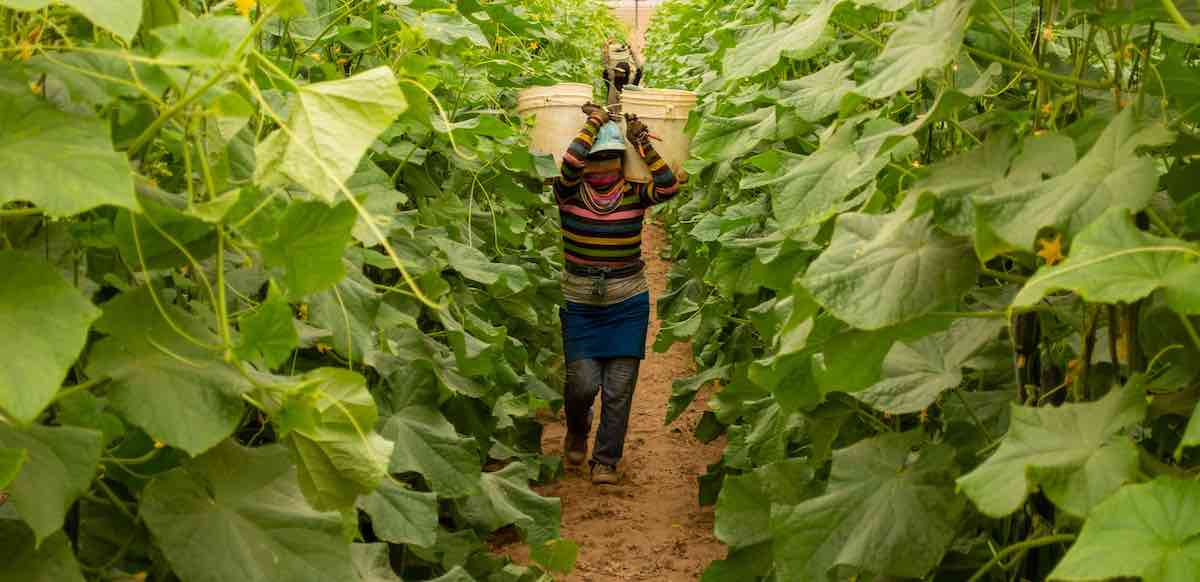
Any U.S. consumer walking down the supermarket aisle will find berries, tomatoes, and other vegetables that are labeled “responsibly grown,” “farmworker-assured,” and “fair-trade certified.”
But behind the labels, the Mexican workers who harvest these fruits and vegetables live and labor in conditions they call “twenty-first century slavery.”
We interviewed 200 workers for our new report “Certified Exploitation: How Equitable Food Initiative and Fair Trade USA Fail to Protect Farmworkers in the Mexican Produce Industry.” They detailed widespread wage theft, sexual harassment, rampant retaliation, and, in the most extreme cases, forced labor.
In the Mexican state of Baja California, farmworkers often get paid just $15 per day—while less than 200 miles north, farmworkers in California earn a minimum of $15 per hour. Often they’re picking for the same familiar household brands, like Driscoll’s or Andrew & Williamson. But that fundamental unfairness is hidden behind labels declaring that the produce is “Responsibly Grown, Farmworker Assured,” and “Fair Trade Certified.”
It raises the question: should farm labor conditions be an issue of consumer choice, or corporate regulation? And who gets to determine what counts as “fair” in the workplace?
‘NO BENEFIT’
The U.S.-based nonprofits Fair Trade USA and Equitable Food Initiative (EFI) claim to prevent abuses by setting private labor standards for their labels. These standards are set through a process that includes feedback from the brands, growers, and nonprofits—as well as, in the case of EFI, U.S. farmworker unions.
Growers and other suppliers pay for audits to assess whether they’re in compliance with the standards. Brands then pay licensing fees to put labels like “FairTrade Certified” on their products. The idea is that people can support fair labor practices when they shop.
But workers in the fields experience a different reality. “From the time I started at Rancho Nuevo five years ago, I do not know a benefit for the worker having EFI,” said a worker who asked to be identified as Ñuu Saví Farmworker. “This is what I would like to know. In what ways can the EFI group help us?”
(The worker names in this article are pseudonyms. The workers are concerned about retaliation from U.S.-based corporations, including being blacklisted from applying for H-2A guestworker visas, which offer the prospect of higher earnings.)
Critics of ethical certifications like Fair Trade USA and EFI mostly decry them as just more corporate PR. But our research shows the standards are worse than useless—they’re creating a parallel realm of corporate-friendly private regulation.
Instead of democratic union elections, farmworkers on certified farms are offered a spot on a committee with management. And instead of labor solidarity, those of us on the other side of the border are offered ethical consumerism as the way to support them.
COMPANY UNIONS
Ñuu Saví Farmworker’s experience with EFI points to the limitations of the existing model. We’ve heard many similar grievances among the 2 million migrant farmworkers from southern Mexican states like Oaxaca who work in the fields of Baja California.
In fact, workers see Fair Trade USA and EFI certifications as tools of management repression. They compare them to the company unions that have Mexico’s labor movement in a vice grip.
These certifications establish joint worker-management committees, meant to provide a union-like grievance system. EFI describes the committee as a tool for empowering workers and building their leadership skills.
But this setup is completely ineffective, said Lucinda, a worker who participated in the committee at Rancho Nuevo Produce. “They’re always on the side of the boss, because they are all part of the same family,” she said.
Both Fair Trade USA and EFI certifications assess compliance through third-party social auditors who visit plantation sites and interview workers.
The audit is set up to deliver good results, with focus-group-style interviews in front of management. “Yes, they ask us a lot of questions,” Lucinda said, “but we can’t say the truth there, because the coordinator is there. The human resources person is there.
“Before they [the auditors] come, they tell us ‘We have to go over this, and when they come we have to tell them yes.’ In other words, they instruct us to lie, and really we aren’t really complying.”
THWARTING LABOR POWER
Lucinda’s account aligns with the findings of the eight years of fieldwork that led to this report, and with findings across other industries. From produce to auto parts manufacturing to fashion, social auditors are signing off on rampant abuses.
While the certification model has become quite common as a tactic to address both environmental and social issues in supply chains, it is increasingly criticized as a “soft” strategy that stymies the organizing of independent unions. Certifications do this by channeling workers’ efforts into ineffective management-controlled committees and promoting token financial incentives – incentives that, as one worker put it, “put blinders on the mule to keep it working.”
One of the arguments made in favor of certifications is that they help fill so-called “governance gaps,” where multinationals do business with little regulation or enforcement of labor standards.
Yet in reality, Fair Trade USA and EFI standards are lower than Mexican labor law for key issues. The certifiers claim to “empower” workers through training on food safety—but they deny them their legal rights.
And as we found in our report, elements of the certification standards have actually gone down over time, belying the certifiers’ claims of “continual improvement.”
UNFAIR TRADE
A group of migrant workers picking cucumbers on Rancho Santa Mónica, a plantation that still bears Fair Trade USA and EFI certifications, had their identity documents taken and wages withheld; they were forced to work long hours without days off.
“I felt like a slave,” said one worker, Pablo. Indeed, those conditions check off many of the indicators of forced labor as defined by the International Labour Organization (ILO).
In the end it was not auditors or Fair Trade USA or EFI who helped the workers get out of the situation. It was the intervention of the only independent farmworker union in the region—the National Independent Democratic Union of Agricultural Workers (Sindicato Independiente Nacional Democrático de Jornaleros Agrícolas, or SINDJA).
SINDJA has thrown its support behind worker organizing and strikes for better wages and conditions. But the union has no collective bargaining agreements.
Those are held by company unions, part of massive federations like the Regional Confederation of Mexican Workers and the Confederation of Mexican Workers. That reflects a major challenge farmworkers face—the stranglehold that company unions have on the Mexican labor movement.
Company unions are prohibited by the ILO Convention on the Right to Organize and Collective Bargaining (No. 98). Yet these company unions exist, even on certified farms—despite the certifiers’ standards that promise to protect freedom of association.
In other export industries, such as car manufacturing, labor reforms codified in the United States-Mexico-Canada Agreement (USMCA) are pushing free and fair union elections where company unions have long shut them out.
Agriculture, however, has not been designated a priority sector for such reforms to date.
Meanwhile, certifications help corporations rebrand the exploitative status quo and undermine the organizing that it would take to win real improvements for workers. As one worker, Raul, put it, “To me, Fair Trade means unfair trade.”
ZNetwork is funded solely through the generosity of its readers.
Donate




