


Iran’s protesters will neither submit to the fascism hidden behind the regime’s pseudo-anti-imperialism nor surrender their country to the hegemony of the United States or their economy to financialized capital. The Western left should learn from them.
ATHENS – Dealing with random, unprovoked abuse is never easy. But dealing with random, unprovoked praise can be even harder.
An Athenian taxi driver, a Nazi sympathizer, told me recently, “I am a Golden Dawn voter, but I think the world of you.” I would rather that he had punched me in the stomach. I had the same sinking feeling the other day when I read far-right Hungarian Prime Minister Viktor Orbán’s proposals for achieving peace in Ukraine – proposals not too dissimilar to what I have been suggesting since Putin’s repulsive invasion began. While Orbán, unlike the Golden Dawn voter, did not praise me personally, the revulsion was the same. Over the years, I have suffered immense discomfort when people whose analyses at least partly resonated with my own suddenly revealed themselves as fascist anti-Semites, unreconstructed Stalinists, loony libertarians, or, more recently, Trumpists. Fine treatises exposing bankers’ shenanigans degenerated into vile attacks on Jews. Critiques of the Gilded Age of early financialized capitalism turned into paeans for Uncle Joe. Forensic analyses of our central banks’ propensity to play fast and loose with our money concluded with crackpot cryptocurrency proposals redolent of the dangerous libertarian idea of apolitical money. And, last but not least, perfectly reasonable reproaches of “liberal” imperialism, or of the liberal establishment’s contempt for blue collar workers, became calls for erecting border walls, hounding brown people, or invading Congress. The sacred duty of spotting a fellow radical’s switch from humanism to misanthropy was brilliantly captured by Sergei Eisenstein in the 1925 movie Battleship Potemkin. During a fervent demonstration against the brutality of the czarist army, Eisenstein depicts an agitator who, suddenly, tries to turn the demonstrators’ rage against the Jews – at which point he is shouted down by the other demonstrators. If only it were that easy! In 2011, I witnessed how hard it is. During the magnificent Athens demonstrations that brought tens of thousands of Greeks to Syntagma Square for 72 consecutive nights to protest the deliberate impoverishment of Greece by the now infamous troika (the European Commission, the European Central Bank, and the International Monetary Fund), there were fascists lurking in our midst. Like the man in Eisenstein’s film, they incited the vast crowd with posters calling for the hanging of all members of parliament, depicting Angela Merkel in Nazi uniform and, ironically, using anti-Semitic tropes to represent Merkel’s local helpers.
While the left-wing crowd learned to keep our distance from them, congregating in the lower part of Syntagma Square, I regretted that we never dealt with the fascists as decisively as the demonstrators in Eisenstein’s film. Worse still, the successive defeats the internationalist left has suffered over the decades have lured many to embrace the awful logic that the enemy of my enemy is my friend. In 1981, I joined a small London demonstration against Saddam Hussein, a Western darling at the time whose regime had recently invaded Iran on the West’s behalf. After being roughed up and briefly detained by police, I was taken to task by left-wing friends who called me naive for not seeing that our duty to the Palestinian cause was to support the only regime in the region willing to confront Israel. Some 22 years later, after a demonstration against the United States-led invasion of Saddam’s Iraq, another group of leftists took me to task for opposing the invasion. The possibility of condemning both the murderous Saddam and the catastrophic invasion to oust him was dismissed. The breakup of Yugoslavia created similar discomforts. In 1999, during the war over Kosovo, the left was split into two camps, both of which I detested. Some fell into the trap of backing the murderous regime of Slobodan Milošević as the last remaining impediment to US imperialism and German economic expansionism in the Balkans. Others portrayed the NATO bombings as a liberal intervention that was necessary to usher in democracy in the Balkans. They were lonely days for those of us who opposed with the same fervor Milošević’s fascism and NATO’s illegal bombing of Serb civilians. Perhaps the loneliest moment came in 2001, during a faculty board meeting at the University of Athens, when the chair tabled a request from Greece’s president that we award an honorary doctorate to Vladimir Putin, in exchange for a similar honor bestowed upon our president by Moscow State University. I was the minority of one who opposed the award on the grounds that Putin had the blood of over 200,000 Chechens on his hands, having bombed Chechnya mercilessly during a cruel war intended to bolster his grip on power. Learned left-leaning colleagues later reprimanded me for not recognizing that an autocratic pseudo-czar in Russia was a small price to pay for checking the spread of US power in Eastern Europe. Today, several Eastern European comrades portray me as Putin’s useful idiot for not believing that a never-ending war will bring about a democratic regime in Moscow. For years, I despaired that nothing can save the international left from the blind spots which cause progressives to lose our way time and again. Until now. The new Iranian revolution offers the international left an excellent opportunity. The women, students, and workers rising up across Iran are adamant: They will neither submit to the fascism hidden behind the regime’s pseudo-anti-imperialism nor surrender their country to the hegemony of the US or their economy to financialized capital. They are learning the hard way how to refuse misleading binary oppositions (neoliberalism-statism, imperialism-autocracy, patriarchy-consumerism). I hope and trust that they can teach us to do likewise. It is another reason why we must support their struggle.

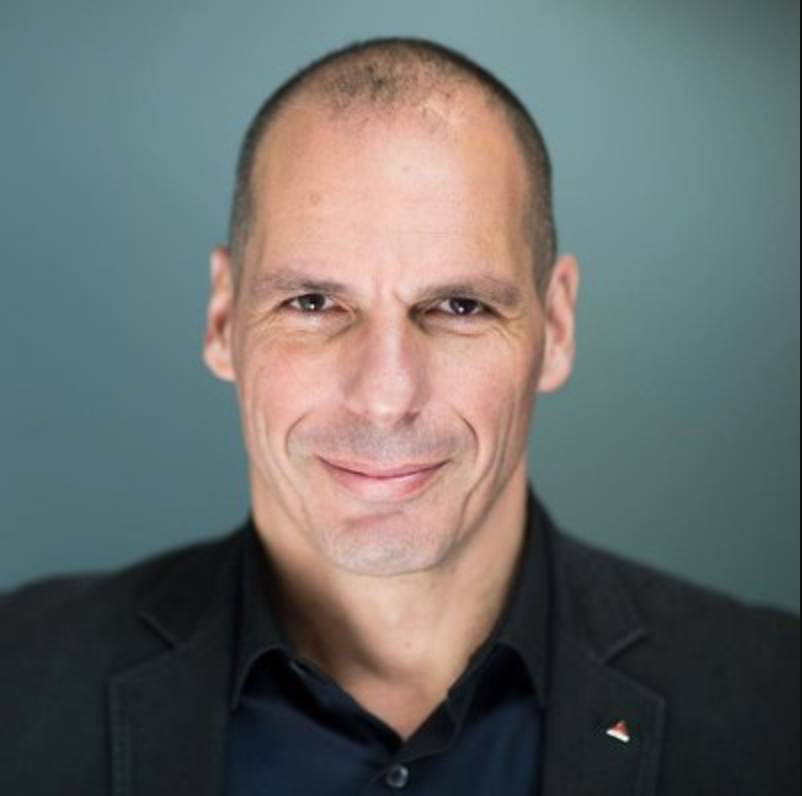
Yanis Varoufakis born 24 March 1961 is a Greek economist, politician, and co-founder of DiEM25. A former academic, he served as the Greek Minister of Finance from January to July 2015. Since 2019, he is again a Member of Greek Parliament and MeRA25 leader. He is the author of several books including, Another Now (2020). Varoufakis is also a professor of Economics – University of Athens, Honorary Professor of Political Economy – University of Sydney, Honoris Causa Professor of Law, Economics and Finance – University of Torino, and Distinguished Visiting Professor of Political Economy, Kings College, University of London.
ZNetwork is funded solely through the generosity of its readers.
Donate




