

Former President Donald Trump has begun to speak openly about placing the federal government in charge of overseeing elections in as many as 15 states where, he claims, corruption is rampant. What might Minnesota and Venezuela have in common under this framing? The answer points toward an emerging imperial logic of rule—one that increasingly displaces the constraints associated with the United States as a constitutional republic.
Trump’s approach follows the logic of the South’s Lost Cause, now scaled up to the national level. This logic implies not merely the containment of the civil rights revolution, but its reversal. Where federal authority was once deployed to dismantle segregation and discrimination by limiting states’ rights, it is now mobilized against Democratic strongholds—not to advance civil rights, but to entrench Republican power. Pushing the analogy further, blue states are recast as the new rebel states: jurisdictions that resist the rightful initiatives of the federal government and must therefore be brought to heel for the sake of a Trumpian “union.”
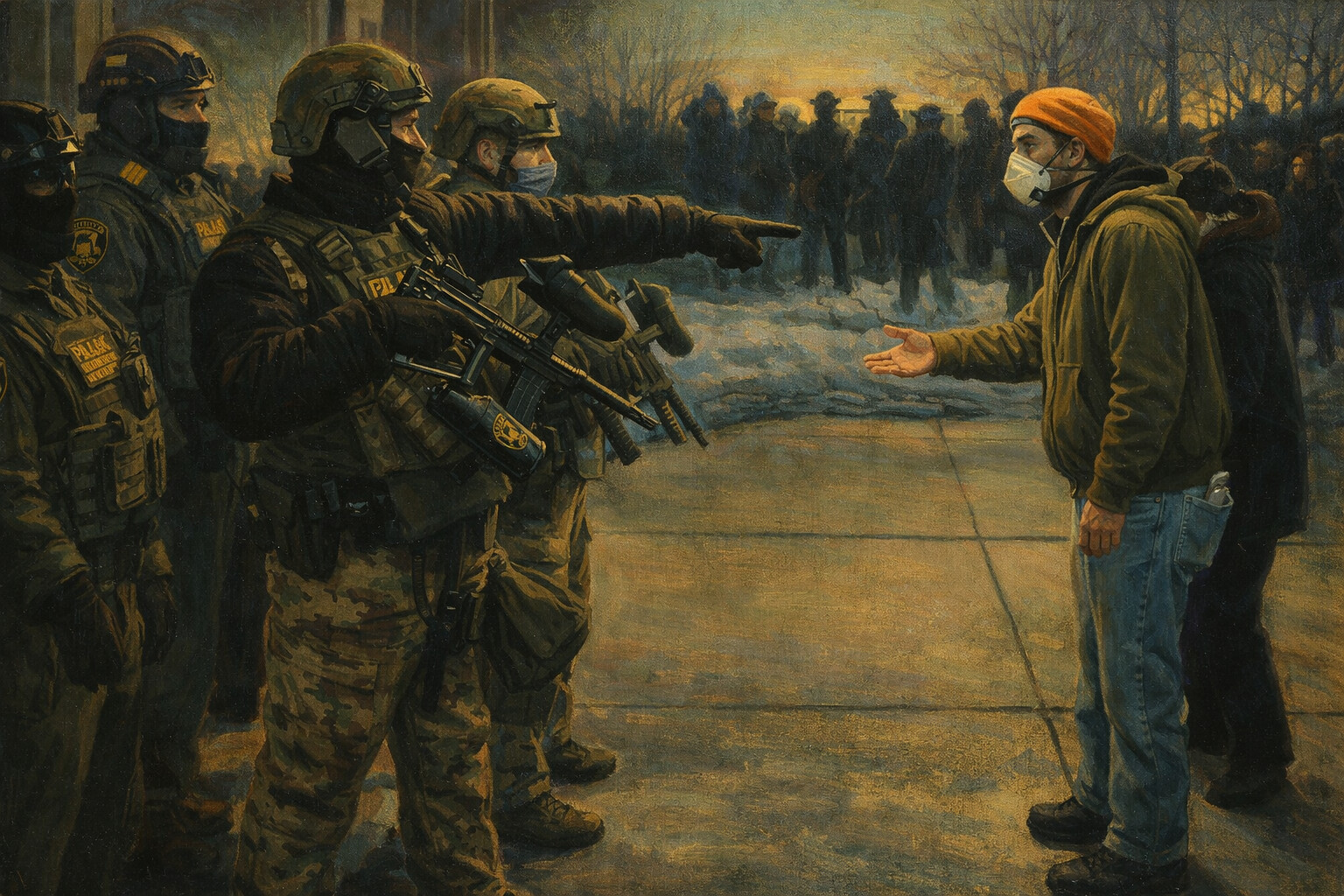
Under this logic, blue states come to resemble Venezuela. They are portrayed as places incapable of ordering themselves, whose autonomy produces unacceptable political outcomes and therefore justifies external intervention. This framing helps make sense of the federal assault on Minneapolis, which has taken on the character of domestic gunboat diplomacy—implemented not through naval force, but through federal enforcement agencies such as ICE. Notable here was Attorney General Pam Bondi’s reported offer to Minnesota officials: hand over voter rolls and the pressure will stop.
In this emerging order, blue states are transformed into an internal frontier, directly analogous to the status long assigned to Venezuela and other “failed” or “rogue” states abroad. Recalcitrant regions are no longer treated as legitimate political communities with divergent preferences but as unsettled territories requiring pacification to be integrated into the dominant political order. When elections do not produce the “right” results, the conclusion is not political disagreement, but corruption, criminality, and disorder. What once applied to countries in the Global South—Guatemala in the 1950s offers a clear historical example—is now applied to domestic political opponents.
What had been a relatively stable federal system is giving way to a regime of revanchist political ordering. Political space is no longer organized as a constitutional republic of coequal states but increasingly as a frontier to be subdued. This transformation reflects deeper shifts: the exhaustion of neoliberalism, the discrediting of the elites who attempted to manage its contradictions, and the emergence of a new nationalist project that operates through coercion rather than consent. The frontier is no longer external to the polity. It has become the organizing logic of U.S. power both at home and abroad.
What unifies these domains is the collapse of restraint. Liberalism once functioned as a set of constitutional limits on power, binding legitimacy to law, procedure, and universal principles. As those restraints erode, power no longer needs to justify itself in neutral or inclusive terms. It is exercised openly, territorially, and punitively. The United States begins to resemble less a settled constitutional republic embedded in a rule-governed international order than a frontier empire turned inward. The same repertoire—delegitimation, exceptional measures, and moralized coercion—is deployed against foreign states and domestic political opponents alike. Blue states become internal Venezuelas; neighboring countries become buffer zones to be bullied into compliance. Elections themselves are recoded as tests of territorial loyalty rather than expressions of popular sovereignty.
These new exertions of imperial sovereignty have not gone uncontested. Residual commitments to constitutional federalism remain, as illustrated by Senate Majority Leader John Thune’s reluctance to pursue national control over state elections. Trump’s political standing has also weakened during the first year of his presidency. Yet what he retains is access to the coercive apparatus of the state—federal law enforcement agencies and, ultimately, the military. Whether these institutions become the battering rams of a new imperial sovereignty remains an open and deeply consequential question.
ZNetwork is funded solely through the generosity of its readers.
Donate




