


Source: In These Times
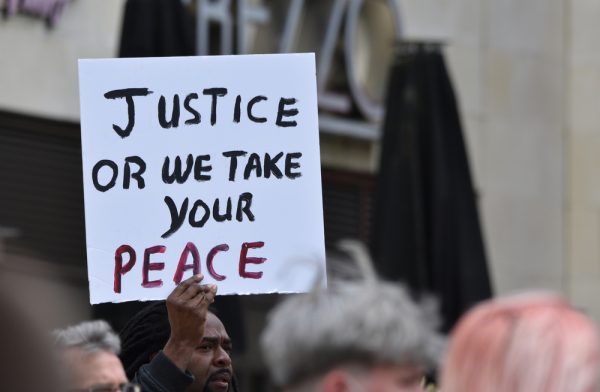

Photo by Amani A/Shutterstock.com
Last night they burned the AFL-CIO headquarters. It was there. It sits right in the middle of downtown DC, just north of Lafayette Square. The office window of the AFL-CIO president looks out at the White House. That is where the protests were last night, and so it got smashed and set on fire. It doesn’t matter.
The protests grew out of yet another case of police violence, but they have grown and persisted because of a much deeper sense of anger at our country’s many failures. It is not likely that the people who broke the windows and sprayed graffiti and set fires in the headquarters of the AFL-CIO had a political motive any more pointed than existential rage. In that sense they share the same motives that should be animating the AFL-CIO. If there is any misunderstanding of that, perhaps the riots will serve a clarifying purpose.
The close-up picture of what is happening now is wanton chaos, but the big picture is perfectly clear. Forty years ago, the right wing governing philosophy became ascendant. Since then, the working people of America have been getting their asses kicked. The wealth of our nation has puddled in the accounts of the very richest people as most everyone else saw their wages stagnate. A “tough on crime” fantasy perpetuated by Republicans and Democrats alike has incarcerated and ruined millions of lives. Globalized capitalism has fully settled over the world in a way that locks in the mechanisms of inequality and makes them extremely hard to fight. And now we are in a deadly pandemic, with Great Depression-level unemployment, and a government that does not care to extend even a bridge to the other side of this disaster for working people, because the stock market is doing just fine.
You don’t have to read an economic study to understand the vile depths of inequality and injustice happening in America right now. Regular people have lost their jobs by the tens of millions in the past two months and people have no way to pay their rent or buy their food, and when they look to the leaders of this country for help, they get a knee on the neck. This is not sustainable. Nor is it human. It is not something that can wait. It is not something that voting is the solution for. This time, things are very bad.
In the grand struggle between capital and labor, capital has won. We now live inside of a system set up to cater to the demands of capital, in which working people are little more than a cost on a balance sheet to minimize. When you think in that logical framework, everything that is happening now makes perfect sense. If the stock prices can stay strong even after 100,000 people are dead from Covid-19 and 40 million people are unemployed, why spend the money to build some sort of social safety net? That money could go back to the bottom line. So here we are. And the 40 million have little left to do but smash and burn.
What is the role of organized labor in all this? Only the role of a soldier who is watching his army get slaughtered and the city he is supposed to protect be raided and destroyed. A key part of capital’s ascendance was the ability to destroy the power of organized labor. That is why, over those same past 40 years of the post-Reagan era, the portion of Americans who are union members has been cut in half. This is the result of a very specific set of legal and regulatory strategies pursued over many years by business interests designed to make it harder to organize unions and keep them operating. Yes. But it is also the result of the failure of organized labor itself to beat back those strategies pursued by its enemies. That is that nature of your enemies, after all: they try to destroy you. It is your job not to let them. In that, organized labor has failed. And when organized labor fails, the working people that organized labor exists to protect are the ones that suffer.
If America had 20 million more union members than it has now, things might not be so bad. The interests of working people would have more political clout. More people would be covered by union contracts, and less subject to poverty wages and exploitation. The laws might be somewhat less bad. People would be somewhat less poor and vulnerable. If America had 20 million more union members than it has now, we might not have ever gotten to quite so low of a place. A place where the government will let citizens get sick and die or get unemployed and starve and offer nothing in return but a police officer and handcuffs. If unions had not died off quite so harshly, things might be different. We will never know.
I don’t dislike the AFL-CIO. It is too institutional, and too moderate, and it spends too much money on politics and not enough on union organizing, and its leaders are generally uninspiring, and it has a poor political track record, and it is too inward-looking, and it often seems to be completely oblivious to the life-or-death scale of the problems it is facing. All of that is true. But if I consider myself a part of the labor movement, and the AFL-CIO is the organization that represents the majority of America’s union members, then I am the AFL-CIO. Its failures are our failures. That’s the nature of a movement. We have to lift it up together. We cannot get disgusted and give up, because that just brings on our destruction sooner.
I’ve been to the AFL-CIO’s headquarters many times. It has a very nice mural in the lobby, and the rest of it is a forgettable office building. It doesn’t mean anything. What means something are the labor unions that it represents and the members of those labor unions whose lives have been less exploited by capital because those unions exist. The other thing that means something are the 90% of American working people who are not members of any of those unions. Who have not ever experienced any of the lofty promises that the labor movement likes to make. Who have nothing to show for the labor movement’s work. Who are truly desperate now. Who are full of rage. Who are in the streets, protesting, and setting things on fire. Including the AFL-CIO’s headquarters.
It’s good to get punched in the face sometimes. It wakes you up. All of America is experiencing that feeling right now. The labor movement needs to experience it for ourselves. If we had served our purpose better for the past two generations, things might not have gotten to this point. If unions are so great, we need to organize the next 20 million union members. Otherwise, we are just making speeches without sharing the spoils.
The way to not get burned down next time is to make sure that everyone in the streets is a union member. We better get to work.


Hamilton Nolan is a labor writer for In These Times. He has spent the past decade writing about labor and politics for Gawker, Splinter, The Guardian, and elsewhere. More of his work is on Substack.
ZNetwork is funded solely through the generosity of its readers.
Donate




