


Richard Whitney was raised on the Colville Reservation in north central Washington, and was always in the woods, cutting firewood, hunting, fishing, or just being “out there, on the rez,” especially with his father and uncle. “It’s always been an important part of my life. I feel like I belong in nature,” he says. This sense of belonging, rooted in a culture with ancient ancestral connections to the land they reside on, dovetailed with the scientific management of natural resources when Whitney began a series of internships with the Colville Tribes’ forestry, fisheries, and wildlife department at the age of 14. He went on to earn his master’s degree from Washington State University in natural resource sciences, studying sharp-tailed grouse. Nearly a decade ago, Whitney took his current position as the Tribes’ wildlife program manager.
This story is the second in a three-part series produced in partnership with bioGraphic, an editorially independent magazine about nature and conservation powered by the California Academy of Sciences. Read part 1 here and part 3 here.

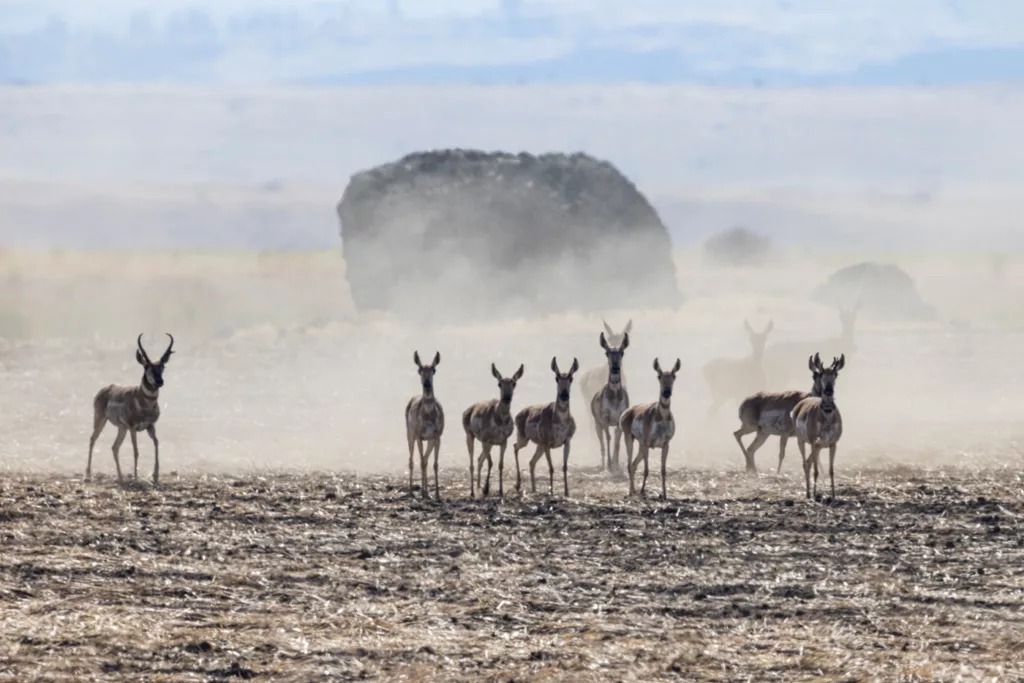
Soon after taking the position in 2014, Whitney began leading pronghorn restoration efforts for the Tribes. Using knowledge gained from habitat evaluation surveys he’d worked on previously, as well as feasibility reports from the 1990s and early 2000s, he determined the region offered plenty of suitable pronghorn habitat. In addition, he and his team looked at pronghorn reintroduction attempts by a number of other agencies to determine what had worked and what hadn’t. The Yakama Nation, for example, had successfully restored pronghorn in the past, while the state of Washington had tried, but failed.
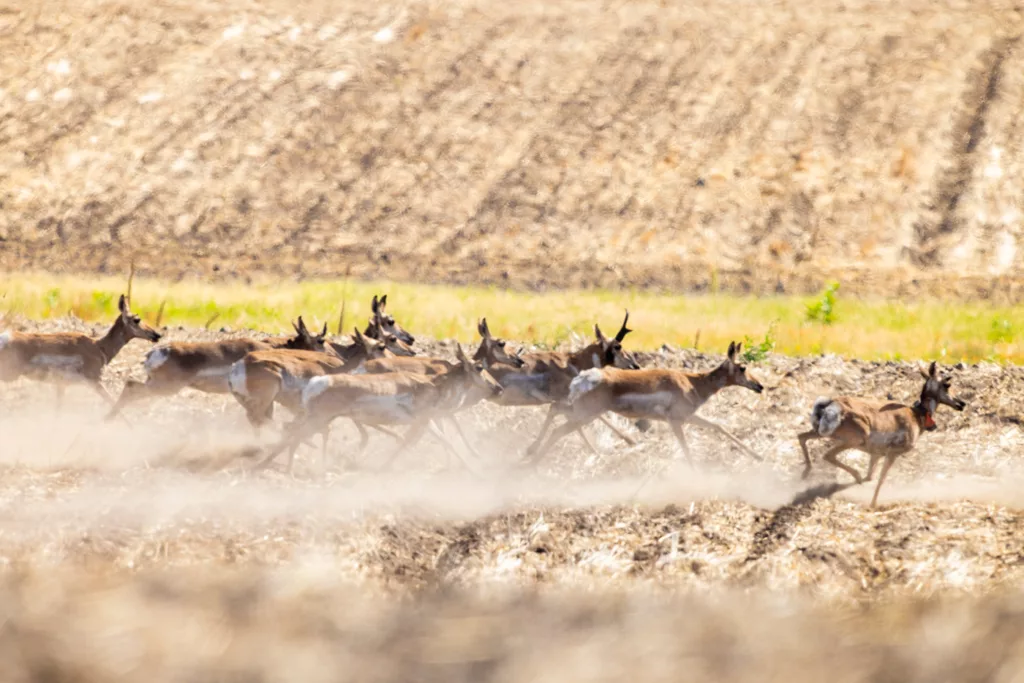
In January 2016, after determining there was adequate habitat and food on the reservation, Whitney and his team reintroduced 52 pronghorn. Some of those animals died, likely due to stress and overexertion during transport. In the project’s second year, the team introduced 98 pronghorn—earlier in the year (in October, rather than in midwinter) and in smaller groups, shortly after they had been captured. Survival of reintroduced animals greatly improved in year two, providing valuable information on reintroductions for the future.
Now, on a sunny July day, Sam Rushing drives us in his pickup truck through the hills outside of Bridgeport on the reservation to see the results. He is the Tribes’ Omak-Nespelem district wildlife biologist and is looking for some of the pronghorn the Tribes reintroduced from Nevada seven years earlier. We scan the open, grassy hillsides in the valley, near a wildfire burn scar, until we spot a herd in the flats near a creek bottom, between two tall ponderosa pines. Spooked by our presence, the group of nearly two dozen animals—does, fawns, and one large buck—trot uphill together. Rushing says the Tribes’ herd now numbers 225.
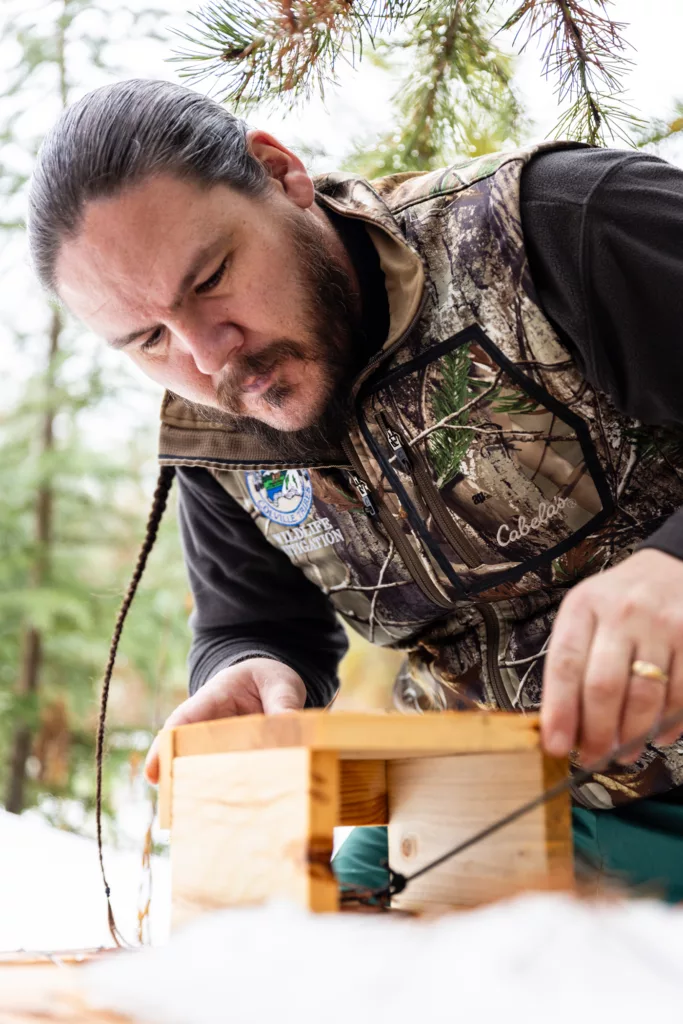
For Whitney and his relatives, animals are friends and often referred to as such. “We don’t rule the kingdom, but are part of it by relating with friends,” he says. “We’re reuniting with old friends. We’re restoring a community, restoring the system.”
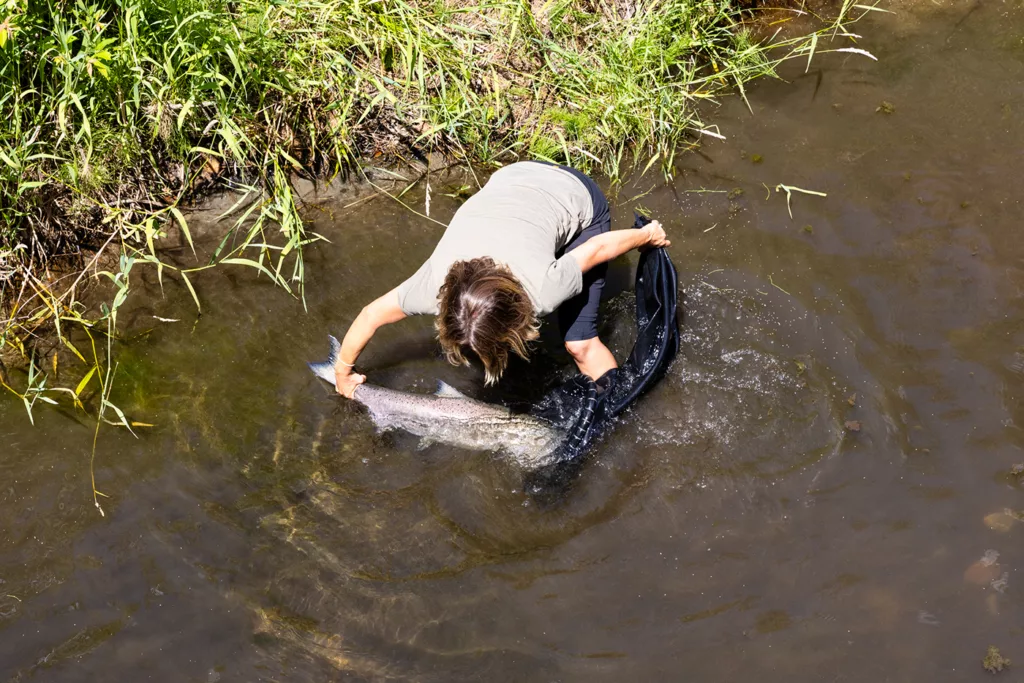
Following previous ceremonial releases, in late July 2023, Tribal members gather at the Sanpoil River’s edge. As they wait, the sun illuminates the sky, which is blue save a few passing clouds, and shines down through the ponderosa pines and into the river, the rays of sunlight twirling through currents and dappling the round stones below.
Members of the Colville Tribes form a line between a fish-hauling truck and the river. They pass Chinook salmon—one after the other, from one to another—in specially designed rubber bags toward the river, returning the generous offering of life to the salmon, and in turn, the animals and land. At the end of the line, in one continuous motion, Patrick Tonasket, Keller District representative for the Tribal council, gently pulls a large Chinook by the tail from a bag and orients the fish in the current’s flow. He holds his right hand on the salmon’s broad back until the fish feels the current’s rush, then flicks her tail and jets upstream.
“We’re dedicated to bringing those salmon back,” Tonasket quietly says.
By day’s end, the Tribes will release 70 summer Chinook salmon. Prior to the operation, biologists working for the Tribes had ensured that the fish were free of disease and had inserted tiny monitoring tags before trucking them upriver for the ceremonial release. These releases give tribal members the opportunity to hold ceremony with and for the salmon. With each salmon released, healing and hope surges through those gathered by the river. Later on, the proof that salmon can spawn in this river will most likely reinforce habitat and model assessments, aiding in future reintroduction efforts by proving they can succeed.
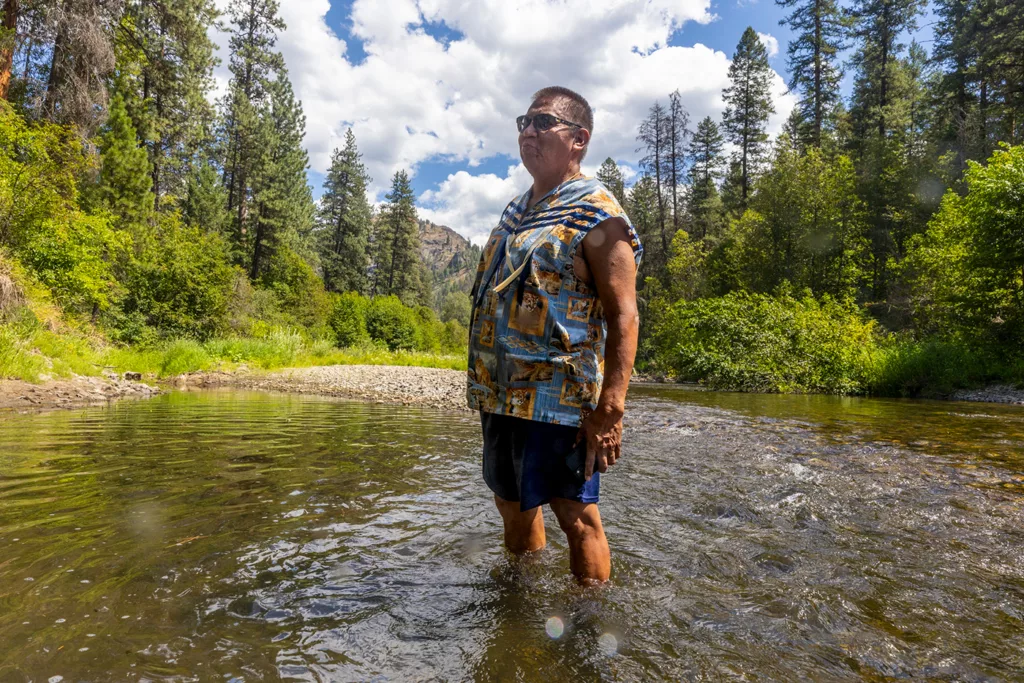
“The salmon used to run strong here,” says Darnell Sam, a descendant of the Sanpoil Band of the Colville Confederated Tribes. Sam is the Wenatchi Salmon Chief, and leads a ceremony for these fish, whom, he says, in the beginning offered themselves to the people so they could survive. Sam is also the great-nephew of Chief Jim James of the Sanpoil, who presided over the Ceremony of Tears, when his relatives’ millennia-old salmon fishery at Kettle Falls was inundated following the construction of Grand Coulee Dam. Now, Sam stands in the river, his shirt adorned with images of mountain lions and white-and-blue ribbons that pulse in the breeze, and he releases a salmon to the river, as birds sing and the sun shines down.
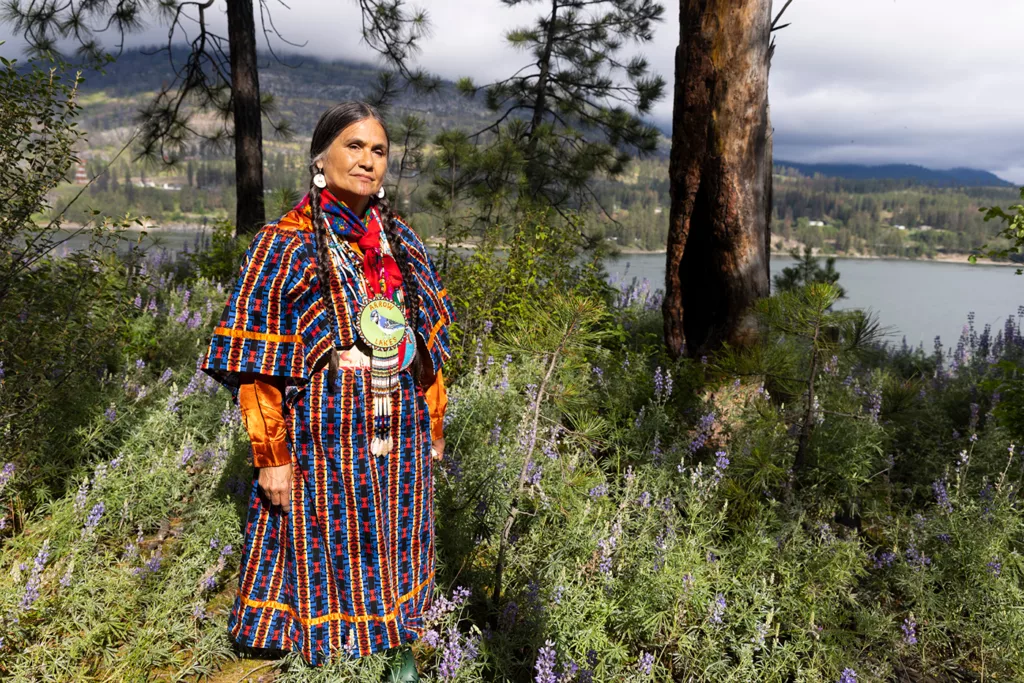
Sam says the salmon have always run parallel to his people, specifically regarding their resilience: “They’ve endured a lot. Our people have endured a lot. … They’ve been colonized; they’ve been oppressed. So has the salmon, but yet, they still endure, and they still survive, and they’re still here.” Recalling the Ceremony of Tears for Kettle Falls, where his ancestors mourned the loss of the salmon from Grand Coulee Dam, he says, “This is an opportunity for us to wipe them tears.”
This story is the second in a three-part series produced in partnership with bioGraphic, an editorially independent magazine about nature and conservation powered by the California Academy of Sciences. Read part 1 here and part 3 here.
CORRECTION: This article was updated at 9:28 a.m. PT on Dec. 16, 2023, to clarify that the Tribes are referred to as the Colville Confederated Tribes or the Confederated Tribes of the Colville Reservation, not the Colville Confederacy. Read our corrections policy here.
ZNetwork is funded solely through the generosity of its readers.
Donate




