


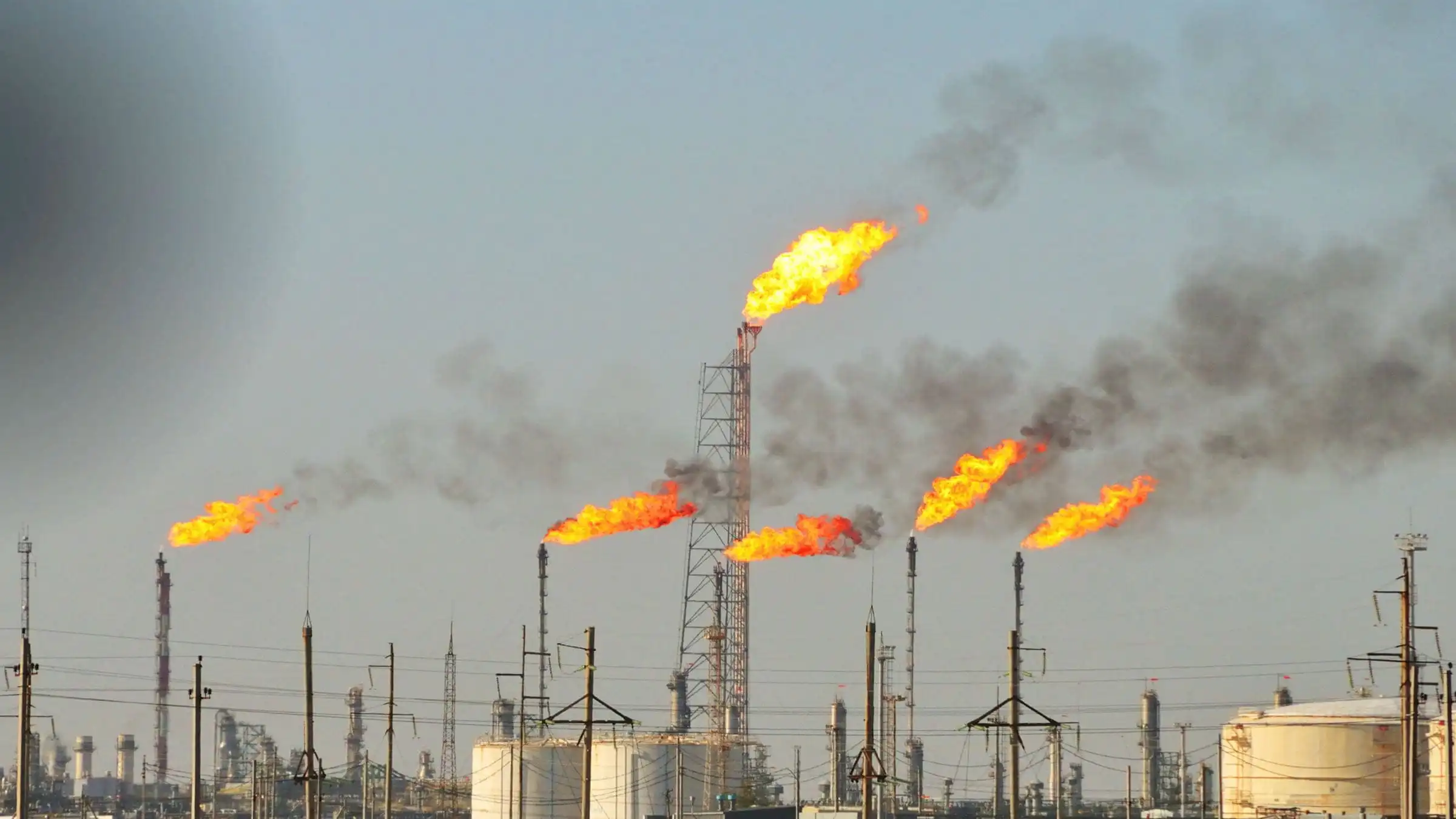
Flaring, the process of burning natural gas escaping from fossil fuel wells, releases five times more methane than previously believed, according to an analysis of most U.S. operations, published Thursday in the journal Science.
“There is a lot more methane being added to the atmosphere than currently accounted for in any inventories or estimates.”
The study, led by researchers at the University of Michigan, is based on data collected during 13 flights over three years at the Bakken oil and gas field in North Dakota as well as the Eagle Ford and Permian fields in Texas—which collectively have over 80% of all U.S. flaring operations.
Flaring turns methane into carbon dioxide; while both are greenhouse gases, the former is over 80 times more potent than the latter, in terms of its global heating potential, in the 20 years after it is released into the atmosphere.
“Industry and governments generally assume that flares remain lit and destroy methane, the predominant component of natural gas, with 98% efficiency,” the study states. “Neither assumption, however, is based on real-world observations.”
The researcher simultaneously measured both methane and carbon dioxide at flaring sites.
“If the flare is operating as it should be, there should be a large carbon dioxide spike and a relatively small methane spike. And depending on the relative enhancement of those two gasses, we can tell how well the flares are performing,” explained lead author Genevieve Plant, an assistant research scientist at the University of Michigan.
As co-author and professor Eric Kort summarized, the researchers discovered that “there is a lot more methane being added to the atmosphere than currently accounted for in any inventories or estimates.”
Specifically, they found that due to inefficient combustion and flares being unlit 3%-5% of the time, the average efficiency rate is just 91%, which works out to “a fivefold increase in methane emissions above present assumptions” and 4%-10% of total U.S. oil and gas methane emissions.
As The New York Times reported:
Riley Duren, chief executive of Carbon Mapper, a nonprofit group that is launching satellites next year that will detect and monitor sources of greenhouse gas emissions, said the findings were not surprising to those who have studied emissions from these oil and gas basins and know the amount of flaring that is done.
But the researchers’ comprehensive survey shows that inefficient flaring “is a more systematic issue,” said Dr. Duren, who was not involved in the study.
Elsewhere in the world, there is little direct observational evidence of flaring efficiency, Dr. Duren said. But globally, he said, “it’s likely the case that combustion and flaring is less efficient than assumed.”
While many campaigners and scientists continue to point to the worsening climate emergency as proof of the need to swiftly transition away from fossil fuels altogether, this research team noted that even improving flaring could have a significant positive impact.
“This appears to be a source of methane emissions that seems quite addressable,” said Plant. “With management practices and our better understanding of what’s happening to these flares, we can reduce this source of methane in a tangible way.”
Fixing the flaring issues to boost efficiency, Kort pointed out in a video about the research, would be equivalent to removing roughly three million gas-powered vehicles from the roads.
The team’s findings align with previous observations by the Environmental Defense Fund (EDF)—a research partner for the new study. The nonprofit group conducted aerial surveys of the Permian Basin in 2020 and found that roughly 10% of flares were unlit or malfunctioning.
“This study adds to the growing body of research that tells us that the oil and gas industry has a flaring problem,” Jon Goldstein, EDF’s senior director of regulatory and legislative affairs, said Thursday. “The Environmental Protection Agency and Bureau of Land Management should implement solutions that can help to end the practice of routine flaring.”
The research was published a day after two congressmen introduced a bill that would direct the U.S. Department of Energy to work with industry plus state and local governments to cut methane emissions, and establish a consortium at DOE focused on leak detection and repair (LDAR) efforts.
“2021 saw the highest annual growth rate for methane emissions to date,” noted Rep. Sean Casten (D-Ill.), who is co-sponsoring the legislation with Rep. Peter Meijer (R-Mich.). “This problem is not slowing down and will only increase without action.”
“The Methane Emissions Mitigation Research and Development Act supports innovative LDAR technologies that are needed to dramatically reduce methane emissions from the oil and gas industry,” Casten added. “We must ensure the Department of Energy has the necessary resources to produce the best possible methane reduction technologies.”
The new study also comes amid finger-pointing over the apparent sabotage of the Nord Stream pipeline system, which could result in the biggest recorded release of methane emissions—an incident that led at least one climate scientist to call for whoever is responsible to be charged with war crimes.


Jessica Corbett is a senior editor and staff writer for Common Dreams.
ZNetwork is funded solely through the generosity of its readers.
Donate




