


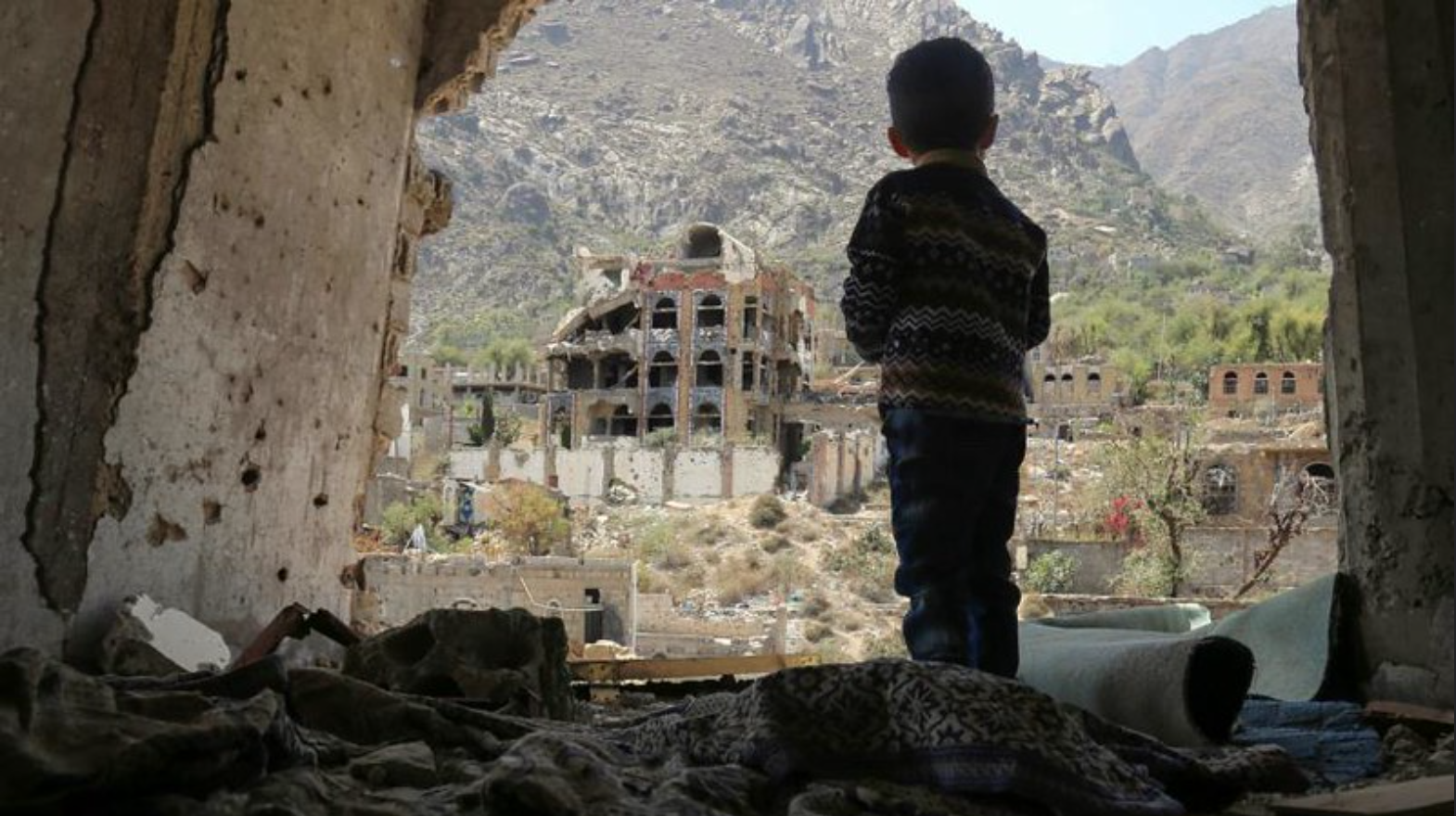
We already knew Donald Trump’s bombing campaign against Yemen was unconstitutional. It turns out it was completely pointless too.
Earlier this week, Trump and the Houthi leadership of Yemen announced a sudden cease-fire deal that took many by surprise, with the US president declaring that the Houthis “don’t wanna fight anymore” and had “capitulated.” After two months of often indiscriminate US bombing, Trump told reporters, the Houthis said they “will not be blowing up ships anymore, and that’s what the purpose of what we were doing” was, so the United States “will honor that.”
The deal has been a rare bit of good news on the foreign policy front, for both Americans, who are tired of being sucked into endless warfare in the Middle East and elsewhere, and for innocent Yemenis, many dozens of whom have been killed by US bombs the past two months. But stop and think about it for a second, and Trump’s cease-fire announcement looks less like a grand accomplishment of presidential diplomacy and more like a fictionalized George H. W. Bush writing the final line of his memoirs in the Simpsons: “Since I’d achieved all of my goals as president in one term, there was no need for a second.”
The key detail missing from the cease-fire agreement is any promise by the Houthis to stop attacking Israeli ships. It’s a key detail, because this was the reason Trump started bombing Yemen in the first place.
As I explained in March, the Houthis only started attacking US vessels after the Trump administration started bombing Yemen, and the reason it started bombing Yemen was to try and deter the Houthis from bombing Israeli ships. (And those attacks on Israeli ships were themselves in response to the Israeli government renewing its policy of starving and massacring the people of Gaza, with no Houthi attacks taking place while the Trump-brokered Gaza cease-fire had been in place).
We now have the same outcome we would have had if Trump had never started bombing Yemen in the first place. In essence, all he’s accomplished here is to get himself and the country out of the self-made jam he had blundered them into, and he’s done so without achieving the central goal of that intervention: deterring Houthi attacks on Israel.
As you read this, the Houthis are still regularly bombing Israeli targets, and those attacks have actually escalated during Trump’s bombing campaign, having moved beyond shipping to Israeli soil. If anything, Israel is now more exposed: the Houthis, an impoverished, low-tech military force, have managed several times now to get past Israel’s air-defense systems, publicly demonstrating how vulnerable the country would be in the case of all-out war with an enemy that is actually on par with Israel in terms of military strength.
The adventure has also been hugely costly for the United States. The bombing campaign may have killed a lot of Yemeni civilians, but grisly as it is, the country and its people already proved last decade that they have an extraordinarily high tolerance for absorbing human suffering. On the US side, meanwhile, the body count may have been low, but the monetary cost has been exorbitant, blowing through more than $1 billion worth of munitions and depleting weapons stockpiles to the point that US commanders are seriously worried about the military’s ability to wage a potential war against China. In just the last eight days alone, the United States lost two $67 million fighter jets deployed to the Red Sea, one when it rolled off an aircraft carrier and plunged into the water, another thanks to a landing mishap.
It’s also been politically costly for Trump himself. The president’s bombing of Yemen was the cause of arguably the most damaging and distracting scandal of his not-even-four-month-old presidency, the “Signalgate” controversy that saw his national security officials accidentally text Yemeni war plans to a journalist, setting off weeks more of embarrassing stories about his team’s use of unsecured communications to send highly sensitive and classified information. It helped claim the scalp of his national security advisor and came very close to doing the same for his defense secretary.
Meanwhile the bombing campaign set off some of the first and loudest tremors of dissent from within his movement. A series of high-profile MAGA figures, including Rep. Marjorie Taylor Greene, Tucker Carlson, and Steve Bannon, criticized the Yemen adventure, correctly pointing out that it clashed with his campaign trail promises of keeping the United States out of foreign wars.
But even as it simply returned things to the pre-March 2025 status quo, the whole affair might be more significant than it seems at first. Besides the broad front of antiwar dissent it activated, it may also have accidentally catalyzed what looks like Trump’s growing impatience with Israel and its prime minister, Benjamin Netanyahu, and his willingness to defy both.
The fact that Trump negotiated and agreed to the cease-fire without informing or involving Israel — not to mention sidelining and “leaving Israel out in [the] cold” or having “ditched” it in the deal itself, to quote the right-leaning Times of Israel — is no small thing. Israeli officials reacted with “astonishment” and shock at the announcement, while back home, a bipartisan group of Israel-first members of Congress have complained that Trump’s deal “leaves Israel dangerously vulnerable and fails to confront the broader threat posed by Iran’s proxy network.”
As of the time of writing, Trump doesn’t seem to have been moved by these criticisms: his upcoming trip to the Middle East is skipping Israel, sources are telling news outlets that he’s run out of patience with Netanyahu, and he’s reportedly ready to present a “comprehensive” Gaza cease-fire deal to the Israeli prime minister as a fait accompli that he can either get on board with or be left alone. This is on top of the way that Trump has defied Israeli leadership in his attempts to reenter the Iran nuclear deal he ripped up in his first term and how he seems to be preparing to sideline the country again in pursuing a deal with Saudi Arabia.
No one should be holding their breath here. Trump is notorious for abruptly changing his mind, backing down, and sudden policy U-turns — just recall the way he forced Netanyahu to accept a cease-fire shortly before he was inaugurated, then two months later let him violate it and resume the destruction of Gaza anyway. And there is no guarantee his current unhappiness with the Israeli government will stick. But to the extent that the Houthi cease-fire is a sign he’s ready to pursue a foreign policy that refuses to let Israeli leadership drag the United States into another self-destructive Middle East war, this is at least a positive development.


Branko Marcetic is a staff writer at Jacobin magazine and a 2019-2020 Leonard C. Goodman Institute for Investigative Reporting fellow. He is the author of Yesterday’s Man: The Case Against Joe Biden.
ZNetwork is funded solely through the generosity of its readers.
Donate




