

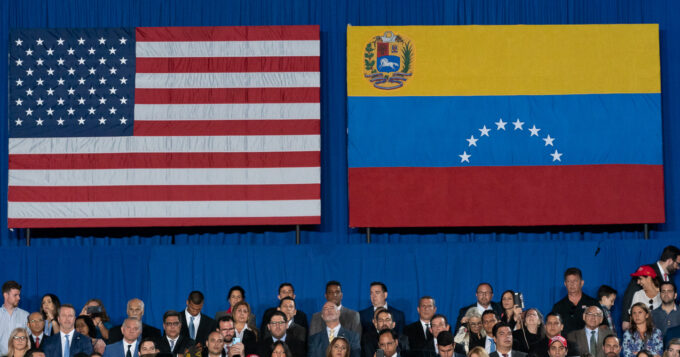
The US government has revived its campaign to label Venezuela a “narco-state”, accusing its top leadership of drug trafficking and slapping hefty bounties on their heads for capture. This campaign, which only momentarily took a backseat, is a strategic fabrication, not a factual assessment. This accusation, particularly amplified under the Trump Administration, is a calculated smokescreen to justify a long-standing agenda: the overthrow of the Venezuelan government and the seizure of its vast oil and mineral resources. A closer examination of the facts reveals a country that has actively fought drug trafficking on its own terms and a US government with a clear and consistent history of destabilizing independent countries in Latin America.
Venezuela’s Fight Against the Drug Trade: A Post-DEA Reality
In 2005, a pivotal moment in Venezuela’s anti-drug strategy occurred when then-President Hugo Chávez expelled the US Drug Enforcement Administration (DEA), accusing the agency of espionage and undermining Venezuelan sovereignty. This decision was based on Chávez’s belief that the DEA was “used as a cover… to carry out intelligence work in Venezuela against this government.” At the time, Venezuelan officials insisted that the country would continue to fight drug trafficking on its own. “The DEA is not essential to the fight in Venezuela against drug trafficking. We will keep working with international organizations against drugs,” Chávez declared.
Contrary to the US narrative that this action would lead to a flood of drugs, Venezuela’s government, through its National Anti-Narcotics Office (ONA) and the Bolivarian National Armed Forces (FANB), intensified its own counternarcotics efforts. According to Venezuela’s National Anti-Drug Superintendency (SUNAD), the country has made significant drug seizures over the years. For example, in 2015, the US ‘s very own State Department quoted ONA as reporting seizing 65.76 metric tons of illegal drugs during the first eight months of the year, a 132% increase compared to the same period in 2014. Cocaine and marijuana comprised the overwhelming majority of the seizures. Venezuela has also cooperated with other countries, signing an international agreement with Russia to fight drug trafficking in 2014.
While the US government has frequently labeled Venezuela as a “major drug transit country,” this characterization often ignores the nation’s proactive measures and its geographic reality. The country’s extensive and porous border with Colombia, the world’s largest cocaine producer, which hosts seven US military bases and three DEA offices, may make it a key transit point. Still, it is not indicative of state complicity.
A study by the Tricontinental Institute for Social Research and the Lawfare Observatory has in fact, found that after five decades of the “War on Drugs,” the DEA has itself reported in mid-2023 that major drug trafficking organizations continue to operate globally. George Papadopoulos, Principal Deputy Administrator of the DEA, testified before the U.S. Congress that the Sinaloa and Jalisco cartels alone have “associates, facilitators and intermediaries in all 50 states of the United States”. The study argues that this continental intervention on narcotics is part of an overarching plan for political and military domination over the Americas, from Alaska to Cape Horn, including the Antarctic, which has become a key point of global contention.
The Trump Administration’s Accusations: A Political Weapon
The Trump administration has elevated the “narco-state” accusation to an unprecedented level, using it as a direct political and legal weapon against the Venezuelan government. In March 2020, the US Department of Justice announced a stunning indictment against President Nicolás Maduro and 14 other current and former high-ranking Venezuelan officials on charges of “narcoterrorism,” corruption, and drug trafficking.
Announcing the indictment, then-Attorney General William Barr accused Maduro and his colleagues of conspiring with a dissident faction of the Revolutionary Armed Forces of Colombia (FARC) to ship tons of cocaine into the United States. Barr stated, “For more than 20 years, Maduro and a number of high-ranking colleagues allegedly conspired with the FARC, causing tons of cocaine to enter and devastate American communities.” He further alleged that the Venezuelan leadership “obtained the support of the Maduro regime, who is allowing them to use Venezuela as a safe haven from which they can continue to conduct their cocaine trafficking and their armed insurgency.”
A bounty for Maduro’s capture accompanied this indictment, initially set at $15 million and since then increased to $50 million. This move, reminiscent of a bounty on a terrorist leader, was a clear effort to delegitimize Maduro and create a legal justification for his removal from power. It was an act of extraordinary political pressure with no precedent for a sitting head of State.
Venezuelan officials fiercely condemned the accusations as a “ridiculous smokescreen.” Venezuelan Foreign Minister Yván Gil called the reward “pathetic” and a “crude political propaganda operation.” In a televised address, President Maduro vowed Venezuela would “defend our seas, our skies and our lands,” characterizing US pressure as “the outlandish, bizarre threat of a declining empire.” Venezuelan National Assembly leader Jorge Rodríguez also weighed in, stating the US had signed a “proclamation that will go down in the pages of international diplomacy as a display of infamy.”
Imperialist Motives and Military Escalation
The legal and rhetorical assault on Venezuela is not an isolated incident. It coincides with a clear military escalation. In April 2020, during the first Trump administration, the US president announced an enhanced counter-narcotics operation in the Caribbean, sending warships and deploying thousands of Marines toward Venezuelan waters.
This military build-up, combined with the bounty on Maduro, served a dual purpose. First, it was meant to intimidate the Venezuelan government and signal a readiness for direct intervention. Second, it was designed to distract from domestic issues in the US, particularly the administration’s handling of the COVID-19 pandemic. Then Venezuelan Foreign Minister Jorge Arreaza tweeted, “As the Florida people agonize over the pandemic, the Pentagon slanders Venezuela to promote Trump’s re-election and secure resources for his war machine. They commit a crime against Venezuela and against their own country.”
A new military escalation comes after the Trump administration recently signed a Pentagon memo on confronting drug cartels in Latin America, a directive that frames these criminal organizations as a national security threat. In a clear and present demonstration of this policy, the US deployed three Aegis guided-missile destroyers—the USS Gravely, the USS Jason Dunham, and the USS Sampson—to the waters off Venezuela. This is part of a broader operation involving approximately 4,000 sailors and Marines, along with P-8 spy planes and at least one attack submarine, intended to operate in proximity to Venezuela’s coasts.
These military maneuvers were met with sharp condemnation from leaders across the region. Mexican President Claudia Sheinbaum firmly rejected the use of US military forces in her country, stressing that cooperation does not extend to “invasion” and that her government has no evidence of a direct link between President Maduro and Mexican cartels. Colombian President Gustavo Petro explicitly stated that he would consider any unapproved US military operation an “aggression against Latin America and the Caribbean” and that an attack on Venezuela would be seen as an attack on Colombia.
Venezuela meanwhile, has called for its more than four million militia members to mobilize across the country in defense of its sovereignty. It was the Bolivarian militia that captured mercenaries attempting to enter Venezuela in May 2020 to carry out a series of assassinations and wreak havoc in the country.
The deployment of warships and troops, along with the Pentagon memo, serves as a stark reminder that the “narco-state” accusation is a pretext for a hostile foreign policy driven by a desire to control a country with the world’s largest proven oil reserves. For people of conscience around the world, the defense of Venezuelan sovereignty is a crucial front in the broader struggle against US-led interventionism and for the self-determination of all nations.
ZNetwork is funded solely through the generosity of its readers.
Donate




