


Trying to sort out the trivial surface events of American political life from the potentially meaningful undercurrents has to be a highly personal exercise. Like the blind men of Rajasthan, we grope various parts of the elephant’s anatomy to grasp its essential nature, and come up with trunk, rope, snake, wall…
I was born, was raised and am now retired in the USA. But I spent most of my adult life as a labour organiser, first in Pennsylvania and then globally, based in Switzerland. Now living in bucolic Acton, Massachusetts, I gaze out the window of my writing/Zooming room onto trees and gardens. The internet is still my chief lifeline to the outer world, though the ebbing of the pandemic has allowed me to participate in person in many labour support actions in Massachusetts. So this is the small segment of the political world that I experienced directly.
My comments on the Washington political scene are filtered through the same international media sources that Chartist readers can access. The clown show that the House of Representatives has become with a slim Republican majority needs little interpretation. The Republican Party at the national level has no platform or programme to govern. McCarthy became Speaker of the House by conceding on most issues to the demands of the ultra-right faction of the Republican Party. Hence, we will have witch-hunt investigations conducted by demagogues and attempts to exonerate Donald Trump from his multiple criminal actions of sexual violence, tax fraud, collusion with foreign powers, etc. Sordid political theatre, probably with few lasting consequences and little legislation enacted.
McCarthy can remove Representative Ilhan Omar from the Foreign Affairs Committee, as a too-vigorous defender of Palestinian rights, but not from Congress itself. The House can pass a resolution condemning “socialism” in all its manifestations, from genocide in Cambodia through social democratic reforms in health and welfare programmes. More than half of the House Democrats, including former Speaker Nancy Pelosi and current Democratic minority leader Hakeem Jeffries, shrugged their collective shoulders and voted for the anti-socialist resolution.
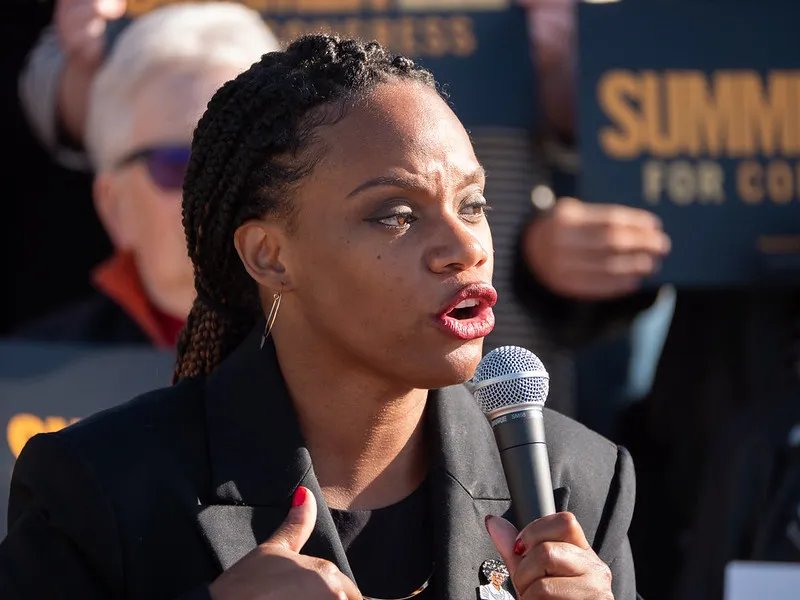
Like Nancy Pelosi, Hakeem Jeffries seems more obsessed with fighting democratic socialists than with the harder task of combatting right-wing Republicans. In a more consequential action, the Democratic Party leadership refused to allow a vote within the DNCC (Democratic National Coordinating Committee) to limit the influx of dark corporate and right-wing money into Democratic primaries. That influx of money into both the primary and general elections narrowly failed to defeat democratic socialist Summer Lee, who was elected in the Pittsburgh area and now serves in the House. Along with Maxwell Frost, Delia Ramirez and Rebecca Balint, Summer Lee will add four newly elected members to the current six Squad members in Congress with democratic socialist politics.
The Squad is neither a political party nor a formal caucus, although its members also belong to the larger, more inchoate House Progressive Caucus. Squad members support each other on issues and in fundraising, sometimes together with Senator Bernie Sanders. The post-Sanders campaign organisation Justice Democrats, together with the national Working Families Party and several progressive NGOs, is closely aligned with the Squad. Although several Squad members are also members of DSA and received initial backing from local DSA chapters, DSA is not a consistent ally for the Squad.
DSA membership is becoming an albatross for democratic socialists serving in Congress. DSA is a ‘big tent’ organisation that has grown dramatically since 2016 in numbers and influence, mainly among the generation under 35 years old. Although the impetus for many of its new members was the Sanders campaign, many of them do not support Sanders/Squad politics, including working within the general framework of the Democratic Party. A few thousand new DSA recruits were entryists from existing or defunct hard-left socialist organisations. For them, the growing Squad represents a dangerous political evolution that could help revitalise the Democratic Party rather than contributing to a purely ‘socialist’ or independent third party under hard-left influence.
Campaigns within DSA to break off any alliance with the Squad have taken several forms. There was a clamour to expel DSA Rep Jamaal Bowman over his position on Israel/Palestine. Since December, there has been another campaign to expel Bowman and censure DSA and Squad members Alexandria Ocasio-Cortez and Cori Bush for a tactical vote on the imposition of the Railroad Labor Act. This last divisive campaign sidetracked DSA from fully supporting the rail rank-and-file caucuses in their struggle to revitalise and reform their fragmented unions and to win scheduling reforms and paid sick leave.
In January, DSA’s National Labor Commission held a well-attended membership meeting on the rail dispute that included key leaders of the rail rank-and-file caucuses. The meeting laid a basis for ongoing DSA support for the campaign of the Railroad Workers United to nationalise the railroads, to correct the safety issues that led to the recent rail disaster in Ohio, and to support the demands of rail workers for scheduling relief and paid sick leave. As predicted in my article, negotiations with one rail corporation have already achieved major improvements in scheduling and paid sick leave, and Sen Sanders is already using his bully pulpit as chair of the Senate Labor Committee to pressure the other freight rail corporations into following that lead.
DSA is also becoming more and more engaged in supporting workers organising at Starbucks, Amazon and the United Auto Workers reform movement. There is a spectacular upsurge of organising among graduate teaching and research assistants, many including DSA members, including a successful massive strike in the sprawling University of California system and a new campaign launched to unionise non-tenured faculty at Harvard.
There is an interesting parallel between the Democratic Party and USA. If DSA can escape from its current chaos by participating in building a stronger and more inclusive workers movement, the same is true on a much greater scale with the Democratic Party. Motivating his improved performance at his State of the Union address, Joe Biden had a focused political goal: to win back white workers without university degrees to the Democratic Party. It will take time to overcome the justified anger of these workers abandoned by three decades of neoliberal, pro-corporate Democratic policies. To lay a secure basis for building a united front resilient enough to combat the dangerous rise of neo-fascist white nationalism, both the left and centre need to join together to rebuild and strengthen the US workers’ movement.

ZNetwork is funded solely through the generosity of its readers.
Donate




