


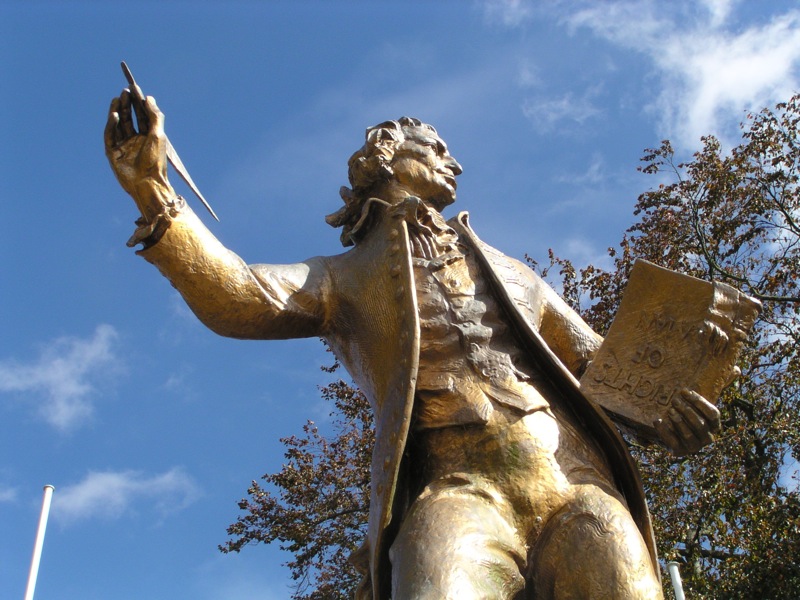
“There is nothing more common than to confound the terms of the American Revolution with those of the late American war. The American war is over, but this is far from being the case with the American revolution. On the contrary, nothing but the first act of the great drama is closed.” 1787, Benjamin Rush
-the beginning of the book, Citizen Tom Paine, by Howard Fast, 1943
The writings below are primarily from a column I published on July 5, 2020. It was a review of the book, Citizen Tom Paine. I am writing this updated version of it again now in connection with the upcoming 250th anniversary of the 1776 USA Declaration of Independence.
Are there going to be any July 4th events later this week anywhere in the USA that raise up the name and the importance of Tom Paine? Perhaps, but probably a very small number. This will be the case even though, without Tom Paine, it is likely that the war of independence against British colonialism that forged what became the United States of America never would have succeeded. That is how important this poor, struggling, working-class, English immigrant was to the revolutionary cause. This was a person who made a difference.
It is rare, from my experience, that the name Tom Paine is voiced among those in 21st century USA who see themselves as revolutionaries or on the political Left. I understand why this is the case, but I think there are very good reasons why we should be raising up his name as we continue to build our growing, 21st century, revolutionary movement for “liberty and justice for all.” A very big one is because he is one of the few well-known leaders of that popular uprising who was not a landowner, who was one of the “common people,” and who opposed both the enslavement of African people and the horrific treatment of the Indigenous nations of the lands which became the USA.
Howard Fast’s book is not a biography of Paine; it’s a work of historical fiction. But it presents the truth about the man, from his very real personal weaknesses and warts to his brilliance as a writer, speaker and organizer, his commitment to the causes of overthrowing tyranny of all kinds, “a way for children to smile, some freedom, liberty, and hope for the future, men with rights, decent courts, decent laws, men not afraid of poverty and women not afraid of childbirth.” (p. 77)
Paine saw himself as a revolutionist. This was his life’s work. In a fictional exchange with fellow revolutionist and doctor Benjamin Rush, in a discussion about revolution, Rush articulates what was historically new about what was happening in the American colonies in the 1770’s: “The strength of many is revolution, but curiously enough mankind has gone through several thousand years of slavery without realizing that fact. But here we have a nation of armed men who know how to use their arms; we have a Protestant tradition of discussion as opposed to autocracy; we have some notion of the dignity of man [mainly white men]. . . but now we must learn technique, we must learn it well. . .Six months ago you were rolled in the dirt [assaulted] because people knew what you were writing; two weeks ago a man in New York was almost tarred and feathered because he planned to publish an answer to [Paine’s] Common Sense. That’s not morality; that’s strength, the same kind of strength the tyrants used, only a thousand times more powerful. Now we must learn how to use that strength, how to control it. We need leaders, a program, a purpose, but above all we need revolutionists.” (pps. 116-117)
Paine was a particular kind of writer, one who was immersed in the cause of independence, on the front lines of deadly battles, spending time in the bitter winter encampments of the nascent continental army, organizing, encouraging men to stick with it, inspiring them and pointing out how important what they were doing was. “This was all Paine had ever thought of or dreamed of, the common men of the world marching together, shoulder to shoulder, guns in their hands, love in their hearts.” (p. 124)
Fast paints a picture of Paine writing the first issue of The Crisis, a newspaper published during the war to present facts and strengthen morale: “The men gathered around him. They read as he wrote: ‘These are the times that try men’s souls. The summer soldier and the sunshine patriot will, in this crisis, shrink from the service of their country, but he that stands it now, deserves the love and thanks of man and woman. Tyranny, like hell, is not easily conquered. . . If there be trouble, let it be in my day, that my child may have peace. . . Let it be told to the future world, that in the depth of winter, when nothing but hope and virtue could survive, that the city and the country, alarmed at one common danger, came forth to meet and repulse it.” (p. 145)
That’s a good last line, relevant for us right now. Let the city, the suburbs and the rural areas come forth this November 3rd to meet and repulse our common Trump/MAGA danger, this decade’s King George III and the Redcoats, and, after their defeat at the polls, let’s keep going to replace the unjust, destructive system which spawned them with something very, very different. It’s just common sense.
Ted Glick has been a progressive activist and organizer since 1968. He is the author of the recently published books, Burglar for Peace and 21st Century Revolution, both available at https://pmpress.org . More info can be found at https://tedglick.com.

Ted Glick has devoted his life to the progressive social change movement. After a year of student activism as a sophomore at Grinnell College in Iowa, he left college in 1969 to work full time against the Vietnam War. As a Selective Service draft resister, he spent 11 months in prison. In 1973, he co-founded the National Committee to Impeach Nixon and worked as a national coordinator on grassroots street actions around the country, keeping the heat on Nixon until his August 1974 resignation. Since late 2003, Ted has played a national leadership role in the effort to stabilize our climate and for a renewable energy revolution. He was a co-founder in 2004 of the Climate Crisis Coalition and in 2005 coordinated the USA Join the World effort leading up to December actions during the United Nations Climate Change conference in Montreal. In May 2006, he began working with the Chesapeake Climate Action Network and was CCAN National Campaign Coordinator until his retirement in October 2015. He is a co-founder (2014) and one of the leaders of the group Beyond Extreme Energy. He is President of the group 350NJ/Rockland, on the steering committee of the DivestNJ Coalition and on the leadership group of the Climate Reality Check network.
ZNetwork is funded solely through the generosity of its readers.
Donate




