

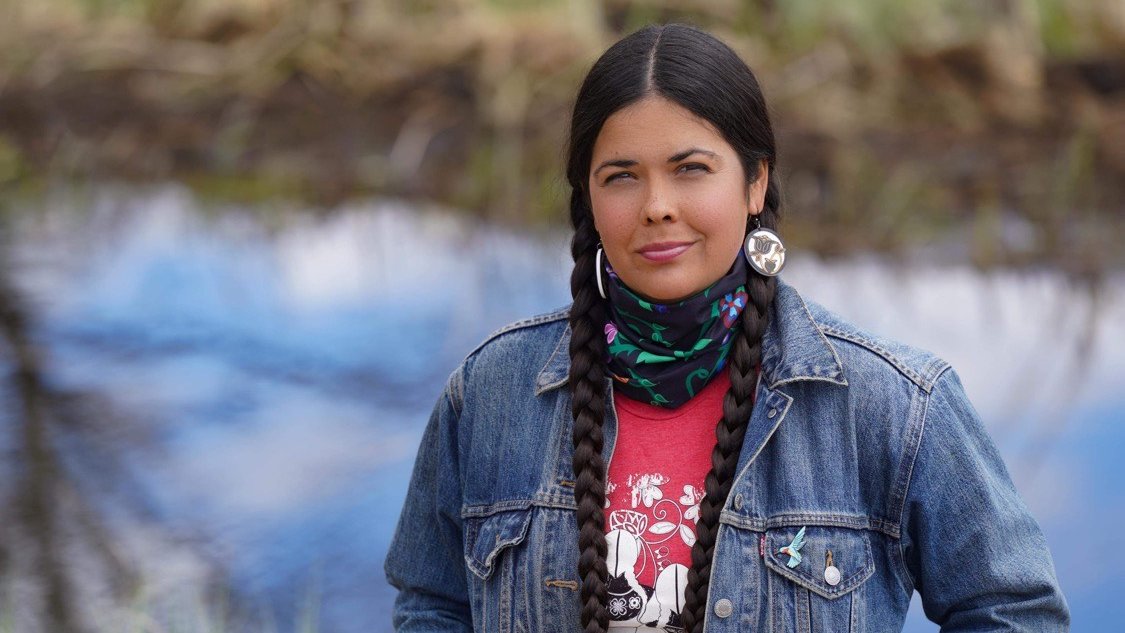
Through her kitchen window, just outside of Ranier, Minnesota—a tiny town east of International Falls—water protector Tara Houska gazes out at Rainy Lake. Called Gojijiing in Ojibwe, the 360-square-mile lake straddles the border between Minnesota and Ontario, Canada. Among the many islands, capes, and peninsulas around the lake is Bald Rock Point, the site of a sixteen-acre former resort built almost a century ago.
Bald Rock Point is also now home to a longtime dream for Houska, a member of Couchiching First Nation. It’s the future location of a “long-term resistance camp” where she intends to raise her infant daughter, host Ojibwe language classes, conduct trainings, hold retreats, and nurture other activists. Houska notes that she made her formal offer on the land on October 10: “What a way to spend Indigenous People’s Day! Land back continues.” She’s planning to save and rehab the old lodge, cabin, and pole buildings on the property; as of February, she’d hired contractors to begin work on them.
For Houska, a tribal attorney, activist, writer, and new mom, the restorative venture is a welcome next chapter. Her years of work fighting against the Dakota Access Pipeline and Enbridge’s Line 3 cost Houska a lot, including more than one wanted pregnancy. Along with other members of the Giniw Collective—a women- and two-spirit-led movement Houska founded to “protect Mother Earth, defend the sacred, and live in balance”—she was arrested, assaulted, and thrown in a county jail alone, for days.
All for nonviolent direct action, or, as Houska wrote in an essay in Vogue, “trying to stop the drilling of a drought-stricken river in my grandmother’s treaty territory.” Police were “shooting us with pepper balls, rubber bullets, and mace,” Houska tells The Progressive. In Minnesota, law enforcement and Department of Natural Resources personnel were enlisted and paid by Enbridge to crack down—alongside Enbridge private security—on the protesters. Truthout reported in November that Enbridge paid $8.6 million to state and local law enforcement agencies around Minnesota.
“That’s a horrific precedent that was set, and I think it’s something that’s still not widely known,” Houska adds. “In my assessment, it’s an obvious violation of the public trust: police and conservation officers in riot gear being paid by a private entity. In this case, a foreign private entity. I don’t think people fully grasp the level of repression that was happening.”
Oil has been flowing through the Line 3 extension for a year and a half, but aspects of the fight are still playing out, including lawsuits over the excessive use of force. “It takes a long time, through the legal system, to achieve any shape or form of whatever justice the system offers,” Houksa says. Still, she focuses on the good that came out of those battles, and they helped inspire her vision for Bald Rock Point. Donations funded the purchase of the property, and Houska is in the midst of transferring ownership to a nonprofit she founded also called Gojijiing, whose future board of directors will ensure the stewardship and communal ownership of the land. Ultimately, Houska dreams of sharing knowledge and skills, and of offering care and rest to other activists there.
Houska’s daughter, born last summer, helps inspire that vision, too. As deeply as she’d felt her convictions about the urgency to protect the planet, the birth of her child crystallized them even more. “She’s here, and I’m looking at her, and I feel like I’m meeting someone I’ve been fighting for,” Houska says. “It’s like, ‘I hope that I’m able to do the best job I can to keep doing that for you. As hard as I can.’ Even when we’re not winning [a particular battle], I hope that we’re trying to build a better world.”
Houska’s path to law and activism wasn’t linear. She changed her undergraduate major at the University of Minnesota six times, and wound up combining art history, biology/pre-med, and American Indian Studies—which she fell in love with through the Ojibwe language program. “I really did love school; I always have.” Houska planned to apply to med school after taking a year off, but an interim stint with a health-care-related company made her leery of the constraints the U.S. private healthcare system places on providers. Her boyfriend at the time suggested law school instead.
“I had never even seen Law and Order,” Houska laughs. “The only lawyer I knew was Bob Loblaw from Arrested Development. But I thought I could do that and I took the LSAT.” She began law school at a private university in St. Paul, transferring to the University of Minnesota the following year. A course on Indian child welfare law lit a spark in Houska—she took as many American Indian studies courses as possible and spent an additional year studying tribal law and governance at Arizona State University.
In her internship in the White House working on the Council on Environmental Quality, Houska worked on a bill—the Helping Expedite and Advance Responsible Tribal Home Ownership (HEARTH) Act—that eventually became law. The act created a voluntary, alternative land-leasing process for tribes. “I remember [an early meeting] sitting in a room with a lot of people who were talking about tribes in a really paternalistic, ignorant, disrespectful way,” Houska says. “Representation is really important. And it’s also important to develop relationships.”
After earning her J.D., Houska got a job working for a law firm that represents tribes across the country. From 2016 to 2019, she served as the campaign director for Honor the Earth, an awareness and advocacy group cofounded by Winona LaDuke. The Dakota Access pipeline fight, which began in spring 2016, called Houska to spend more time engaging on a physical level. Houska said it reaffirmed for her the need to foster healing and solidarity—a big part of why she’s committed to building the resistance camp on Rainy Lake.
Houska takes a long view of the struggle against fossil fuels and for a just, equitable transition to clean energy. “What I observe in these fights is an increasing number of people, from all walks of life, who recognize that we have to do something,” Houska says. While she sees politics and policymaking as key—in fact, Houska served as the Native American Advisor to Senator Bernie Sanders’ 2016 presidential campaign—she believes “they aren’t the end-all, be-all. I don’t really look as much to those top-level solutions.”
She’s most energized by “seeing the anarchist alongside the biologist, the young person with all the tattoos and multicolored hair next to the middle-aged suburbanite next to the grandparent—all side by side because they recognize that we have one home. That’s the beauty of movements, right? This diversity. And it makes us more powerful.”
With the number of billion-dollar disasters in the United States increasing in recent decades—2022 saw ongoing drought and frequent wildfires out West, historic floods in the Midwest, tornadoes in the South, and the devastation of Hurricane Ian—more Americans are experiencing climate change firsthand. “You can give people statistics and facts and figures,” Houska says. “But the thing that’s really going to open someone’s eyes is the fire in my backyard. We’re seeing these extremes; it’s terrifying.
“You can’t deny what’s right in front of you,” Houska notes. “Is my daughter going to be able to experience ice fishing the way that I did? Is she going to be able to live the way I’ve lived? That really does eat at my heart.”
Houska invests her hopes in the evolving movement she’s helping lead. Honor the Earth and Giniw Collective involved more than 1,000 people on the ground in the pipeline fight over last few years, she says.“You know, you create these ripples of change, and you hope you inspire somebody to see, ‘maybe there’s something I could do’ . . . because the system creates a feeling of powerlessness.” But whether she’s in a water protector camp or talking with bank shareholders at their annual meeting, Houska embraces the very real grassroots power she’s helped to build.
“We’re building a holistic movement, because there’s no one way to win against these oligarchs who are destroying the Earth,” Houska says. “Creating inspiration, showing people that the Earth is a relative, a living being we have to protect.”
ZNetwork is funded solely through the generosity of its readers.
Donate




