

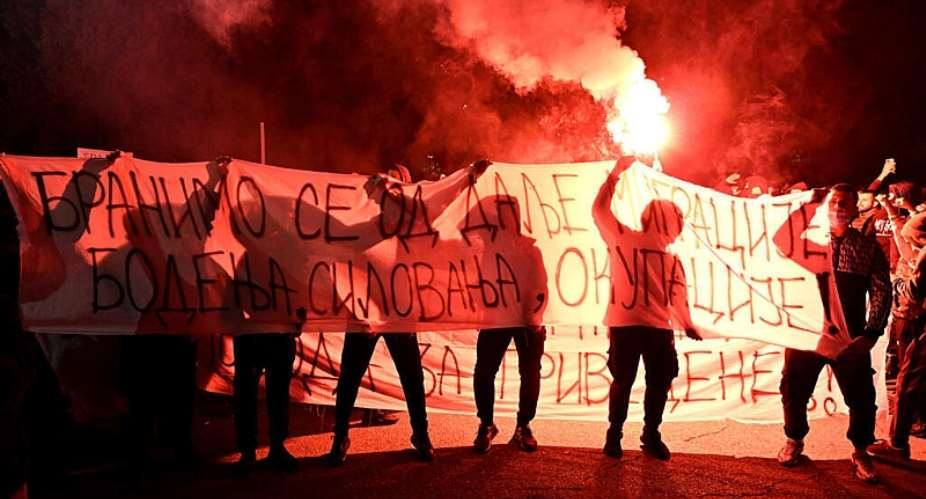
In late October 2025, in the Zabjelo district of Podgorica, the capital of Montenegro, a serious stabbing incident triggered a wave of public unrest. A Montenegrin man was wounded after an altercation involving foreign nationals, initially reported to include Turkish and Azerbaijani citizens. Authorities later detained dozens of Turkish- and Azerbaijani-nationals and suspended the visa-free entry regime for Turkish citizens. The unrest quickly escalated: there were reports of Turkish citizens being beaten, several small Turkish-owned shops vandalized or destroyed, and crowds chanting “Ubij, ubij Turčina” (“Kill the Turk”). This flare-up exposed deeper anxieties in Montenegrin society about migration, identity and foreign investment. Turkish citizens have in recent years moved to Montenegro — drawn by tourism opportunities, business ventures and relaxed residency regimes — yet also stirred unease among locals who feel that state control and effective integration policies are lacking. The collision of these factors set the stage for a volatile moment in which historical resentments, economic insecurities and symbolic politics fused into a public outburst.
This explosion of violence sparked a wave of euphoric yet shallow reactions within Montenegro’s deeply divided society. Montenegrin nationalists and other habitual agitators against the country’s historic Serbian community immediately blamed the “malign influence of the Serbian Orthodox Church,” while Serbian right-wing nationalists were quick to claim that Montenegro was facing a “new Turkish invasion” — a punishment, they said, for failing to heed the lessons of The Mountain Wreath, the 19th-century masterpiece by Prince-Bishop Petar II Petrović Njegoš. As if Njegoš’s verses about the “Turks” referred to kebab vendors and economic migrants rather than Ottoman conquerors. In truth, the “Serbian Church” can neither control migration flows nor the frustrations of the local population, nor has it ever shown such ambition — and these tensions are hardly unique to Montenegro. After all, The Mountain Wreath was never about integration policy, but about something far deeper: the boundaries of identity and freedom.
To be fair, this drama in the public sphere is often stripped of its historical context until it becomes a collective neuralgic point — one that needs only the slightest touch for a crowd to erupt with cries of “Kill the Turk.” Had the attackers of M.J. been, say, Russians or Ukrainians, there would no doubt have been fights, perhaps even street clashes for dominance, but it is unlikely that Russian travel agencies would have been set on fire, or that the “Orthodox brothers” would have been treated in the same way as the “Turks” — that is, with gangs of hooligans, really just lost and socially discarded young men, chanting “Slaughter the Russians!”
And of course, this is nothing peculiar to Montenegrins or to the Balkans. Every culture carries within its collective memory an image of the “Other” — the eternal stranger, enemy, or traitor. The pattern is universal. In the Islamic world, for instance, similar fault lines exist between Sunnis and Shiites, where centuries of mutual prejudice and a deep-seated sense of historical insecurity run so strong that even peoples who share the same faith often cast one another as heretics, impostors, or “false Muslims.” The Saudi attitude toward Shiites in the Eastern Province, Pakistan’s hostility toward the Hazara, the Iranian–Arab mistrust across the Gulf, and the brutal divisions among different Islamic groups in Sudan or Yemen — all reflect the same mechanism. Historical trauma, political manipulation, and religious interpretation merge into a single matrix in which collective identity is reinforced through the continual resurrection of the “Other,” even when he speaks the same language and practices almost the same faith — much like today’s Montenegrins and Serbs, who in the nineteenth century were still one and the same people.
Key theorists such as Edward Said (the seminal Orientalism), Ernest Gellner (Nations and Nationalism, 1983), Fredrik Barth (Ethnic Groups and Boundaries: The Social Organization of Culture Difference, 1969), and Talal Asad (Genealogies of Religion: Discipline and Reasons of Power in Christianity and Islam, 1993) have all shown that in different cultures the “Other” is not defined by essence but through a process of differentiation. In times of conflict, these boundaries become ideological and moral: the Other is depicted as a barbarian, an infidel, a heretic, or a threat to order. In that sense, the Other is not “something else,” but rather “something that must be kept apart.”
In the case of the Ottoman Empire and early Montenegro, the Other was constructed through a mutual process of symbolic violence. From the Ottoman perspective, Montenegrins (like other Christian populations) were portrayed as rafiza — defiant highlanders and savages who endangered the empire’s “order and law,” in other words, as barbarians within the supposedly civilized Islamic world (nizâm-ı alem). From the Montenegrin (and broadly Serbian) side, the Ottomans, or “Turks,” became the archetype of the foreigner — not only politically and religiously, but also anthropologically: a symbol of slavery, injustice, alien law, and moral corruption. In epic and folkloric narratives, the Turk was not merely a military enemy but a category of evil itself — precisely because he embodied the anti-normative traits of deceit, “godlessness,” and dishonor. Within the epic discourse, this image assumed sacred dimensions: the struggle against the “Turks” was not only a fight for land, but a ritual defense of the cosmic order, where freedom became a form of sanctity, and betrayal — the deepest moral fall.
Such patterns outlive the historical circumstances that produced them, often long after the original events have faded from memory. Over time, they lose contact with their historical context and devolve into grotesque shadows of former conflicts — vestiges that persist even in the absence of a real enemy. Thus, in contemporary discourse, the “Turk” is no longer the Ottoman, just as the “Vlach,” (Serb) the “Latin,” (Croat) or the “Švabo” (German) are no longer concrete ethnic designations, but symbolic residues of bygone hostilities that fill the void in collective consciousness when a society lacks a tangible Other. In that process, violence ceases to be a historical necessity and becomes — like so many other things in human societies — a meaningless cultural reflex, one that reactivates every time a (now peripherally capitalist) society loses its sense of purpose and reaches for an easier way to redefine itself.
Therefore, all this hysteria — ostensibly in defense of honor and cultural identity — is, in truth, the finest gift to the new colonization of the Balkans. Not the Ottoman one, but the modern fiscal-global variety that dictates what we will eat, think, and do for a minimum wage. This is not to say that those responsible for the reckless settlement — including criminal elements from the Republic of Turkey — namely, Montenegro’s techno-managerial government, a formally multi-confessional administration composed of both Christian and Muslim officials, should not be held accountable for the chaos they created in their eagerness to attract “foreign investment.” Yet while people brawl in the streets over The Mountain Wreath, regional offices quietly sign agreements turning our coasts and mountains into zones of concession, and our citizens into serfs on their own land.
The irony is that today, in Serbia, Muslim Bosniaks — some would say “Turks” — and Orthodox Serbs march side by side against that very same colonial authority that promises “stability,” while in Montenegro, under the same sky, people are still waving swords at ghosts from pre-Njegoš times. The “Turk” from The Mountain Wreath has long ceased to exist — except when, from time to time, figures such as Rifat Fejzić, the Reis of the Islamic Community of Montenegro, and others like him, pull him from the archives of national fears, attempting, in the best Goebbelsian fashion, to reduce every complex social phenomenon to a “Serbian conspiracy.” Yet the need to invent him anew, every time we lack the courage to confront our real masters, remains as alive and vigorous as ever.
For the grand finale, a small but telling statistic. According to Montenegrin police data, out of nearly 100,000 foreigners with residence permits — mostly from Serbia, Russia, Ukraine, and Albania — the least crime is committed by newcomers from Turkey and Azerbaijan. Which only proves that when you stare at reality through an epic lens, you usually end up starring in an epic farce — as the court jester, not the hero.
ZNetwork is funded solely through the generosity of its readers.
Donate
