


Like many people, I've spent years writing and speaking about the lethal power-subservient pathologies plaguing establishment journalism in the west. But this morning, I feel a bit like all of that was wasted time and energy, because this new column by career British journalist Chris Blackhurst – an executive with and, until a few months ago, the editor of the UK daily calling itself "The Independent" – contains a headline that says everything that needs to be said about the sickly state of establishment journalism:
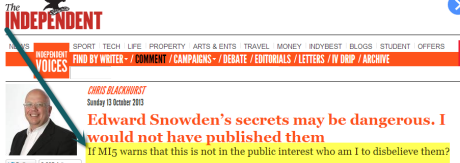

In other words, if the government tells me I shouldn't publish something, who am I as a journalist to disobey? Put that on the tombstone of western establishment journalism. It perfectly encapsulates the death spiral of large journalistic outlets.
Lest you think that the headline does not fairly represent the content of the column, Blackhurst, in explaining why he would never have allowed his newspaper to publish any of the documents from NSA whistleblower Edward Snowden, actually wrote:
If the security services insist something is contrary to the public interest, and might harm their operations, who am I (despite my grounding from Watergate onwards) to disbelieve them?"
Most people, let alone journalists, would be far too embarrassed to admit they harbor such subservient, obsequious sentiments. It's one thing to accord some deference or presumption of good will to political officials, but the desire to demonstrate some minimal human dignity, by itself, would preclude most people from publicly confessing that they have willingly sacrificed all of their independent judgment and autonomy to the superior, secret decrees of those who wield the greatest power. Chris Blackhurst has obviously liberated himself from these inhibitions, though not entirely, as he infuses insincere caveats like this into his paean to the virtues of obedience: "I'm cynical about officialdom, having seen too many cover-ups and appalling injustices carried out in our name." One would think that most journalists (particularly those who edit a newspaper called "The Independent") would want to maintain at least a pretense of independent thought and thus refrain from acknowledging such cringe-inducing things about themselves.
Still, what Blackhurst is revealing here is indeed a predominant mindset among many in the media class. Journalists should not disobey the dictates of those in power. Once national security state officials decree that what they are doing should be kept concealed from the public – once they pound their mighty "SECRET" stamp onto their behavior – it is the supreme duty of all citizens, including journalists, to honor that and never utter in public what they have done. Indeed, it is not only morally wrong, but criminal, to defy these dictates. After all, "who am I to disbelieve them?"
That this mentality condemns – and would render outlawed – most of the worthwhile investigative journalism over the last several decades never seems to occur to good journalistic servants like Blackhurst. National security state officials also decreed that it would "not be in the public interest" to report on the Pentagon Papers, or the My Lai massacre, or the network of CIA black sites in which detainees were tortured, or the NSA warrantless eavesdropping program, or the documents negating claims of Iraqi WMDs, or a whole litany of waste, corruption and illegality that once bore the "top secret" label. Indeed, one of the best reporters in the UK, Duncan Campbell, works for Blackhurst's newspaper, and he was arrested and prosecuted by the UK government in the 1970s for the "crime" of disclosing the existence of the GCHQ. When Blackhurst sees Campbell in the hallways, does he ask him: "who are you to have decided on your own to disclose that which UK officials had told you should remain concealed?"
The NSA reporting enabled by Snowden's whistleblowing has triggered a worldwide debate over internet freedom and privacy, reform movements in numerous national legislatures, multiple whistleblowing prizes for Snowden, and the first-ever recognition of just how pervasive and invasive is the system of suspicionless surveillance being built by the US and the UK. It does not surprise me that authoritarian factions, including (especially) establishment journalists, prefer that none of this reporting and debate happened and that we all instead remained blissfully ignorant about it. But it does still surprise me when people calling themselves "journalists" openly admit to thinking this way. But when they do so, they do us a service, as it lays so vividly bare just how wide the gap is between the claimed function of establishment journalists and the actual role they fulfill.


Glenn Greenwald is a journalist, former constitutional lawyer, and author of four New York Times bestselling books on politics and law. After working as a journalist at Salon and The Guardian, Greenwald co-founded The Intercept in 2013. He writes independently sine 2020.
ZNetwork is funded solely through the generosity of its readers.
Donate




