In the United States, college athletes — particularly those who compete at some of the largest football and basketball programs — generate not millions but billions of dollars for universities, brands, and television networks. In 2015, the top programs made a combined $9.1 billion. The NCAA, for its part, just signed an $8.8 billion dollar deal with CBS to air March Madness, the college basketball championship tournament.

College sports is a business – a very lucrative business.

That very obvious dynamic undergirds a lawsuit filed by former NCAA athlete Lawrence “Poppy” Livers asserting that scholarship students who play sports are employees and deserve pay. The Livers case argues that student-athletes who get scholarships should at least be paid as work-study students for the time they put in.

What the NCAA did in response to the lawsuit is as vile as anything going on in sports right now. I had to see it for myself before I believed it. At the root of its legal argument, the NCAA is relying on one particular case for why NCAA athletes should not be paid. That case is Vanskike v. Peters.

Only there’s an important detail: Daniel Vanskike was a prisoner at Stateville Correctional Center in Joliet, Illinois, and Howard Peters was the Director of the state Department of Corrections. In 1992, Vanskike and his attorneys argued that as a prisoner he should be paid a federal minimum wage for his work. The court, in its decision, cited the 13th Amendment and rejected the claim.

The 13th Amendment is commonly hailed as the law that finally ended slavery in America. But the amendment has an important carve-out: it kept involuntary service legal for those who have been convicted of a crime. “Neither slavery nor involuntary servitude, except as a punishment for crime whereof the party shall have been duly convicted, shall exist within the United States, or any place subject to their jurisdiction,” the amendment says. It’s that phrase — “except as a punishment for crime” — which allows American prisons to force their inmates to do whatever work they want or need them to do.

The use of the case stems from several other law cases alleging unpaid labor; two of them are previous lawsuits against the NCAA in which the case was cited as precedent, and the NCAA won.
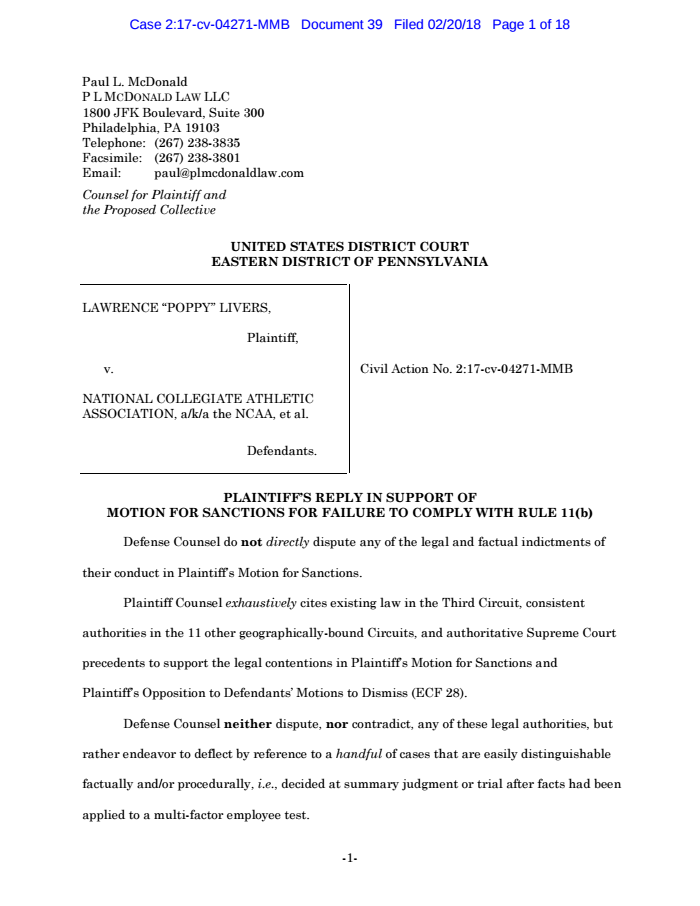
Livers v. NCAA Filing on Comparison of Student-Athletes to Prisoners18 pages

In their response to the NCAA’s motion to dismiss, Livers’s lawyers are arguing that the precedent was mistaken for applying the 13th Amendment exception for unpaid prison labor in a case dealing with non-prisoners.

“Defense Counsel’s insistence that Vanskike be applied here is not only legally frivolous, but also deeply offensive to all Scholarship Athletes – and particularly to African-Americans,” Livers’s rebuttal to the NCAA’s motion says. “Comparing athletes to prisoners is contemptible.”

The NCAA is showing an incorrigible nerve to use this case, Vanskike v. Peters, as one of its justifications for not paying student-athletes. The Vanskike case has been cited in the 3rd Circuit Court of Appeals 14 times before, but in each of those 14 cases there were prisoners arguing that they should be paid a fair wage for their work.

Yet the NCAA wants to rely on this case and to call on the 13th Amendment. The body that runs college sports wants to use a justification for the slave labor of convicted criminals to justify its outrageous greed.

This is not just bad optics. It gets to the heart of what the multibillion-dollar enterprise that is the NCAA thinks not just of its athletes, but of its core business model. It is, in essence, admitting that student-athletes are working as slave laborers and as such do not deserve fair compensation.

Bigotry has a way of revealing itself. And that is exactly what the NCAA — by leaning on the case of a prisoner demanding he be paid as its justification for denying their athletes a wage of any kind — has done here. It has revealed itself to us.


ZNetwork is funded solely through the generosity of its readers.

Donate
Donate
Leave A Reply

Subscribe

All the latest from Z, directly to your inbox.

Institute for Social and Cultural Communications, Inc. is a 501(c)3 non-profit.

Our EIN# is #22-2959506. Your donation is tax-deductible to the extent allowable by law.

We do not accept funding from advertising or corporate sponsors.  We rely on donors like you to do our work.

ZNetwork: Left News, Analysis, Vision & Strategy

Subscribe

All the latest from Z, directly to your inbox.

THE WIND CRIES FREEDOM

The Wind Cries Freedom, the new book from Z co-founder Michael Albert, is a sweeping oral history of a future American revolution.

Through thirty interconnected chapters, it draws out the strategies, failures, turning points, and hard-won wisdom of a movement that called itself the Revolutionary Participatory Society. These are not the polished memoirs of politicians: they are the unfiltered accounts of people who organized in neighborhoods, hospitals, universities, stadiums, courthouses, and places of worship, and kept a shared vision alive through cynicism and exhaustion.

The result is speculative political fiction that reads like history: messy, human, and quietly hopeful in the way that only real experience and long thought can produce.

Get your copy and peruse more features on the book’s website below.

“Read it, argue with it, but don’t look away. The future it recalls is one we must still fight to deserve.”

Yanis Varoufakis

“The most unusual and intriguing combination of prophecy, manifesto, and movement building manual that I have ever encountered.”

Bill Fletcher Junior

“This work fills a huge gap in our social movement literature.”

Cynthia Peters

You've just read your article on Z this month.

DOES Z'S SURVIVAL MATTER?

You keep coming back for a reason: serious political analysis, movement reporting, and debate beyond the priorities of corporate media. Today, Z is in a precarious financial position. If Z is part of how you understand the world, help keep it going. The readers who give monthly are the reason this work survives between fundraisers.

Z is in a precarious financial position. If it’s part of how you understand the world, help keep it going.

Number of donors717
Our goal1,000

Sustainers at $9/month or more receive the digital Z Magazine.

Already a sustainer? Click here and we won’t ask again. Thank you!

Your reading count is stored only in your browser and is never sent to us.

Sound is muted by default.  Tap 🔊 for the full experience

CRITICAL ACTION

Critical Action is a longtime friend of Z and a music and storytelling project grounded in liberation, solidarity, and resistance to authoritarian power. Through music, narrative, and multimedia, the project engages the same political realities and movement traditions that guide and motivate Z’s work.

If this project resonates with you, you can learn more about it and find ways to support the work using the link below.

Z is in the most precarious financial position in its history.

Z is a place to think beyond the limits of the present.

For decades, Z has brought together political analysis, movement reporting, debate, and visions of a different future from writers and activists around the world. That work is more than journalism. It is movement infrastructure: movements need places to develop ideas, test arguments, learn from experience, and imagine what comes next.

In the first two days of this fundraiser, 19 donors and 8 new monthly sustainers stepped up. Help us reach 1,000 donors who keep Z independent, for everyone.

For decades, Z has published the analysis, debate, and visions movements need, free of paywalls, ads, and billionaire owners. If that work should continue, Z needs your support now.

Number of donors717
Our goal1,000

Sustainers at $9/month or more receive the digital Z Magazine.

Subscribe

Join the Z Community – receive event invites, announcements, a Weekly Digest, and opportunities to engage.

Exit mobile version

