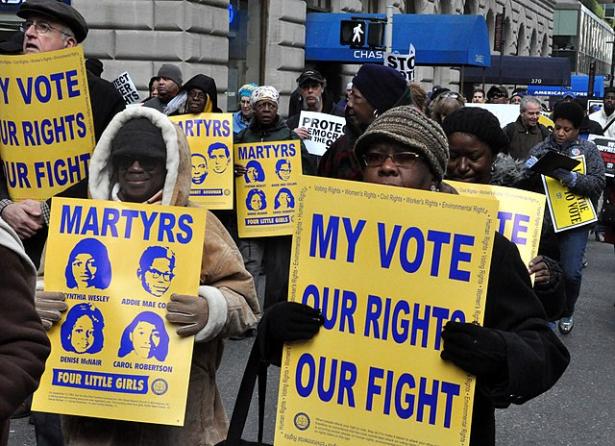
Source: Portside

This premise is simply false, and it leads us into hopeful delusions about inevitable progress. We must rid ourselves of these pollyannaish expectations. Think of President Obama’s stirring second inaugural, in which he evoked an America always moving forward, from “Seneca Falls to Selma to Stonewall.”  That’s a lovely notion, but it’s odds with the facts.

The fallacy that voting rights have organically broadened over time has real political implications. It blinds us to how access to the ballot has see-sawed back and forth since the Founding, just as often restricted as enlarged.

Its essence is the constant assertion by journalists, pundits, and even scholars that “only propertied white men voted at the Founding.” This claim is wrong all counts.

First, independent (single and widowed) women voted freely in New Jersey from 1776 to 1807 under a constitutional provision enfranchising all “inhabitants” who owned a minimal amount of nearly worthless revolutionary paper money.  And this was no obscure accident, as it was affirmed by the state’s highest court on several occasions.

Second, only three of the original thirteen states (Georgia, South Carolina, and Virginia) had a racial limit on suffrage in 1775, and after the Revolution, the small number of free Black men began voting in steadily increasing numbers. Here, as with New Jersey women, the historical impetus was to dis-franchise, with Delaware (1792), Maryland (1802), New Jersey (1807), Connecticut (1818), New York (1821), Rhode Island (1822), and finally Tennessee (1834), North Carolina (1835), and Pennsylvania (1838) moving to exclude or severely limit their often-substantial Black electorates.

Many people seem to view the above, however, as exceptions to the larger trend of democratization.  What is hardest to give up is the notion of a universal property requirement.  As of 1775, seven of the thirteen colonies (New Hampshire, Rhode Island, New York, Virginia, North Carolina, Georgia, and New Jersey) kept the British suffrage requirement of a “forty pound” freehold, e.g. owning a minimum value of land. But Georgia, New Hampshire, and New Jersey dispensed with their land-owning requirements early in the revolutionary era, while Massachusetts and Pennsylvania legislated that voters pay only a nominal local or state tax, which was at most haphazardly enforced.

Historians have long known these facts, most of which appeared in an authoritative 1957 study. So why do pundits, journalists, and otherwise educated folk keep repeating the mantra that the republic’s original electorate was made up exclusively of property-owning white men?

In my view, it is a feel-good mechanism, which allows Americans avoid the disturbing realities of U.S. history.  Many people know about the disfranchisement of Black southerners in the Jim Crow era, from the late nineteenth century through passage of the Voting Rights Act in 1965.  Putting the blame on one part of the country lets the rest of us off the hook. It avoids how many people—obviously women and also Native Americans, Mexican Americans, and various immigrants were legally or illegally stripped of their suffrages over the past two centuries. The constant racial gerrymanders, illegal purges of voter rolls, removal of polling places, and spurious “voter ID” laws that Republicans have legislated over the past decade should remind us of how it’s done.  They are just updating the history.

Voter suppression and disfranchisement are as American as cherry pie.  Let’s get rid of our myths of slow but inevitable progress and get down to the hard work of securing the right to vote for everyone.


This article was originally published by Portside; please consider supporting the original publication, and read the original version at the link above.

ZNetwork is funded solely through the generosity of its readers.

Donate
Donate
Leave A Reply

Subscribe

All the latest from Z, directly to your inbox.

Institute for Social and Cultural Communications, Inc. is a 501(c)3 non-profit.

Our EIN# is #22-2959506. Your donation is tax-deductible to the extent allowable by law.

We do not accept funding from advertising or corporate sponsors.  We rely on donors like you to do our work.

ZNetwork: Left News, Analysis, Vision & Strategy

Subscribe

All the latest from Z, directly to your inbox.

THE WIND CRIES FREEDOM

The Wind Cries Freedom, the new book from Z co-founder Michael Albert, is a sweeping oral history of a future American revolution.

Through thirty interconnected chapters, it draws out the strategies, failures, turning points, and hard-won wisdom of a movement that called itself the Revolutionary Participatory Society. These are not the polished memoirs of politicians: they are the unfiltered accounts of people who organized in neighborhoods, hospitals, universities, stadiums, courthouses, and places of worship, and kept a shared vision alive through cynicism and exhaustion.

The result is speculative political fiction that reads like history: messy, human, and quietly hopeful in the way that only real experience and long thought can produce.

Get your copy and peruse more features on the book’s website below.

“Read it, argue with it, but don’t look away. The future it recalls is one we must still fight to deserve.”

Yanis Varoufakis

“The most unusual and intriguing combination of prophecy, manifesto, and movement building manual that I have ever encountered.”

Bill Fletcher Junior

“This work fills a huge gap in our social movement literature.”

Cynthia Peters

You've just read your article on Z this month.

DOES Z'S SURVIVAL MATTER?

You keep coming back for a reason: serious political analysis, movement reporting, and debate beyond the priorities of corporate media. Today, Z is in a precarious financial position. If Z is part of how you understand the world, help keep it going. The readers who give monthly are the reason this work survives between fundraisers.

Z is in a precarious financial position. If it’s part of how you understand the world, help keep it going.

Number of donors705
Our goal1,000

Sustainers at $9/month or more receive the digital Z Magazine.

Already a sustainer? Click here and we won’t ask again. Thank you!

Your reading count is stored only in your browser and is never sent to us.

Sound is muted by default.  Tap 🔊 for the full experience

CRITICAL ACTION

Critical Action is a longtime friend of Z and a music and storytelling project grounded in liberation, solidarity, and resistance to authoritarian power. Through music, narrative, and multimedia, the project engages the same political realities and movement traditions that guide and motivate Z’s work.

If this project resonates with you, you can learn more about it and find ways to support the work using the link below.

Z is in the most precarious financial position in its history.

Z is a place to think beyond the limits of the present.

For decades, Z has brought together political analysis, movement reporting, debate, and visions of a different future from writers and activists around the world. That work is more than journalism. It is movement infrastructure: movements need places to develop ideas, test arguments, learn from experience, and imagine what comes next.

In the first two days of this fundraiser, 19 donors and 8 new monthly sustainers stepped up. Help us reach 1,000 donors who keep Z independent, for everyone.

For decades, Z has published the analysis, debate, and visions movements need, free of paywalls, ads, and billionaire owners. If that work should continue, Z needs your support now.

Number of donors705
Our goal1,000

Sustainers at $9/month or more receive the digital Z Magazine.

Subscribe

Join the Z Community – receive event invites, announcements, a Weekly Digest, and opportunities to engage.

Exit mobile version

