


An Oppenheimer Review Through the Lens of an Anti-War Activist
The ground-breaking movie Oppenheimer, despite its unsympathetic protagonist, packs a powerful anti-nuclear punch that makes it hard, if not impossible, to sleep after watching the film.
For this reason alone, the movie should be shown on the floor of Congress and in the White House as required viewing by all in DC bent on spending $1.7 trillion over the next decades to build new nuclear weapons to kill us all.
Only those with a global death wish or on the payroll of Northrop Grumman, the military contractor with the nuclear “modernization” contract, could watch this film and still root for US nuclear rearmament, a horror show now underway with the blessings of DC politicians. Unless people rise up in fury, unless this Hollywood movie sparks a second nuclear-freeze movement, a repeat on steroids of the 80’s nuclear weapons freeze, Congress and the White House will raid the treasury to expand our nuclear arsenal.
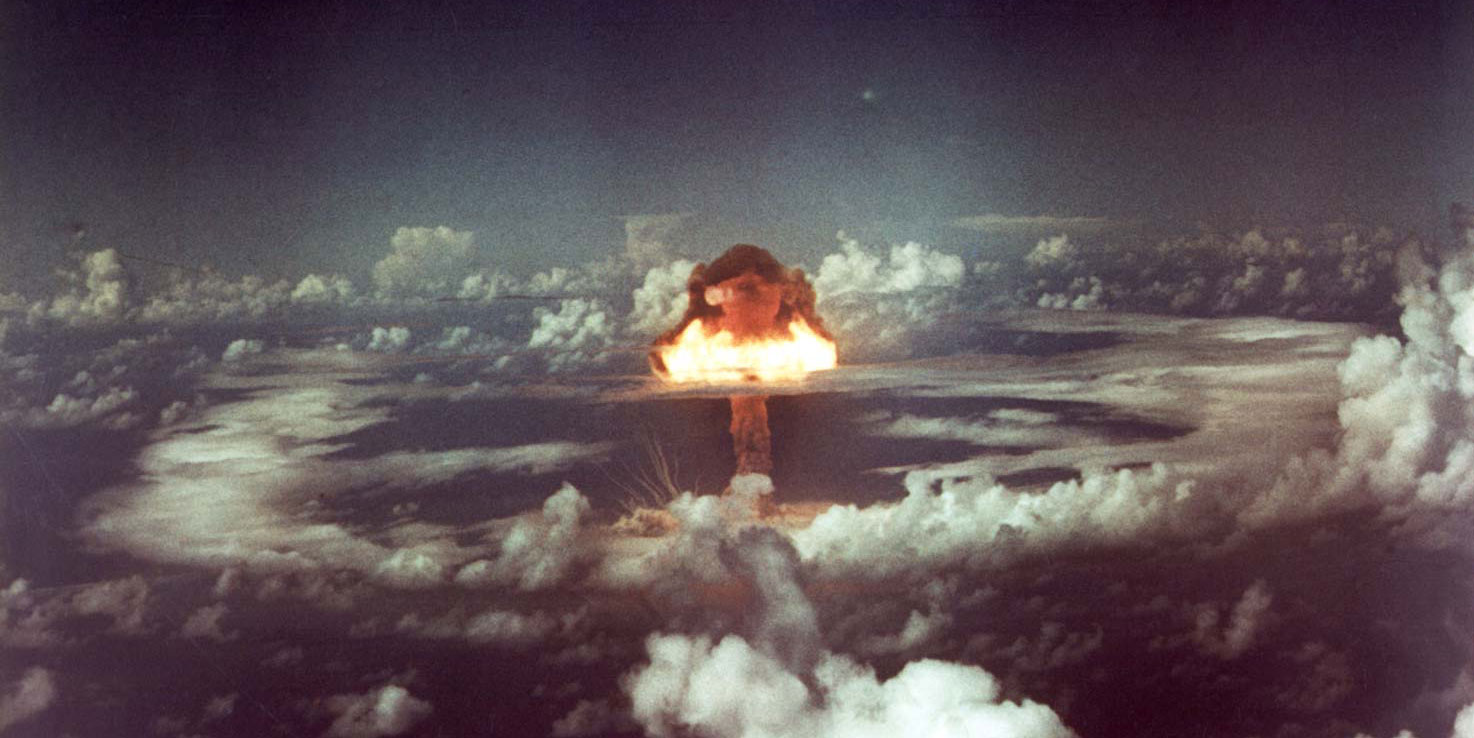
On the agenda is a new sea-launched nuclear cruise missile, a gravity bomb with two-stage radiation implosion, a long range strike bomber and the replacement of 400 underground nuclear missiles in the midwest with 600 new Intercontinental Ballistic Missiles. These new ICBMS–The Sentinel–could each carry up to three warheads 20 times more powerful than the atomic bombs the US dropped on Hiroshima and Nagasaki to incinerate 200,000 people in a span of three days.
Irish actor Cillian Murphy plays the role of J. Robert Oppeneheimer, a hand-wringing scientist, an unfaithful lackluster womanizer, a man with few convictions but lots of demons, who traverses an emotional landscape of ambition, doubt, remorse and surrender.
Oppenheimer oversees the Manhattan Project, the team of scientists hunkering down in the beautiful desert of Los Alamos, New Mexico, to build the hideous atomic bomb before the Germans or Russians crack the code.
In a scene reminiscent of the absurd 1950s, when pig-tailed school children scrambled under desks in mock nuclear drills, scientists don sunscreen and goggles to protect themselves during the blinding Trinity Test. This was the first atomic test conducted with no warning to the downwinders–the nearby indigenous people of the Southwest who developed cancer as a result of radioactive fall out. This was the test before President Truman ordered a 9,000 pound uranium bomb named “Little Boy’ loaded onto a B-29 bomber. This was the trial performance before the same President, depicted in the movie as unctuous and arrogant, orders Fat Boy, a second plutonium bomb– prototype for today’s nuclear weapon–dropped on Nagasaki.
Though the movie can be slow, a three hour endurance test, its historical insights and gut-churning imagery compensate for its lack of likable characters, save for Lt. General Leslie Groves, played by a fun-to-watch Matt Damon as Oppenheimer’s Pentagon handler.
One of the most haunting moments juxtaposes in living color celebrations of the bombings, applause and accolades for Oppenheimer standing at the podium with the guilt-consumed scientist’s black and white visions of irradiated souls, skeletal remains, flesh turned to ash–all amid a cacophony of explosions and pounding feet, the death march.
Even more disturbing are the questions that tug at the moviegoer, who wonders, “Where are the Japanese victims in this film? Why are they missing from this picture? Why are they never shown writhing in pain, their lives and cities destroyed?” Instead, the human targets are seen only through the lens of Oppenheimer who imagines faceless x-rayed ghosts torn asunder in the burning wreckage, their skin, their flesh falling off their bones, their bodies disappearing into nothingness. The omission of the real victims in the interest of maintaining a consistent point of view may make sense from a filmmaker’s perspective, but not from the standpoint of historians and truth tellers. Writer-director Christopher Nolan could have shown us photos, authentic aerial footage of the Japanese, blinded and burned, before the final credits roll to remind us the horror is real, not just a Hollywood movie bound for several Oscar nominations.
In the name of truth the movie does, however, smash the persistent myth that the US had no other choice but to drop the atomic bombs to end WWII. Through dialogue, we learn Japan was about to surrender, the Emperor simply needed to save face; the point of irradiating Hiroshima and Nagasaki, targeting civilians in far off cities, was not to save the world but to show the Soviets the US possessed the technology to destroy the world, so better not cross the aspiring empire.
In closed door sessions, all filmed in black and white, we watch as crusading anti-communist politicians–determined to stop Oppenheimer from advocating for arms control talks with the Soviets–crucify their atomic hero for his association with members of the Communist Party, leftist trade unions and a long ago anti-capitalist lover who threw his bourgeois flowers in the trash.
When the McCarthyites strip Oppenheimer of his security clearance, it’s a big “who cares” shrug for a movie audience weary of Oppenheimer’s internal conflicts over whether science can be divorced from politics, from the consequences of a scientist’s research. How can anyone with a heart want to continue this line of work? To hell with the security clearance.
The movie Oppenheimer is compelling and powerful in its timeliness, though one can’t help but think it would have been exponentially more powerful had it been told from a different point of view, from the point of view of a scientist who opposed the death-march mission.
We see glimpses of a pond-staring fate-warning Albert Einstein, who in real life lobbied to fund the atomic bomb research only to later oppose the project. It could have been his story–or the story of one of the 70 scientists who signed a “Truman, don’t drop the bomb” petition that Oppenheimer squelched, persuading Edward Teller, the “father of the hydrogen bomb” not to present Truman with the petition drafted by Leo Szilard, the chief physicist at the Manhattan Project’s Chicago laboratory. The movie’s reference to the petition was so fast, so quiet, so mumbled, the audience could have missed it.
If we are not careful, more mindful, more awake, we might miss our moment, our moment to avert another nuclear holocaust, this one a far worse nightmare in which five billion of the Earth’s 8 billion people perish, either immediately from radiation burns and fire or in the months that follow during a famine in which soot blocks the sun.
The White House and a majority of Congress want to rush us, a sleepwalking populace into WWIII with Russia, a nation of 143 million people, 195 different ethnicities and 6,000 nuclear weapons. For those, like the shameful editors of the Washington Post, who insist we continue to forever fund the proxy war, for those in high places who refuse calls for a ceasefire, this movie reminds us of the existential danger we confront in a sea of denial, complicity and exceptionalism.
Despite campaigning on a platform of no first use of nuclear weapons, President Biden’s Nuclear Posture Review echoes his predecessor Trump’s approval of first use should our allies’ interests be threatened.
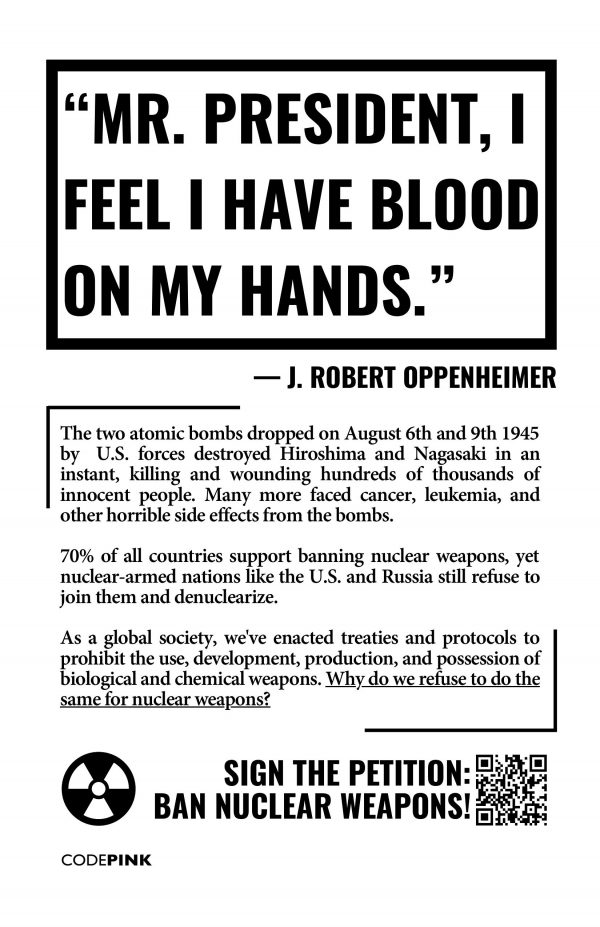
CODEPINK activists are distributing flyers outside showings of Oppenheimer to invite stunned movie goers leaving the theater in a daze to take action, to join our organization and amplify our peace-building campaigns, to ground the nuclear-capable F-35, to declare China is Not our Enemy and to partner with the Peace in Ukraine Coalition.
This is the movie, this is the moment, this is the time to challenge the euphemistic nuclear modernization program, to expose the madness of militarism that abandons urgent needs at home to line the pockets of military contractors gorging at the Pentagon trough.This is the time to demand a ceasefire and peace talks to end the war in Ukraine, to stop preparations for war with China, to finally pass legislation to ban first use, to take our ICBM’s off hair trigger alert, to abide by our disarmament obligations under the Nuclear Non-Proliferation Treaty and to campaign for the US to become signatories to the UN Treaty on the Prohibition of Nuclear Weapons (TPNW).
Opposed by NATO–a huckster for nuclear proliferation–the TPNW has been signed by 95 state parties wishing to outlaw the development, deployment and use of nuclear weapons.
Unlike Oppenheimer, we can make the right choice; the choice that saves the human race from immediate extinction.



Marcy Winograd of Progressive Democrats of America served as a 2020 DNC Delegate for Bernie Sanders and co-founded the Progressive Caucus of the California Democratic Party. Coordinator of CODEPINKCONGRESS, Marcy spearheads Capitol Hill calling parties to mobilize co-sponsors and votes for peace and foreign policy legislation.
ZNetwork is funded solely through the generosity of its readers.
Donate




