

In a recent contribution to Jacobin, Chris Maisano provides a potted history of two twentieth-century efforts at realigning the United States’ two main political parties. In one case, right-wingers succeeded in transforming the Republican Party of Dwight Eisenhower into a true conservative party, setting the stage for the party’s further-right realignment under Donald Trump.
Meanwhile, liberals, civil rights activists, labor leaders, and socialists worked to realign the Democrats in the 1960s and ’70s. Progressives did not succeed in their goal of winning a social democratic party. But they did succeed in pushing out conservative Southerners, remaking the Democratic Party from a Dixiecrat/New Deal coalition into a properly liberal organization.
The upshot of this history, Maisano argues, is that the Left today ought to embrace the strategy of attempting to realign the Democratic Party. If right-wingers could realign the Republicans and leftists could achieve a partial realignment of the Democrats, he seems to suggest, then the Left today might remake the Democrats in our own image.
But there are clear obstacles to a socialist or social democratic realignment of the Democratic Party that the Right in the GOP has not faced. One issue, alluded to in Maisano’s piece, is that right-wingers can rely on seemingly endless financial support from rich backers, and the Left cannot.
That’s just symptomatic of a deeper problem, though. The Right’s political project is entirely compatible with the interests of the ultrarich who bankroll and dominate both parties. Though some in the business class balk at Trump or far-right elements within the GOP, on the whole capital does not have sufficiently strong incentives to coordinate opposition to right-wing advance — and of course many individual capitalists can find much to like in the party’s extreme anti-worker policies and embrace of minority rule. Far-right politics are compatible with the fundamental interests of the ultrarich.
By a similar token, the fact that liberals were able to kick reactionaries out of the Democratic Party in the Civil Rights Era doesn’t give us much reason to think the party is susceptible to being realigned into a true labor party. The earlier generation of left-wing realigners like Bayard Rustin and Michael Harrington failed to do this, Maisano notes, because pro-corporate forces came to occupy a dominant position in the new Democratic coalition; that was at least in part because organized labor was beginning its long decline.
If labor could not win hegemony in the Democratic Party in that earlier era, however, things seem even bleaker today. Despite exciting organizing efforts at big corporations like Amazon and Starbucks, an uptick in strikes this year, and an increase in the favorability of unions, union density continues to decline and fell to an all-time low in 2022.
Moreover, the Democratic Party has no real mechanisms of internal democracy. That was illustrated powerfully when democratic socialists took over the Nevada State Democratic Party in 2021. Though they took over the party’s formal structures, socialists did not secure control of the Democrats’ actual power sources — the membership lists, technological tools, and donor and consultant networks. So when they were ousted from formal leadership positions, establishment Democrats simply took all those things with them, created an alternative structure, and continued to play the same role in Nevada Democratic Party politics.
So long as the Democratic Party is home to elites and there are no actual democratic processes by which members can assert influence on the party apparatus, there is little reason to think that labor or the Left can wrest control of the party from its neoliberal establishment. Even primary elections, where ordinary people have some say, are limited in what they can accomplish. Party leaders and the corporate media exert an outsize influence in these contests, and in the past have declared their willingness to override voters to choose their own favored candidate. The establishment could even change ballot-access rules to prevent socialists from running in their primaries, or bar access to important tools like NGP VAN.
There is even less reason to think that the establishment can be “brought around” to support a socialist agenda. As with the GOP, the most powerful forces in the Democratic Party are the big-money donors from corporate America and Wall Street, and their interests are at odds with the major redistribution of wealth and power that the Left wants. Capitalists can accept the social liberalism of today’s Democrats as well as they can fascism — they will less easily accept an assault on their profits and control over production.
Don’t Make a Virtue Out of Necessity
Maisano is right that the barriers to forming a third party in the United States are steep, and that democratic socialists have made major strides in building the Left by running on the Democratic Party ballot line. But it is also correct for socialists to view this tactic with ambivalence; whatever its short-term merits, it creates problems for our longer-term project.
Major reforms — like Medicare for All, a jobs guarantee, universal free college, etc. — are likely to be won only by mass grassroots disruption of the kind that birthed the New Deal and that achieved the civil rights movement’s victories. And the broader and deeper democratization of the economy that socialists want can only happen with a mass movement of working people taking to the streets and striking to wrest control of society’s productive resources from capitalists, and then starting to run things ourselves.
Historically, workers have made major steps in that direction by organizing themselves into trade unions and parties. Those organizations are an essential condition for the development of class consciousness: workers recognizing that they have common interests as a class opposed to those of the capitalists, and that they can and should take collective action to advance those interests. Socialist politicians should use their platforms and whatever legislative power they have to build that organization and consciousness.
If a left-wing takeover of the Democrats isn’t going to happen anytime soon, as Maisano hints, then socialists will have to operate as a “minority faction” within the Democratic coalition. But doing that imposes major constraints on socialists’ ability to build worker organization and consciousness. In publicly identifying as Democrats, socialists are associating themselves with decades of neoliberal rule and a brand that is toxic to millions of voters — including, increasingly, working-class voters of all races. That bodes ill for winning the support of the workers we’re claiming to represent. Breaking free of the Democratic Party label may ultimately be necessary for appealing to the working class more broadly.
The more fundamental problem, though, is that socialists can’t succeed in organizing workers on a class basis if they are constantly sending confusing signals about what they stand for and whose side they’re on. When they hobnob with politicians who support the war machine and take money from billionaires and oppose raising taxes on the wealthy and vote to break strikes — or worse, when they’re convinced to do those things themselves — socialist politicians undermine their ability to cohere working-class people around an alternative political identity and agenda. And because party leaders control access to important committee appointments in legislative bodies and access to lists of voters, donors, and campaign consultants, they have a powerful set of carrots and sticks to keep left-wingers in the Democratic fold from speaking up or acting out publicly in opposition.
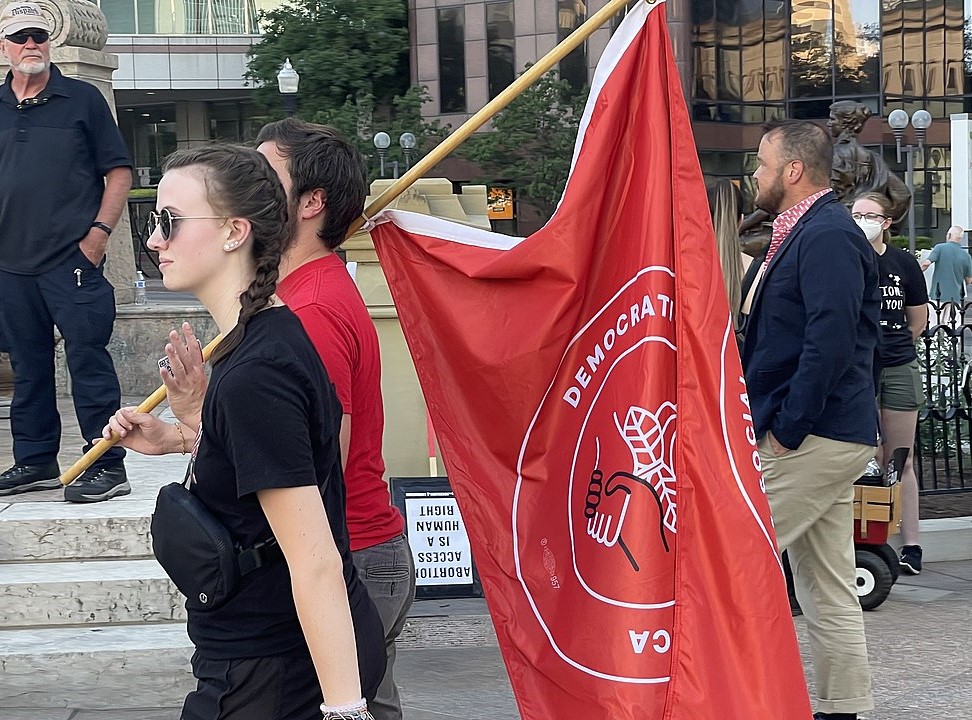
None of that is to say that the Left can or should attempt to start a new party now. But it does suggest the importance of building an independent organization and projecting an identity distinct from that of the Democrats. There are a number of things that socialist politicians can do to develop an independent identity and organization even while using the Democratic ballot line — in fact, Democratic Socialists of America (DSA) just voted to take such steps at its most recent national convention. Those include, among others:
- Developing its own lists of voters and volunteers so it wouldn’t have to depend on other organizations, including local, state, or national Democratic Party apparatuses, for those things;
- Building “Socialists in Office” committees (like the one that currently exists in New York State) across the country, so that socialist elected officials can coordinate their legislative strategy independent of Democratic caucuses;
- Creating a unified communications approach for DSA-endorsed politicians everywhere, so that socialists can publicly present themselves as an alternative to the political establishment.
We don’t know how or when the conditions for a third party in America will come about. It would likely take a big upsurge in the labor movement, and an internal fracturing of the existing Democratic Party base; indeed, many in DSA share Maisano’s skepticism that a new party is possible. But it also seems clear that building independent organization and identity is crucial to winning people over to the cause of socialism and encouraging them to fight on their own behalf.
By developing that independent party-like organization — a “party surrogate” — we can lay the groundwork for a potential new party. However, this sort of organization is likely necessary as well to maximize our political impact even while we remain within the Democratic Party, by cohering a popular base that can support socialist politicians in confrontations with party elites and help the Left win concessions from the establishment. Keeping the goal of political independence in our sights, then, may be a boon to the Left whether or not we ever get our own ballot line.
ZNetwork is funded solely through the generosity of its readers.
Donate




