


You watch. Over the weekend and on Monday, the Hallmarked memory of Dr. Martin Luther King Jr will be sanitized and blackwashed until he is no more than a sentimental husk hoping that little children of all races will one day be able to play together. Then you'll see shots of just that, as if to indicate, well, thanks, that's all done, nice historical figure. Bye. One of these years they will probably launch the USS Martin Luther King Jr, a spanking new destroyer, or perhaps they will name a class of drone aircraft the MLK Ground Dominators.
But who was this King guy? What did he really stand for and how can we most accurately and sincerely honor his name and legacy?
Martin Luther King Jr was a radical pacifist who used Gandhian nonviolence and then, with others in his movement, improved upon it. Gandhi was the Henry Ford of nonviolence, inventor of the mass liberatory action. Gatling may have industrialized warfare with his machine guns, Napoleon may have industrialized the human side with his levee en masse, but Gandhi industrialized strategic nonviolent civil society uprisings and Martin Luther King Jr improved on the model.
How did he and his folks do that?
First, they weren't so sensitive to giving away their advantage once they had earned it. When Gandhi saw the British empire stressed during various wars, he dialed back on the resistance. By contrast, in Nashville, during the sit-in movement in 1960, the students were shocked at 5 in the morning when their lawyer's home was bombed and they immediately wired the mayor, demanding a meeting, pressing him that morning and gaining his admission that segregation was wrong and his pledge to work to end it. The Civil Rights movement watched various windows open and generally shot straight through, not holding back for some gentleman's courtesy, as Gandhi seemed to do.
And MLK was more consistent than Gandhi in some key ways. Although it took him a while to do so (several years after the frontline spokespeople such as Bob Moses), King denounced the war in Vietnam, whereas Gandhi volunteered to help the British or stood aside without objection during several wars. In what was both a stirring and powerful speech delivered in the Riverside Church in New York on 4 April 1967, Martin Luther King Jr said a great deal that mightily angered the federal government, from J. Edgar Hoover to Lyndon B. Johnson, including:
Over the past two years, as I have moved to break the betrayal of my own silences and to speak from the burnings of my own heart, as I have called for radical departures from the destruction of Vietnam, many persons have questioned me about the wisdom of my path. At the heart of their concerns this query has often loomed large and loud: "Why are you speaking about the war, Dr. King?" "Why are you joining the voices of dissent?" "Peace and civil rights don't mix," they say. "Aren't you hurting the cause of your people," they ask? And when I hear them, though I often understand the source of their concern, I am nevertheless greatly saddened, for such questions mean that the inquirers have not really known me, my commitment or my calling.
This is the Martin Luther King Jr who will be invisible in mainstream media as the US celebrates the birth of a hero for racial reconciliation. But he was also a hero for peace, no war, and nonviolence, a man who died with a (peace and justice) felony on his record and yet is the only American for whom we celebrate a national holiday. Dr. King's call for peace was powerful–the best speech of his life, in my view–but it will not be featured as we pretend to pay attention to the history of his life and contributions.
If he were alive today he'd probably be in jail for resisting the occupations of Iraq and Afghanistan, or perhaps for resisting our client state, Israel's, occupation of Palestine. At the least he would be reflecting on his evolved and holistic attempt to move to the next level of activism, past the termination of Jim Crow segregation and forward to ending poverty and stopping war. He never stopped evolving but the mainstream historians have gone to the period five years before he was murdered and regard him as forever frozen there, just giving an I Have a Dream speech.
Dr. King deserves full honors; he was a fearless and brilliant campaigner for human rights, civil rights, economic justice and peace. Our young people need to know who he really was. We cannot pretend in honesty that he would support the wars and corporate bailouts featured in today's America.
~#~#~#~#~
Tom H. Hastings is Director of PeaceVoice, a program of the Oregon Peace Institute.

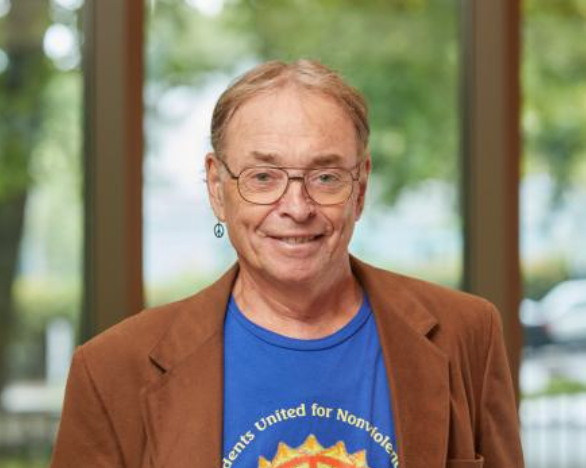
Dr. Tom H. Hastings is Coördinator of Conflict Resolution BA/BS degree programs and certificates at Portland State University, PeaceVoice Senior Editor, and on occasion an expert witness for the defense of civil resisters in court.
ZNetwork is funded solely through the generosity of its readers.
Donate




