


The Anglosphere’s political atmosphere is thick with bourgeois outrage. In the United States, the so-called liberal establishment is convinced it was robbed by an insurgency of “deplorables” weaponized by Vladimir Putin’s hackers and Facebook’s sinister inner workings.
In Britain, too, an incensed bourgeoisie are pinching themselves that support for leaving the European Union in favor of an inglorious isolation remains undented, despite a process that can only be described as a dog’s Brexit.
The range of analysis is staggering. The rise of militant parochialism on both sides of the Atlantic is being investigated from every angle imaginable: psychoanalytically, culturally, anthropologically, aesthetically, and of course in terms of identity politics. The only angle that is left largely unexplored is the one that holds the key to understanding what is going on: the unceasing class war unleashed upon the poor since the late 1970s.
In 2016, the year of both Brexit and Trump, two pieces of data, dutifully neglected by the shrewdest of establishment analysts, told the story. In the United States, more than half of American families did not qualify, according to Federal Reserve data, to take out a loan that would allow them to buy the cheapest car for sale (the Nissan Versa sedan, priced at $12,825). Meanwhile, in the United Kingdom, over 40% of families relied on either credit or food banks to feed themselves and cover basic needs.
William of Ockham, the fourteenth-century British philosopher, famously postulated that, when bamboozled in the face of competing explanations, we ought to opt for the one with the fewest assumptions and the greatest simplicity. For all the deftness of establishment commentators in the US and Britain, they seem to have neglected this principle.
Loath to recognize the intensified class war, they bang on interminably with conspiracy theories about Russian influence, spontaneous bursts of misogyny, the tide of migrants, the rise of the machines, and so on. While all of these fears are highly correlated with the militant parochialism fueling Trump and Brexit, they are only tangential to the deeper cause – class war against the poor – alluded to by the car affordability data in the US and the credit-dependence of much of Britain’s population.2
True, some relatively affluent middle-class voters also supported Trump and Brexit. But much of that support rode on the coattails of the fear caused by observing the classes just below theirs plunge into despair and loathing, while their own children’s prospects dimmed.
Twenty years ago, the same liberal commentators were cultivating the impossible dream that globalizing financialized capitalism would deliver prosperity for most. At a time when capital was becoming more concentrated on a global scale, and more militant against non-owners of assets, they were declaring the class war over. As the working class was growing in size worldwide, even though its jobs and employment prospects were shrinking in the Anglosphere, these elites behaved as if class were passé.1
The 2008 financial collapse and the subsequent Great Recession buried that dream. Still, liberals ignored the undeniable fact that the gigantic losses incurred by the quasi-criminal financial sector were cynically transferred onto the shoulders of a working class they thought no longer mattered.
For all their self-image as progressives, the elites’ readiness to ignore widening class divisions, and to replace it with class-blind identity politics, was the greatest gift to toxic populism. In Britain, the Labour Party (under Tony Blair, Gordon Brown, and Edward Miliband) was too coy even to mention the post-2008 intensification of the class war against the majority, leading to the rise across the Labour heartland of the UK Independence Party (UKIP), with its Brexit parochialism.
Polite society seemed not to give a damn that it had become easier to get into Harvard or Cambridge if you were black than if you were poor. They deliberately ignored that identity politics can be as divisive as apartheid if allowed to act as a lever for overlooking class conflict.
Trump had no compunction to speak clearly about class, and to embrace – however deceitfully – those too poor to buy a car, let alone send their children to Harvard. Brexiteers, too, embraced the “great unwashed,” reflected in images of UKIP leader Nigel Farage drinking in pubs with “average blokes.” And when large swaths of the working class turned against the establishment’s favorite sons and daughters (the Clintons, the Bushes, the Blairs, and the Camerons), endorsing militant parochialism, the commentariat blamed the riffraff’s illusions about capitalism.
But it was not illusions about capitalism that led to the discontent that fueled Trump and Brexit. Rather, it is the disillusion with middle-of-the-road politics of the kind that intensified the class war against them.
Predictably, the embrace of the working class by Trump and the Brexiteers was always going to arm them with electoral power that, sooner or later, would be deployed against working-class interests and, of course, minorities – always the penchant of populism in power, from the 1930s to today. Trump has thus used his working-class support to usher in scandalous tax reforms, whose naked ambition is to help the plutocracy while millions of Americans face reduced health coverage and, as the federal budget deficit balloons, higher long-term tax bills.
Similarly, Britain’s Tory government, which has espoused Brexit’s populist aims, has recently announced another multi-billion-pound reduction in social security, education, and tax credits for the working poor. Those cuts are matched exactly by reductions in corporate and inheritance tax cuts.
Today, establishment opinion-makers, who scornfully rejected the pertinence of social class, have contributed to a political environment in which class politics was never more pertinent, toxic, and less discussed. Speaking on behalf of a ruling class comprising financial experts, bankers, corporate representatives, media owners, and big industry functionaries, they act exactly as if their goal were to deliver the working classes into the grubby hands of the populists and their empty promise of making America and Britain “great again.”
The only prospect for civilizing society and detoxifying politics is a new political movement that harnesses on behalf of a new humanism the burning injustice that class war manufactures. Judging by its callous treatment of US Senator Bernie Sanders and Labour leader Jeremy Corbyn, the liberal establishment seems to fear such a movement more than it does Trump and Brexit.
*Yanis Varoufakis, a former finance minister of Greece, is Professor of Economics at the University of Athens. In Project Syndicate.

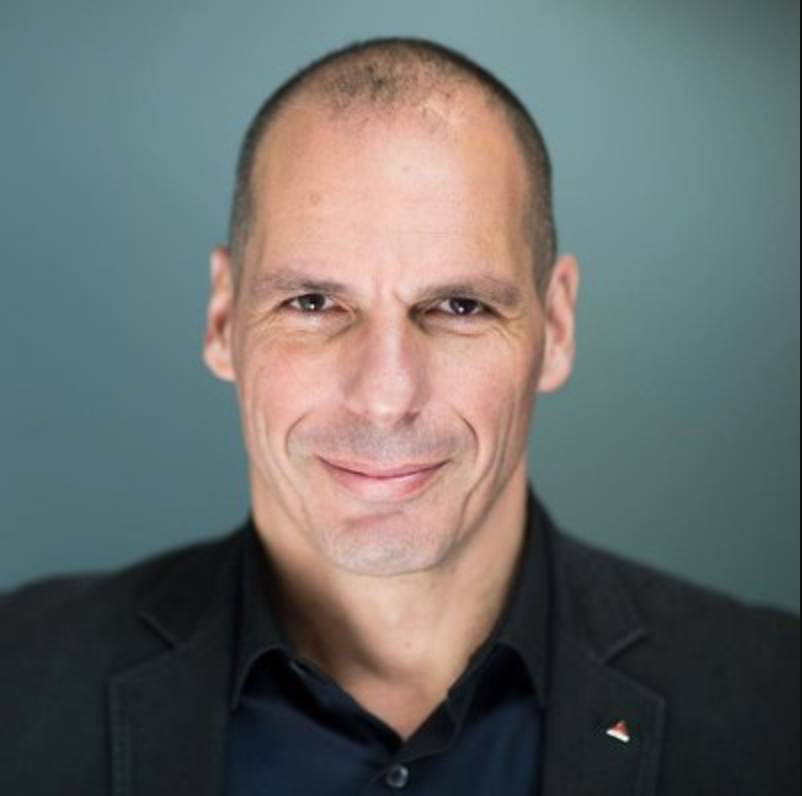
Yanis Varoufakis born 24 March 1961 is a Greek economist, politician, and co-founder of DiEM25. A former academic, he served as the Greek Minister of Finance from January to July 2015. Since 2019, he is again a Member of Greek Parliament and MeRA25 leader. He is the author of several books including, Another Now (2020). Varoufakis is also a professor of Economics – University of Athens, Honorary Professor of Political Economy – University of Sydney, Honoris Causa Professor of Law, Economics and Finance – University of Torino, and Distinguished Visiting Professor of Political Economy, Kings College, University of London.
ZNetwork is funded solely through the generosity of its readers.
Donate




