

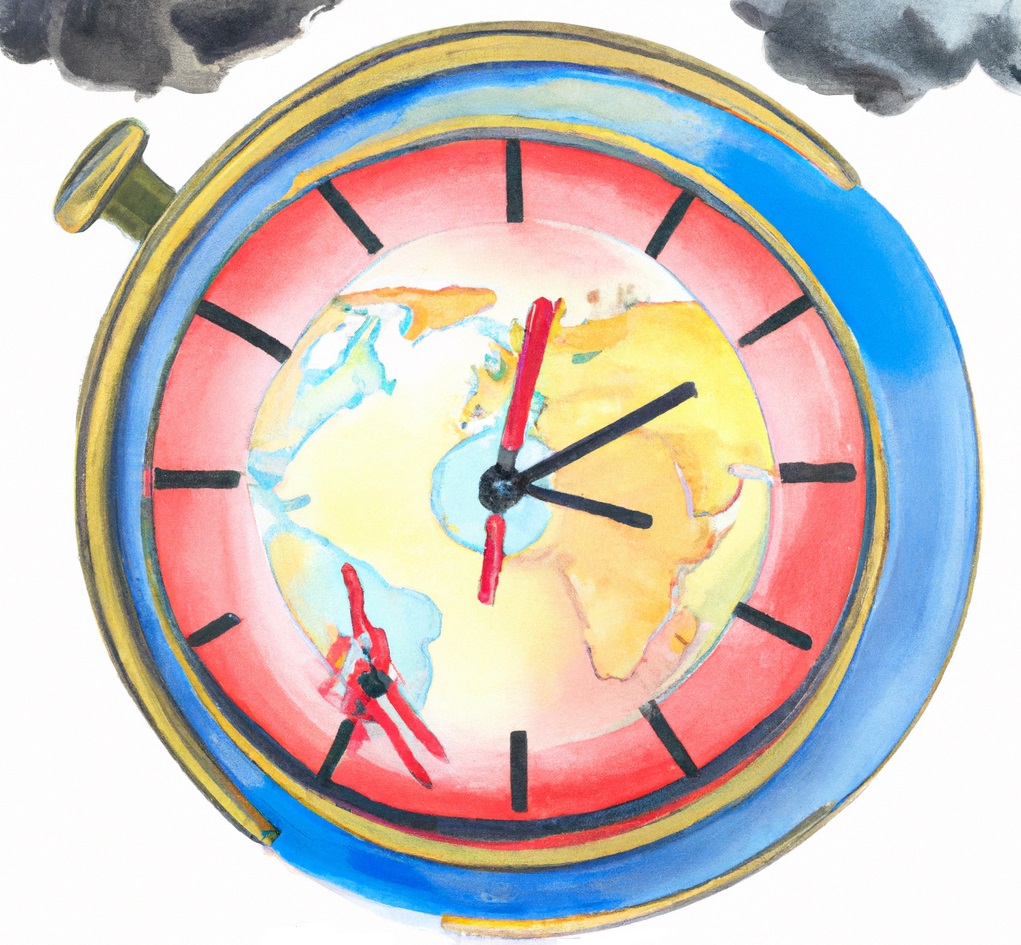
The odds are against us. That is the bottom line in the latest IPCC report of the Intergovernmental Panel on Climate Change (IPCC) on global warming, the most comprehensive scientific report to date. Once again we are told that 2030 is the year of living dangerously—when humanity must cut greenhouse gas emissions in half, and then proceed to stop them altogether by 2050.
Otherwise, the planet faces all the climate catastrophes we’re already witnessing evolve. “The climate time bomb is ticking,” said the UN’s secretary-general. “The rate of temperature rise in the last half-century is the highest in 2,000 years. Concentrations of carbon dioxide are at their highest in at least two million years.”
The chances of holding global warming to 1.5 degrees C., which scientists tell us is the aim if we are to survive those catastrophes, are very small. The planet has already warmed to 1.1 degrees C. above pre-industrial levels, and every year we see heat records being set around the world.
Another major part of the problem is national interests: Governments will violate their pledges on climate change whenever their economies need pumping up—such as China’s decision to permit 168 new coal-fired power plants to be built, or the US decision to go ahead with the Willow oil drilling project in Alaska.
Then there is the refusal of populations, especially in the richest countries, to change their habits. They (we!) want more plastic packaging, more air conditioning, more access to food from far away, more oil and gas, more lumber from old forests, more water to combat the drought they helped create, more homes where they shouldn’t be built, and more government bailouts when things go wrong.
More Bad News
Climatologists are not saying that the world will end as we approach 2.0 degrees C. of warming. What they are saying is that living conditions for nearly everyone will be profoundly affected by changes in weather, including health and safety for many millions of people and other species.
We are all aware of what those changes will probably be, but they are regularly updated, invariably with worse news than before. For example (the quoted words are from the IPCC report):
- The rich-poor gap in greenhouse gas emissions (GHG) continues to grow: “The 10% of households with the highest per capita emissions contribute 34–45% of global consumption-based household GHG emissions, while the bottom 50% contribute 13–15%.”
- Food and water security is endangered: “Roughly half of the world’s population currently experience severe water scarcity for at least part of the year due to a combination of climatic and non-climatic drivers.” As many as 2.4 billion people will experience water scarcity by 2050, and millions more will not have access to safe sanitation in water supplies.
- Extreme heat is responsible for increased deaths, water-borne diseases, and displaced persons in all world regions. “Compound heatwaves and droughts are projected to become more frequent . . . Due to relative sea level rise, current 1-in-100 year extreme sea level events are projected to occur at least annually in more than half of all tide gauge locations by 2100 under all considered scenarios. Other projected regional changes include intensification of tropical cyclones and/or extratropical storms, and increases in aridity and fire weather.”
- Every increment of global warming increase will increase the risks and make them more difficult to manage. “Multiple climatic and non-climatic risk drivers will interact, resulting in compounding overall risk and risks cascading across sectors and regions. Climate-driven food insecurity and supply instability, for example, are projected to increase with increasing global warming, interacting with non-climatic risk drivers such as competition for land between urban expansion and food production, pandemics and conflict.”
Good News, But Not Enough
As usual, the IPCC report does mention multiple ways in which adaptation and mitigation can affect climate change. All are quite familiar, such as more efficient use of resources, better forest management, carbon capture of fossil fuels, sustainable land use, electric vehicles, and more efficient buildings. There’s never been a problem imagining a net-zero carbon world. Here and there, these changes are being accepted. But for every piece of good news, there’s an “on the other hand.” For example:
- From 2035 on, new gasoline-powered cars and most heavy trucks cannot be sold in California, and only zero-emission cars can be sold in New York. That’s two big states, but it leaves 48 others.
- Greenpeace reports that an international group is now putting together a legally binding Global Plastics Treaty. (Worst offender? Coca-Cola.) But only a tiny fraction of plastics is being recycled, and more than 170 trillion plastic particles are found in the ocean alone.
- The soft-energy path is catching on. As the IPCC reports: “From 2010– 2019 there have been sustained decreases in the unit costs of solar energy (85%), wind energy (55%), and lithium ion batteries (85%), and large increases in their deployment, e.g., >10x for solar and >100x for electric vehicles, varying widely across regions.” But: “Public and private finance flows for fossil fuels are still greater than those for climate adaptation and mitigation.” Any wonder why oil and gas company profits are at their highest level ever? BP, for example, reported $28 billion in profits in 2022, and ExxonMobil reported $56 billion in profits. These companies have, without embarrassment, announced they will be scaling back commitments to move toward renewable energy.
- The Macron government in France is the first to support a ban on deep sea mining. Will any others follow suit?
The Sky is Falling
This latest IPCC report was approved by 195 governments, and synthesizes the results of countless other scientific reports as well as summarizes its six previous assessments. Yet many people read them (if at all) as just more dire predictions that are either overly pessimistic or best left to future generations to deal with.
Thus, the IPCC contributing authors keep issuing warnings, governments keep making dubious promises, and worsening environmental conditions keep multiplying. We’re approaching a tipping point, but no authority exists to stop our passing it.
This time, the sky really is falling.
—————————
Mel Gurtov, syndicated by PeaceVoice, is Professor Emeritus of Political Science at Portland State University and blogs at In the Human Interest.
ZNetwork is funded solely through the generosity of its readers.
Donate




