


“My recovery may be a joke to Dr. Oz and his team, but it’s real for me,” said John Fetterman, Pennsylvania’s Democratic lieutenant governor, in late August. It had been roughly three months since he had, in quick succession, suffered a stroke that nearly killed him and clinched his party’s nomination to represent Pennsylvania in the U.S. Senate. Mehmet Oz, a TV doctor and Fetterman’s Republican opponent, invited him to a series of five debates while he recovered. Fetterman declined them all.
In the two months since, the candidates in one of the hottest Senate races in the country have still never engaged face to face. They’ve instead battled on the internet, where a laid-up Fetterman put out content — much of which he crafted himself — fresh enough to break through the miasma on Twitter. Oz, meanwhile, seized on Fetterman’s fitness, emphasizing the reluctance to debate. They will finally do so on October 25, just two weeks before the election.
The Oz campaign’s urging may seem mean-spirited, especially considering that the Republican is a retired cardiothoracic surgeon and experienced TV personality with teams of paid handlers to help him appear suave on screen. But the fact that the candidates have not confronted one another on substantive policy issues is significant. Pennsylvania is a crucial swing state, often looked to as a barometer for the rest of the country. It has grabbed headlines repeatedly for questions governing crime, labor, and industry. And yet, neither of its next potential senators has expressed much of a vision that wouldn’t fit in a meme.
That a race which politicians and strategists have anticipated for years has become so vapid tells us more about modern American electoral politics than any of the nonstop horserace polling could. Substance is a liability, and the base is everything. Social media is an attractive battleground. The soundbite has been replaced by the meme war.
While Fetterman has campaigned aggressively on weed legalization, commonsense gun control, and preserving the right to abortion, he has seldom engaged Oz on the issues. That’s partially because Oz himself is campaigning on little other than “putting Americans first,” a slogan whose strength lies in its lack of meaning, and attacking Fetterman as a socialist who wants to let convicted murderers run wild. But Fetterman has the opportunity to confront voters with what Pennsylvania could look like with Oz in the Senate — what “reversing Biden’s failed agenda,” as Oz promises, would mean for wages, health care, and unemployment rates, or why having another self-proclaimed “pro-life” senator could destroy the lives of countless people across the state, not to mention the country.
Rather than try to reason with Oz’s attacks, Fetterman’s campaign has conjured a steady stream of its own hits. The strategy, which started out with simple jabs at Oz for living in New Jersey, has evolved into a series of viral tweets and videos that have made a mockery of his campaign and driven Fetterman’s fame and fundraising haul to new levels.
The soundbite has been replaced by the meme war.
Pennsylvania voters driving last week near Lincoln Financial Field, the home of the Philadelphia Eagles, would have seen a billboard telling them that Oz is a Cowboys fan. Earlier this month, Fetterman’s campaign blitzed its email lists with news that experiments overseen by Oz killed upwards of 300 dogs. There was the picture of Oz posing with fans at a PennState tailgate: The candidate sipped red wine under a tent while the young attendees stood drenched in rain holding red Solo cups. And the “crudité” debacle, which Fetterman’s campaign maneuvered into another example that Oz is an out-of-touch millionaire and capitalized on for a self-described $500,000 fundraising boon.
Fetterman’s adoption of some of the low-balling tactics that might seem more fitting for a vacuous TV personality like Oz has not, however, definitively proved to be successful. Even as his aggressive social media strategy nets national supporters and donors, new polling in recent weeks has shown Fetterman’s lead over Oz cut in half since August. If he fails, Republicans will gain one more seat in the Senate, one more likely vote in favor of draconian crackdowns on rights from abortion to education to voter access. And if he wins, where will he stand among the Democrats?


Supporters react as Democratic candidate for Senate John Fetterman speaks during a rally at Nether Providence Elementary School on Oct. 15, 2022 in Wallingford, Pa.
Photo: Mark Makela/Getty Images
The page that Democrats are encouraged to take from Fetterman covers tone: He seems accessible, relatable; the press loves to point out his blocky tattoos and hulking height. As he goes gleefully for the kill in widespread and well-liked tweets, once-fashionable concerns about “populism” seem to fade. He has been pitched as the antidote to help Democrats speak to the “white working class” they’ve long sought after.
Pennsylvania ultimately decided the 2020 presidential election for Joe Biden, and voters in Philadelphia played a significant role in that win. Many of them were driven by issues of police brutality, racial justice, economic inequality, and criminal justice reform.
Likely appealing to those voters in the primary, Fetterman has long embraced the populist style taken up by politicians like Sen. Bernie Sanders, I-Vt., who he endorsed for president in 2016 but not in 2020. The attitude is typically associated with a suite of left-leaning priorities that have come to define the progressive movement: Medicare for All, a Green New Deal, sweeping reforms to the criminal justice system, and a rethinking of U.S. foreign policy. These days, his campaign seems light on those topics.
With Medicare for All falling out of fashion, Fetterman’s campaign website advocates “any legislation that gets us closer to the goal of universal healthcare coverage.” He has said that, while pushing a transition to clean energy, he supports fracking and preserving jobs in the natural gas industry — a contradiction to the core tenets of a Green New Deal. While Fetterman has been vocal on his commitment to criminal justice reform — the Philadelphia Inquirer proclaimed in May that “John Fetterman ran the Board of Pardons like an activist” — his platform shies away from any specific proposals outside of sentencing reform and diversion programs. And on foreign policy, he appears firmly within the mainstream: One of the specific stances he’s articulated is his “unwavering” support for Israel.
In his home state, Fetterman has so far stayed away from one of the most influential political fights of the moment. As Republican lawmakers in rural parts of Pennsylvania fast-track efforts to impeach reform-minded Philadelphia District Attorney Larry Krasner, Fetterman, in his capacity as lieutenant governor, has refused to weigh in. In an interview Tuesday with Semafor, Fetterman said he agreed with Krasner on some issues but disagreed on others. “I think we need to be having a better relationship with the police,” he said, “and making sure that the police feel they feel supported by the DA.”
Fetterman’s campaign did not respond to The Intercept’s request for comment.
At least to a point, Fetterman’s strategy seems to be working, if fundraising and social media metrics are to be believed. Pennsylvania voters outside of Philadelphia and Pittsburgh are notably conservative, and engaging in wonky policy debates with Oz may risk tarnishing the man-of-the-people image Fetterman has pushed. So maybe the Pennsylvania Senate race is just not about policy. And maybe that’s OK.
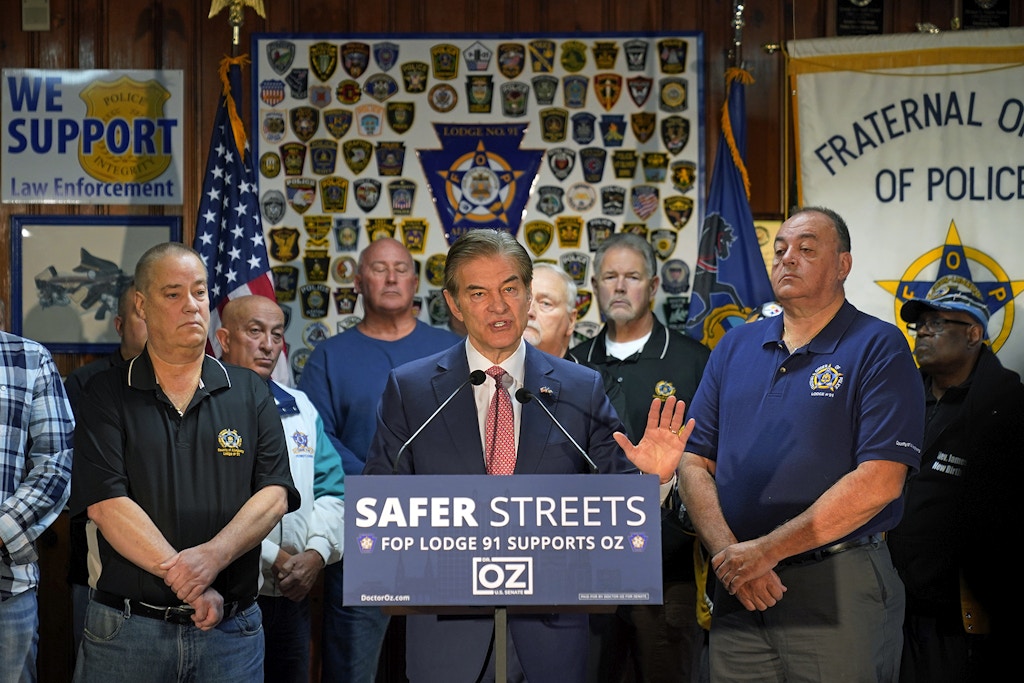
Dr. Mehmet Oz, Republican candidate for Senate in Pennsylvania, visits the Fraternal Order of Police Lodge 91 in West Homestead, Pa., on Oct. 18, 2022.
Photo: Gene J. Puskar/AP
Once the shit-posting and media tours are over, of course, someone will actually be tasked with representing the state of Pennsylvania in the Senate. And regardless of all the theorizing about messaging tools and toxic topics, the future senator’s constituents will have real challenges they expect to be addressed. Ahead of this year’s midterm elections, Pennsylvania voters ranked the economy, abortion rights, and climate change among their top concerns. One candidate will arguably do a better job representing their interests on those issues than the other. But that’s not the case that’s being made.
Most Read
Oz, for his part, has resorted to running lurid attacks on multiple fronts. For weeks, he and his Republican allies have been painting Fetterman as “soft on crime,” dropping an ad in August that claimed “John Fetterman wants to free murderers.” And while none of that is true, it appears to be having an impact. As Fetterman’s lead in polls has dipped, some strategists, Democratic officials, and media outlets have credited the attack ads.
If the millions spent on the race in Pennsylvania reflect its importance as a bellwether, where are we left when the lessons learned primarily have to do with tone and not with policy? No matter the winner in November, immediate takeaways will likely run along these lines: If it’s Oz, voters wanted someone tough on crime, and if it’s Fetterman, voters wanted someone who could connect with “regular” people. But any analysis that overlooks the banality of recent months will be at best, an overstatement, and at worst, the kind of revisionist history that keeps real substance out of politics.
“Politicians spend so much time arguing about things that don’t matter,” Fetterman says in a campaign ad released Friday. “I’ll always be focused on what does.” It’s a reminder of what’s at stake — but one absent a definition.
Perhaps an alternate strategy would fare worse, and Fetterman’s vague approach is the safe one. Perhaps his campaign finds it too risky to distinguish his vision of criminal justice reform from the one Oz is trying to paint or to give voters a clear picture of what life might look like Oz in the Senate. Some might call it cutting through the “poll-tested bullshit.” Others might call it dumbing voters down.

ZNetwork is funded solely through the generosity of its readers.
Donate




