

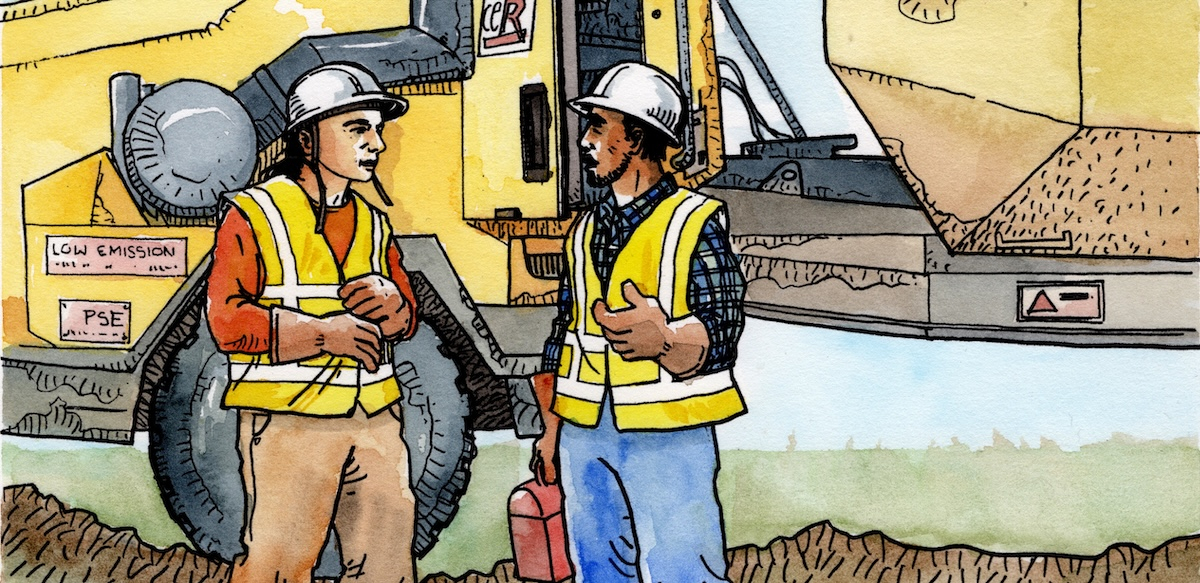
Solidarity among co-workers is your source of power against the employer. And one essential ingredient for solidarity is respect.
In the workplace we typically don’t experience respect—we experience coercion. No matter how much the boss may call us “partners” or claim “we’re a family here,” the employment relationship is fundamentally undemocratic: The employer makes the decisions, and workers are required to comply.
The union must be different in its DNA. Starting with the first building block of organizing, the one-on-one conversation, your goal is to show your respect for your co-workers.
You’re inviting them into the process of building a powerful, democratic union—one where their values, their experience, their ideas, and their contributions matter. You’re inviting them to become a fellow organizer.
WHAT BINDS US
When you talk to your co-workers as an organizer, your goal is not to become friends, though that may happen. And you’re not trying to build relationships only with people who share your values or political views, though you may find some and consider them allies.
What you are doing is attempting to build relationships of solidarity. You and your co-workers might be different in lots of ways that could divide you, such as race, gender, age, or job title; it’s easy to get caught up in who you like or don’t like, who’s a good worker or a slacker, who is a suck-up, who is ambitious or lazy, who is helpful or toxically competitive, on and on.
But despite all these judgments there is a single bottom-line fact that, once recognized, can bring workers together: “We all work for the same employer, so we are bound to one another. If we want to change anything here, our best hope is in working together.”
Developing this understanding of our common interest is the key to overcoming divisions. The strength that workers have is our numbers and our unity. To build power, we’ll need to build relationships with all sorts of people.
Be honest with people about why you’re talking with them, and why you’re so curious about their experiences and insights. For example: “I don’t think things are going well here. I want to solve problems. I want our union to be better.” Does that sound like you have an ulterior motive? Quite the opposite. You’re sharing your values and showing your honesty.
You can do all this—show respect, build a picture of who each co-worker is, and develop relationships of solidarity—all the time, with everyone, in your most casual and your most profound interactions.
BE CURIOUS
One of the most useful qualities an organizer can cultivate is curiosity. You actually want to know something about the person you’re talking to.
For that you’ll need to listen, rather than doing most of the talking yourself. Many organizers suggest that you listen 80 percent of the time and talk 20 percent. But curiosity goes deeper than that.
Really listen—and not just for an opening to make your pitch. Give yourself over to the kinds of questions you would ask if you were at a party, meeting someone you genuinely liked for the first time. Everything they’re talking about is stuff you’ve been thinking about too. You keep asking questions because what they have to say is so compelling to you.
You don’t have to fake it. People who are motivated to make their union more democratic tend to be curious about their co-workers, even those they don’t much like. You are not going to like all of your co-workers, but you can still try to find something that connects you with them. Allow this warm interest in each and every co-worker to spring naturally from your commitment to building a stronger union.
ANSWERABLE QUESTIONS
Start by asking people questions that they will know the answers to and can speak confidently about. This doesn’t necessarily mean asking people to list their problems at work. In fact, that may not be a question they can easily answer. Many people don’t spend time thinking about problems because they don’t think anything can be done to change things. They feel powerless.
So, in the beginning of the relationship, after you’ve gotten to know someone a bit—where they live, what’s their family situation, what’s important to them outside the job—it’s good to let them tell you about their work. You could ask questions like:
- What do you do here?
- How long have you been here?
- How did you end up working here?
- What do you think about this place?
- What do you like about this job?
- Do you get to know the people you work most closely with?
- What do you think of the boss?
- What bothers you about working here?
- Are you thinking about leaving?
- Have you had better jobs or worse jobs in the past?
- Have you ever tried to do anything to improve things?
- What were the results of that?
- Who do you look up to in the workplace?
- Who do you trust?
- Who don’t you trust?
None of this is small talk. All of it will help you get a sense of who this person is, in the context of this workplace. You are building up a picture of what it might take to invite this person into a collective process—that’s your goal. Very often the minimum thing it would take is their feeling that there is someone in the union who has shown them some respect!
LISTEN FOR UNION VALUES
Respect is about the character of the interaction; it’s not about following a script. Good organizing begins with the belief that each co-worker has dignity, can think and plan, and can cooperate with others to fix problems.
Without this belief, we will default to expecting someone else to fix our problems—maybe the boss, maybe HR, maybe some charismatic politician. But that won’t work, because in reality, these people are taking care of their own problems, not ours.
One way you might show your co-worker respect is by simply finding out how they’re doing and especially what they are doing. It may seem that a co-worker is apathetic, clueless, or resigned to bad conditions. But in truth, nearly everyone will have tried something to protect themselves, improve things, or help others on the job.
You are looking for that special ingredient—it’s going to be there in almost everyone you meet—that shows that they share a union value, such as compassion, cooperation, or independent thinking. When you see even a smidgeon of that, ask more about it!
For example:
- I noticed you rolling your eyes when the supervisor was describing the new procedure. What was on your mind?
- You were really helpful when I ran into that problem. How did you figure that out?
- I saw you remind our new co-worker that she didn’t have to take overtime work, even though the boss was pressuring her. How did that go?
- How do you manage to avoid all the cliques at work? It seems you’re fair with everyone.
And keep it honest. Don’t pander or flatter; just follow your own curiosity and respond to the leads you are offered in the conversation.
This kind of dialogue can be great for understanding your co-workers’ values, motivations, and what they really care about. This is where you can find common ground and expand on it. Begin with the idea that your co-workers have dignity and deserve a say in their own lives, and you’ll start to see the path to building collective power.
This article is excerpted from the new Labor Notes book Keep Going: A Guide to Organizing When It’s Hard, by Ellen David Friedman, a veteran organizer who serves on the board of Labor Notes. Order here.
ZNetwork is funded solely through the generosity of its readers.
Donate




