


This is Part 1 of a two-parter, about how the housing crisis causes debt-bondage and wage-slavery, and how the housing Commons can release people from debt and give them freedom to do what they know needs to be done.
Part 2: how the housing commons can solve the housing crisis.
In Stroud Commons, we’re looking to find ways to speed up the building of the commons – especially the housing commons, which we were talking about in terms of ‘the rock on which the commons can be built’ before we’d even formed the core group in Stroud. Dil Green of Mutual Credit Services (MCS – who design models for the commons in all sectors), posted a message in our chat group, giving his take on the housing crisis, and how we might speed up the housing commons by allowing / helping / encouraging people to put their house into the commons, and carry on living in it for the rest of their life – and pass it on to their family, too. They’d be able to free up cash (like equity release, but without having to go into more debt), they could retire early, maintenance of the property would be taken out of their hands, and as they get older, commoners will visit regularly to chat, check they’re OK and see if they need anything. Freed from debt-bondage and wage-slavery, and with greater security, people will have more time. And they would spend it on things they know need to be done.
We’ve turned the thread into a 2-part article. Part 1 is about the housing crisis, and Part 2 is about how the housing commons can help solve it.
First, let’s look at the problem:
How the housing crisis causes debt-bondage and wage-slavery
There is a housing crisis in the UK, but it’s not the way the papers frame it – which is all about numbers of houses, nimbys, building on the green belt or building council houses – it’s not a supply problem, really – it’s a distribution problem, caused by over-inflated prices.
The reason we’re told it’s a supply problem is because there is so much money (and employment) in housing development, and because the UK finance system is hooked on mortgage income. All politicians (even the Greens) seem gung-ho on building more houses. But house building is an enormous cause of CO2 emissions and other environmental degradation. Surely, we should be looking to solve the distribution problem – dealing with house prices – before digging up the green belt?
The graph shows UK house price inflation in blue and population growth in green; clearly, this is not a simple supply/demand relationship. It is best described as a government sponsored ‘Ponzi scheme’ – where the ‘too good to be true’ rewards are paid for by ‘greater fools’ joining in – until the whole thing crashes. Similar schemes are under way in every country across ‘the West’.

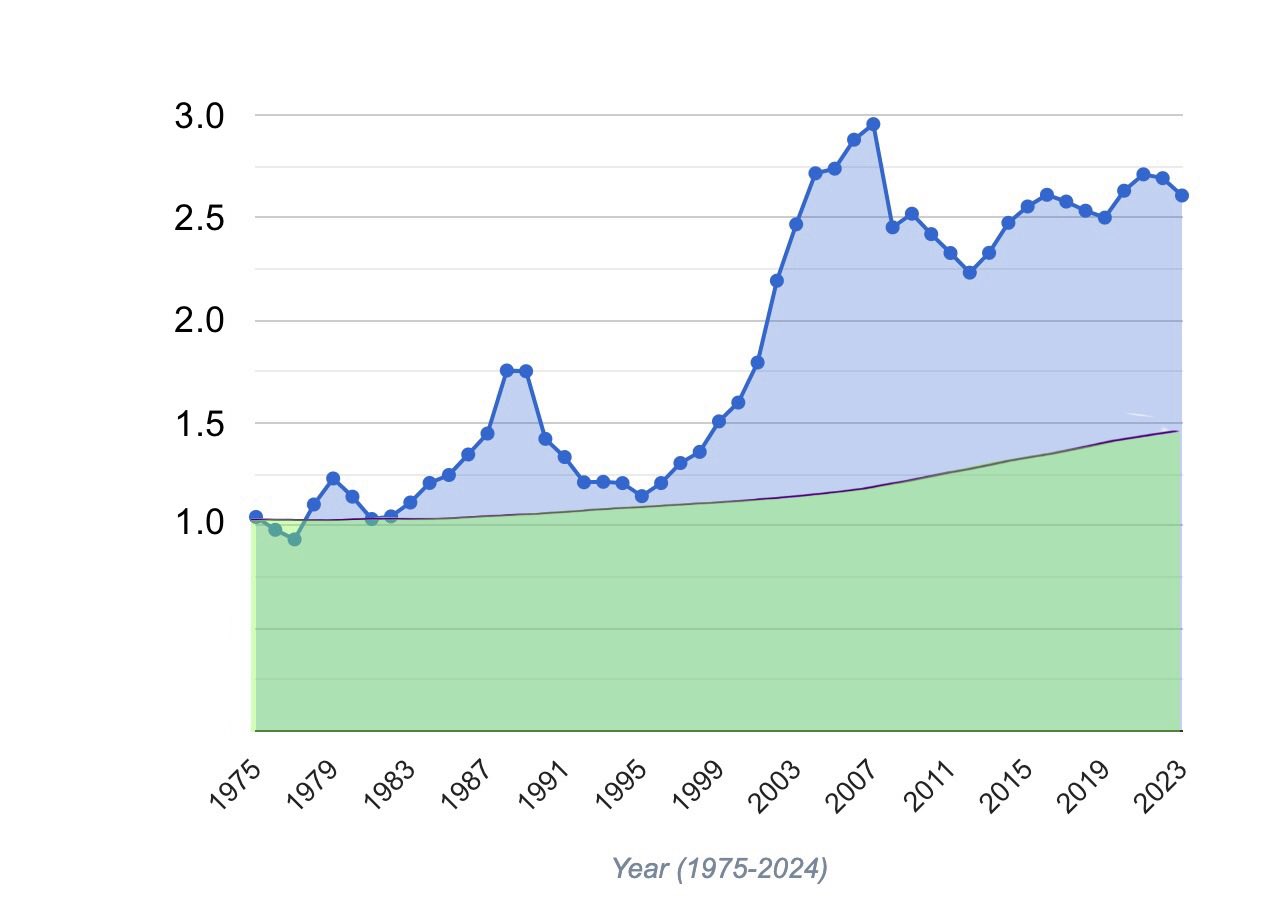
Over the last fifty years, the cost of having a secure place to live has eaten up a larger and larger fraction of people’s income. Over the period of the graph, the price of UK housing has approximately doubled in relation to earnings.
This has gone hand-in-glove with the campaign to turn more and more people into ‘home-owners’ – aka slaves to mortgage debt for most of their working lives.
Employers are told – ‘if you want a reliable worker, look for someone with a mortgage and 2 kids’. Why? Because they will undergo almost any pain in order to provide a safe place for those kids to live, and they are already in debt-bondage. Wage-slavery comes as part of the package.
The ‘reward’ for participation in this programme has been the enrichment of a small fraction of the population – those lucky enough to get onto the ‘ladder’ early on (ie at least 20 years ago). The problem with this is that the upwards escalator of house prices cannot carry on forever – there is only so much of your income that can be allocated to a place to live, and it’s already too high for most. Those rewards are simply not possible for most people under the age of 40.
The 2008 crisis was triggered by the housing market in the US, and that instability is not going away – there will be other crises, and soon. In the UK, the ‘value’ of the housing stock is now considered to be somewhere between £7-8 trillion – around £200,000 per working person (about half of us). Since we all buy our houses on debt, and mortgages double the initial price of the houses we (and landlords) buy, that suggests that every working person will spend £400k on having somewhere to live in their lifetime – but the average lifetime income is only £570k! Something has to break.
The Housing Commons offers a way out of this mess, a way which diminishes debt-bondage and wage slavery, de-risks the housing finance system, and does not attack individuals who ‘got lucky’ (after all, their lives have already been spent in wage-slavery and debt-bondage).
But there’s more. If we can, even by a fraction, free people from debt-bondage and wage-slavery, it will liberate them to do what, deep down, they know they want to do – work to secure their and their children’s longer-term future.
Part 2: how a housing commons can address and help solve the housing crisis – very quickly, by allowing people to put their homes into the commons, but be better off, and with lots of practical and social benefits.
ZNetwork is funded solely through the generosity of its readers.
Donate




