


It’s not for nothing that the elimination and distortion of popular historical memory has always been a central project of totalitarianism. The accurate and widespread understanding of the past is critical for effective popular government. Like an individual who loses her memory, a citizenry that lacks a rich and truthful record of prior experience is easy prey for authoritarian misleaders, who write their special “elite” interest into the great narratives that provide meaning and direction to shared human experience.
History, the real unvarnished story, is a great tool of democracy. It is a vast reservoir of healthy skepticism, inspiration, counsel, warning, and hope. Mass popular amnesia is a great weapon of authoritarian rule.
Those of us who are determined not to abuse, disregard, distort, and delete the real past have been watching in discomfort as the right-wing United States government and the American “mainstream” (corporate-state) media conduct a distorted, amnesiac, sickeningly sweet commemoration of Ronald Reagan.
In the spirit of honoring the dead, we have been instructed to bite our historical tongues. We are told to play along with a great, politically crafted ritual of mass national amnesia. “Now it not the time,” we are lectured, in the name of proper patriotic decorum, to remember:
– the tens of thousands who lost their lives to Central American state-terrorist repression funded, protected, and directed by the Reagan administration
– the Reagan administration’s bloody, terrorist campaign against attempted social democracy and national self-determination in Nicaragua
– the Reagan administration’s revolting embrace of South Africa’s racist apartheid state and numerous other authoritarian, Third World fascist forces like the neo-Nazi military junta in Argentina, Duvalier in Haiti, Marcos in the Phillipines, Mobutu in Zaire, Pinochet in Chile, and, curiously enough, Saddam Hussein in Iraq
– the Reagan administration’s sponsorship of deadly extremist Islam in Afghanistan and beyond
– the Reagan administration’s winking enablement of the massacre of thousands of Palestinians at the Sabra and Shatila refugee camps in 1982
– the Reagan administration’s deep corruption, seen in the Iran-Contra scandal (for which Reagan never apologized) and the hugely expensive (for taxpayers) Saving and Loans debacle
– the Reagan administration’s brutal, racist, and corporate-plutocratic homeland assault on the domestic social safety and social contract, an attack that targeted and significantly rolled back labor, welfare, economic and environmental regulation, and civil rights.
The Reagan administration significantly advanced the toxic far-right corporate-fundamentalist agenda at home and abroad. That agenda was implemented with great success. Its conscious mission was to starve the state’s positive social-democratic functions and concentrate power and wealth into few and fewer hands. The right, repressive, militarist, carceral, and plutocratic/state-capitalist hand of the state was fed and strengthened in the name of the “free market” “Reagan Revolution.” Domestically, the “revolution” returned inequality to 1920s peaks, all in the name of “the little guy.”
Sorry, but that’s more forgetting than my American blood can withstand, even after many hours spent in front of my nation’s ubiquitous, amnesiac television and movie screens.
Again and again, in recent days, I’ve heard and read reporters make references to Reagan’s youthful employment as a lifeguard in Dixon, Illinois. Reagan was once a lifeguard: that’s a simple, accurate fact we are all supposed to remember. As president, we are supposed to forget, Reagan helped push masses under the deep, dark waters of empire and inequality.
Never more than a figurehead for the implementation of plutocratic and imperialist policies he barely understood, Reagan was blissfully indifferent to these drowning others, certain that he would be rewarded for his service to the great white rich men who rule the world and profit from what Marguerite Feitlowitz called “the entrenched politics of impunity and amnesia” (Feitlowitz, A Lexicon of Terror: Argentina and the Legacies of Torture [New York, NY: Oxford University Press, 1998], p. 255). The pomp and circumstance of his extravagant, expensive state funeral is part of his prize, full of contemporary political significance.
Telling us to forget the real history of Reaganism is what we expect America’s Big Brothers of the right and center to do. It is consistent with their Orwellian essence, reflecting a totalitarian, mind-colonizing imperative that has always lurked behind the smiling face of imperial and capitalist “democracy.”
Paul Street (pstreet99@sbcglobal.net) is a writer and researcher in Chicago, Illinois.

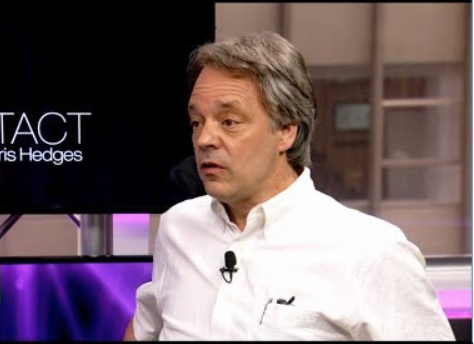
Paul Street is an independent radical-democratic policy researcher, journalist, historian, author and speaker based in Iowa City, Iowa, and Chicago, Illinois. He is the author of more than ten books and numerous essays. Street has taught U.S. history at numerous of Chicago-area colleges and universities. He was the Director of Research and Vice President for Research and Planning at the Chicago Urban League (from 2000 through 2005), where he published a highly influential grant-funded study: The Vicious Circle: Race, Prison, Jobs and Community in Chicago, Illinois, and the Nation (October 2002).
ZNetwork is funded solely through the generosity of its readers.
Donate




