

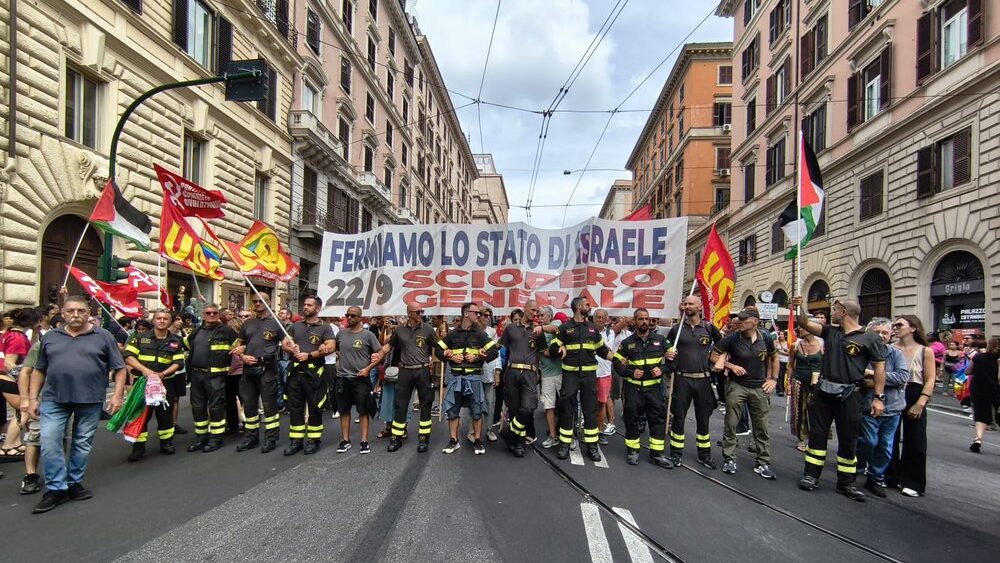
On September 22, approximately one million people across Italy staged a general strike in support of Palestine and the Global Sumud Flotilla, offering a vision of solidarity sharply at odds with the one displayed by European leaders at the United Nations these days. Ports, train stations, and major junctions were shut down as workers, many of whom members of the grassroots union Unione Sindacale di Base (USB), brought the country to a halt.
In Rome alone, 300,000 demonstrators occupied the city’s main railway hub before marching through the streets. “The call came from Genoa’s dockworkers, and here we are: we’ve blocked everything,” the protesters proclaimed. Among those leading the crowd were firefighters’ union representatives, who told il manifesto: “First responders will never be complicit in genocide, and we are protesting a government that is entrapping us in rearmament.”
Port cities against arms trade and genocide
Earlier this month, as the Global Sumud Flotilla prepared to launch, members of the dockworkers’ collective CALP in Genoa vowed to halt port operations if Israel attacked or blocked the fleet. Weeks later, following continuous local mobilizations and public assemblies, they made good on their promise. Thousands shut down Genoa’s port from the early morning hours, joined by workers in the strategic harbors of Trieste, Venice, and Livorno. Rallies erupted in Bologna, Milan, Turin, Naples, across Sicily and Sardinia, and in dozens of other localities, where teachers, parents, and students walked out of schools together, chanting for a free Palestine.
Speaking from the Genoa blockade, Marta Collot of the left party Potere al Popolo stressed that the strike demonstrated concrete solidarity with Palestinians, affirmed support for their legitimate resistance, and denounced European complicity in genocide. “Embargo and sanctions: these must be our priorities,” Collot said.
Authorities responded to the massive mobilization with violence. Police forces used water cannons against protesters demanding an end to Italy’s arms trade with Israel and calling for severing all political and economic ties. Despite growing public pressure, Giorgia Meloni’s government has refused to act against Israel, instead continuing communications with Israeli officials and arms deliveries through the state-linked company Leonardo.
Only days before the strike, Infrastructure and Transport Minister Matteo Salvini, leader of the far-right Lega, appeared in an interview with Israeli media, in which he supported Israel’s “right to build itself a serene future” as occupation forces inflicted even more destruction upon Gaza City. In its campaign “to build a serene future,” Israel has killed at least 65,000 Palestinians in Gaza, including over 1,000 health workers and hundreds of journalists. While some government figures signaled mild unease about recent attacks, Salvini set out his allegiance in very clear terms: “Defending Israel’s right to exist is complicated right now, but friends are revealed in the most difficult moments.”
In some strike locations, protesters singled out Salvini’s statements in their speeches. In Venice, they sent what they termed a special message to “a special enemy,” insisting that their loyalty was with Palestinians under attack and their energy committed to building international solidarity.
International solidarity is “alive and kicking”
The mass character of Monday’s strike likely shook much of Italy’s political class. In recent years, the government had passed measures to restrict demonstrations and downplayed the organizing capacity of trade unions and the left. Yet weeks of continuous protests culminating in the general strike undermined these efforts.
“Workers have returned to center stage and are calling on citizens, all citizens, to stand up. They are not doing so for a contract renewal but to demand justice for a distant and tormented people,” USB declared on the day of the strike. “In this age of selfishness and individualism, this seems unthinkable. But no, solidarity between peoples and brotherhood beyond borders are not dead and buried values; on the contrary, they are alive and kicking.”
For Potere al Popolo’s Giuliano Granato, the strike also captured broader anger. “Palestine has given a name to our discontent,” he told Peoples Dispatch. “The outrage, protest, and anger over the massacre of the Palestinian people has intersected with years of oppression, repression, and deteriorating material conditions. For young people in particular, there is the absence of a future, fear, and the awareness of living in societies where only the horrendously rich and powerful have a say.”
The momentum built by the strike is set to continue. Italian dockworkers will host an international sectoral meeting on September 26–27, bringing together trade unions capable of disrupting Europe’s arms flows to Israel. National demonstrations in solidarity with Palestine are also planned for October 4, as eyes remain fixed on the Global Sumud Flotilla. If Israel attempts to stop it, Italian workers have already shown they are ready to block the country – sending a signal that could inspire others to organize along the same lines.
ZNetwork is funded solely through the generosity of its readers.
Donate




