


It is the largest successful union election in recent memory: 10,000 nurses will be joining the Teamsters. They work for hospital conglomerate Corewell Health at eight hospitals and one outpatient facility, all in southeast Michigan.
“We’re so excited we can hardly stand it,” said Katherine Wallace, a nurse at the hospital in Troy, who has been a core part of the campaign since October 2023.
The union won the November election with 63 percent, with more than 85 percent voting. The union committee is Nurses for Nurses, part of Teamsters Joint Council 43.
The campaign was a response to staff cuts, unsafe practices, and worsening benefits, nurses said, after local hospitals were bought out by a conglomerate, now known as Corewell.
“They did a lot of department mergers and cut a lot of staff, and that work has all been put on nurses,” said Becky Smola, a 10-year nurse in Dearborn. “It was becoming unsafe for us as nurses, and it’s not fair for the patients too because it’s not safe for them.”
MERGING AND CUTTING
Hospital mergers and consolidations have been rampant in the U.S. over the last 30 years, with community hospitals absorbed into larger networks, sold, and then resold. Over 68 percent of hospitals are now part of networks, up from 53 percent in 2005.
“I’ve been through five corporations at the hospital, and Corewell is the worst,” said nurse Natalie Lunsford, who has been at the Wayne campus since 1987. “I know what they have taken away from us. I have a small pension, but the new nurses won’t get that. I know the benefits, the holidays they’ve taken away from us.
“They’re just going to keep taking from us, and enough was enough.”
Corewell also forced a new insurance plan on the workers, doubling the out-of-pocket maximum and increasing prescription costs. As is increasingly the case with health care conglomerates, Corewell is the primary owner of the new insurance provider. “It was like double-dipping for them,” said Smola.
TRIED BEFORE
The nurses had explored forming a union before, but this time was different because of problems resulting from the merger, and support from the Teamsters, they said. The organizers the nurses worked with “encouraged us not to be afraid to be public. I think that made other people feel comfortable too,” said Smola.
“Teamsters were really good at helping us navigate conversations with harder questions,” said Wallace. Nurses had questions about how unions work, how dues work, and their democratic rights to vote on a contract.
Wallace tabled at hospital shift changes to get basic information out to co-workers, and had many one-on-one conversations. “We refused to go door to door [to homes],” she said. “It was not well received in previous attempts. It created a backlash.”
“Especially in the beginning, there were a lot of skeptical people because we’ve tried [to organize] before, most recently in 2019,” said Sarah Johnson, a radiation oncology nurse at Royal Oak, the largest hospital campus. “I just kept talking to people. I would table right outside the main entrance at shift change. We had nice conversations with people that way.

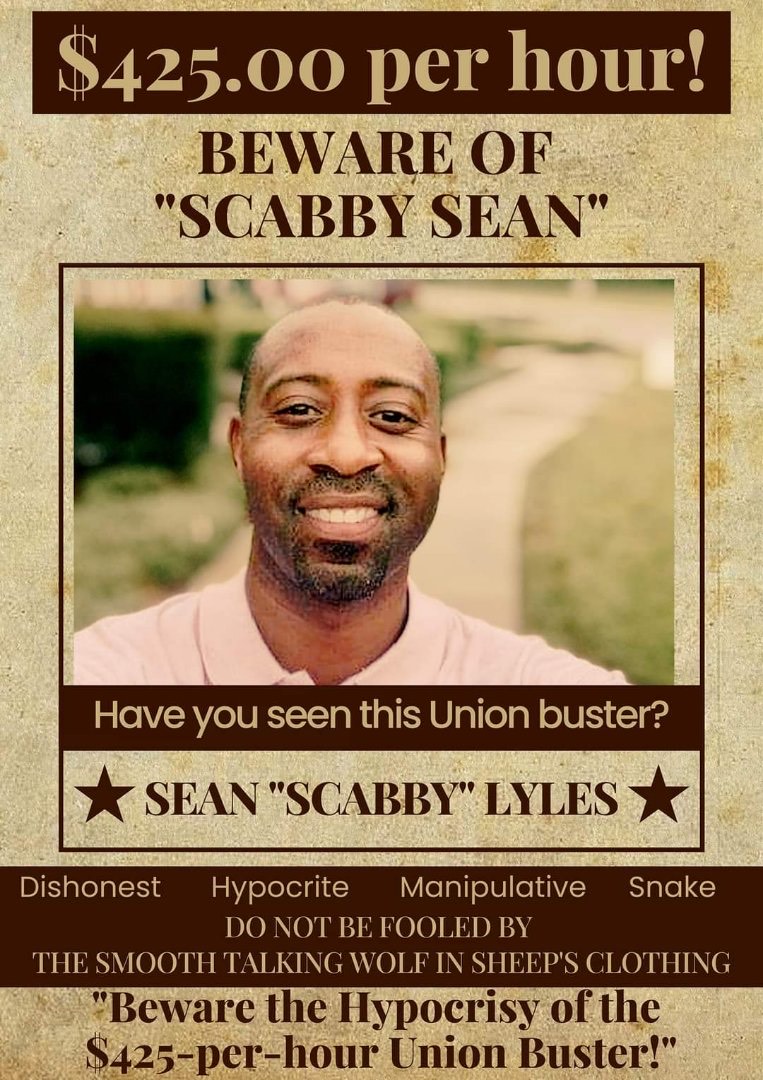
Corewell nurses made posters to alert their co-workers to the presence of union-busters.
“We had to get creative. If I put up a flier on the bulletin board, [managers] would take it down immediately. We created a Facebook page, a private group. We’d screen everyone first. It became our safe place to educate everyone.”
Nurse organizers made creative use of TikTok and Instagram to educate other nurses and encourage their support, and the lead organizers used an encrypted app to keep in touch with each other across the nine campuses. They also used social media to combat misinformation from union-busters.
WANTED POSTERS
The presence of union-busters was not well-received by the nurses. When the first one showed up, the nurses immediately got his picture and figured out his name. They made “wanted” posters to alert other nurses.
Lunsford said that when hospital managers brought the union-busters into her campus, it backfired on the hospital, turning nurses who had previously planned to sit out the election into “yes” votes.
After one of the union-busters left her nurses station, Lunsford said, she spoke with a nurse the union-buster had been talking to. “I said to her, ‘Did you know that was a union-buster?’ I started explaining to her everything we’ve lost. She wasn’t going to vote at all, and after I spoke with her, she said she was going to vote yes.”
Following the vote, nurse organizers reported many co-workers reaching out to be part of the next steps of forming the union and bargaining a contract. Due to the size of the bargaining unit, the nurses will have their own local.
“We’re just looking forward to a strong contract, and we’ll get it,” said Wallace. “We have strength in numbers with an immense bargaining unit. We’ll do real well at the table.”
ZNetwork is funded solely through the generosity of its readers.
Donate




