

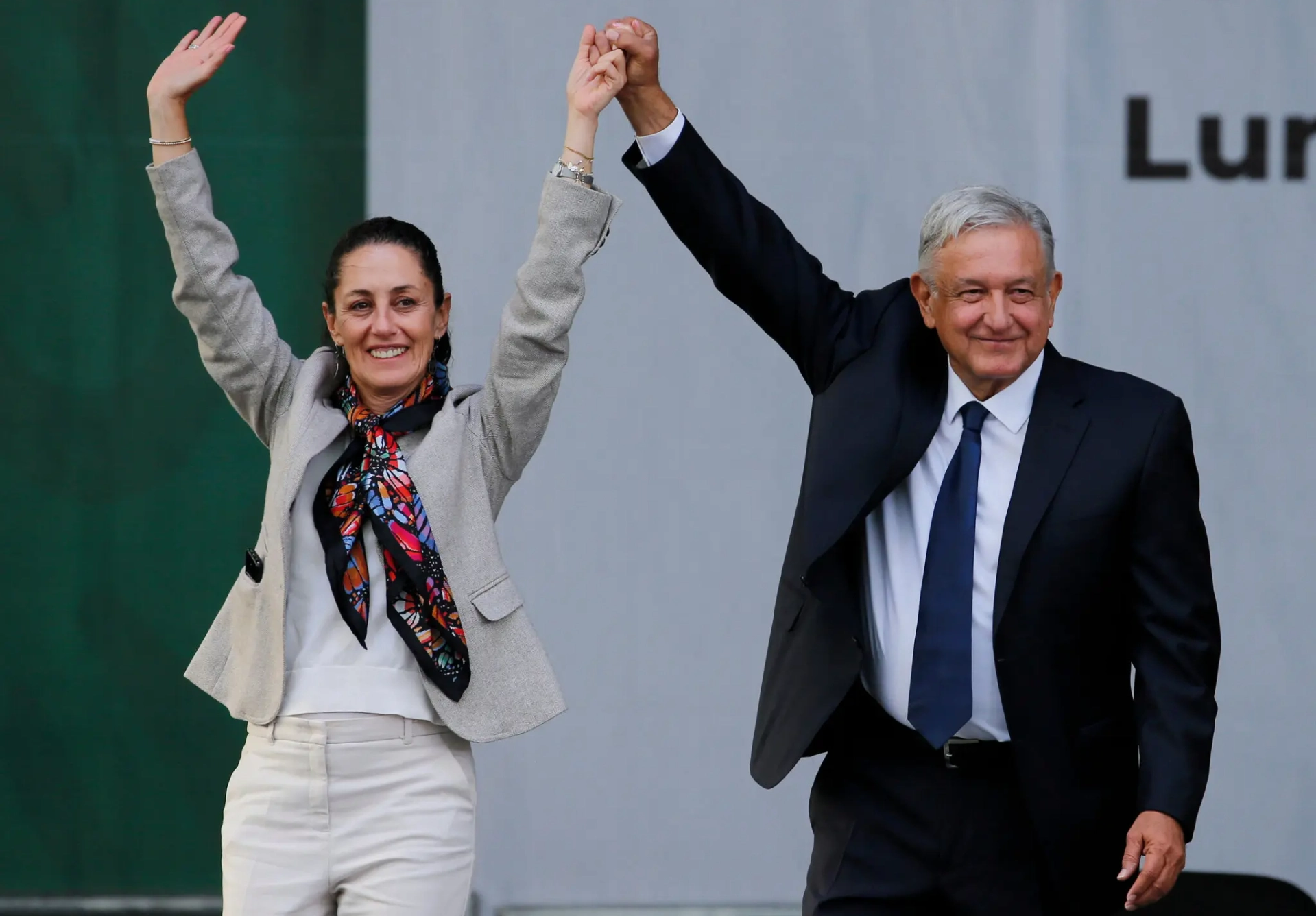
On November 19, Dr Claudia Sheinbaum, the former mayor of Mexico City, registered as MORENA’s “pre-candidate” for the presidency, guaranteeing that she will be its standard-bearer in the presidential election to be held on June 2, 2024. Days before, Clara Brugada, the head of the city’s Iztapalapa district, registered as the party’s pre-candidate for Mexico City mayor in elections to be held the same day.
Joining Sheinbaum and Brugada will be female gubernatorial candidates in four other states including Veracruz, where former Energy Secretary Rocío Nahle, one of the most prominent members of President Andrés Manuel López Obrador (AMLO)’s cabinet for her key role in promoting energy sovereignty, will be heading up the state ticket. Building on the gender parity achieved in the Mexican Congress in the elections of 2018, the next chapter of MORENA’s history is set to be shaped by women.
The Post-’68 Generation
Aside from running at the same time for the top two elected offices in the nation, Sheinbaum and Brugada have much in common. Just a year apart in age (Sheinbaum is sixty-one and Brugada is sixty), both grew up in the turbulent generation following the twin massacres of Tlaltelolco 1968 and Corpus Cristi 1971, the latter known in Mexico as the Halconazo. Both cut their teeth in left-wing militancy and activism, Sheinbaum as a student leader in the 1986–87 movement opposing one of the National Autonomous University’s periodic attempts to turn Mexico’s free public university model into a fee-paying one; Brugada defending the housing rights of the urban dwellers of Iztapalapa, a sprawling district of nearly two million made up of many internal immigrants from the countryside. Both worked their way up through the Party of the Democratic Revolution (PRD) before becoming founding members of MORENA when it became a political party in 2014.
Both have made priorities of public transport, collaborating on the elevated trolley and cable car lines known as the Cablebus, which serve the marginalized communities on the outskirts and hillsides surrounding Mexico City. Both, too, have made signature projects of a network of social and cultural centers, Sheinbaum with the Pilares project and Brugada with the award-winning Utopias. And both squared off against well-connected, more conservative men in their internal contests: Sheinbaum against former foreign minister Marcelo Ebrard and Brugada against city security minister Omar García Harfuch.
The Mexico City mayoralty (in reality, governorship, as the federal district attained the status of state in 2016) is a natural springboard to a presidential candidacy. Sheinbaum has seized upon this political advantage by acting on a wide variety of fronts, building parks, schools, and a pair of universities, repairing housing damaged in the massive 2017 earthquake, investing in public Wifi, solar and hydrothermal energy, and designing a widely praised vaccine rollout for COVID.
For women, there is a network of brightly left “safe routes” with emergency buttons, a dedicated hotline, women’s lawyers in public prosecutor’s offices, and the “aggressor leaves the house law,” in which a domestic violence aggressor is required to leave the home, even if they are the owner. But Sheinbaum’s biggest calling card at the national level will undoubtedly be her crime-fighting success: where the federal government has struggled to contain cartel and organized crime-fueled violence, Mexico City has seen a 50-70 percent reduction in “high impact” crimes such as homicides, kidnapping, human trafficking, together with violent carjackings, and robberies.
Navigating the Pitfalls
Sheinbaum also marks a break in questions of style. Where AMLO wields his regional Tabasco accent with aplomb, she speaks with the polished tones of the capital. In contrast to his folksy phraseology and fiery, naming-names rhetoric, Sheinbaum prefers a more measured discourse. And where AMLO has been much criticized by Mexico’s US-looking elites for being monolingual, Sheinbaum looked equally at ease on an October swing through Los Angeles speaking in Spanish before union and migrant leaders and in English at the city’s Chamber of Commerce.
This very difference, however, entails its dangers. While measured tones work well in press conferences and one-on-one interviews, Sheinbaum has yet to find her footing before larger crowds, where she can often sound stiff and wooden. And while her middle-class origins and academic credentials — she holds a doctorate in environmental engineering, was a researcher at the Lawrence Berkeley Laboratory in California and a member of the UN’s Intergovernmental Panel on Climate Change — will no doubt be comforting to members of the international media who seemed to have every single one of their buttons pushed by López Obrador, the greater challenge will be to communicate not with them but with MORENA voters who live far from the capital and its respective ivory towers.
Sheinbaum’s bet is clearly to replace immediate charisma with a sense of technical competence. But absent the communicational wizardry and ear to the ground that helped López Obrador get over so many humps in his administration, a personal touch can slip over into a perception of being out of touch, “technical” to “technocratic.”
An example of what this could look like in practice is one of the more unnecessary fumbles of Sheinbaum’s term as mayor, when at a time of rampant gentrification and soaring rents she launched an alliance with AirBnB to bring even more digital nomads into the capital. In the face of protests, she announced she would look into regulating the practice, only to drag out the process without providing a clear answer.
Another cause for concern, as well, is the campaign’s willingness to perpetuate MORENA’s less-than-fortunate tradition of sharing platforms with, and raising the hands of, opportunistic wash-ups from the right-wing Institutional Revolutionary Party (PRI) and National Action Party (PAN) at the state and local level. In a September event in Oaxaca, for example, Eviel Pérez Magaña, a member of the vilified government of Ulises Ruiz that violently repressed striking teachers in 2006, signed on to the Sheinbaum project amidst a chorus of boos.
While such a broad front strategy was at least understandable in 2018, when a fledgling MORENA was seeking to oust a mafia that had governed the country for decades, it is less so now with the party in such a commanding position. Although the goal is clearly to run up the score on a potential victory, both in terms of total votes and congressional seats, the question must always be asked at what cost, as local activists toiling in the trenches are asked to stomach the adhesion of figures they have, in many cases, fought against for years.
And although foreign policy is traditionally less important in Mexican campaigns than in American ones, recent events have made it another area that could become unexpectedly thorny. In addition to becoming Mexico’s first woman president, Sheinbaum would also be its first Jewish one: her paternal grandparents emigrated from Lithuania in the 1920s, while her maternal grandparents fled Bulgaria ahead of Nazi persecution at the outset of the 1940s.
During Israel’s first major military operation on Gaza, the so-called “Operation Cast Lead” of 2008–9, Sheinbaum published a forthright letter in the newspaper La Jornada. “Due to my Jewish origins, my love for Mexico and considering myself a citizen of the world. . . . I can only look with horror on the images of the bombardments of the Israeli State in Gaza,” she wrote. “No reason can justify the killing of Palestinian civilians. Nothing, nothing, nothing can justify the killing of a child. Thus I join the cry of millions all over the world in demanding a ceasefire and the immediate withdrawal of Israeli troops from Palestinian territory.”
Nearly fifteen years later, with her words echoing eerily today, presidential candidate Sheinbaum has been much more circumspect. At some point, however, she is going to have to provide a clearer stance, especially in light of the frontal denunciations of Israeli aggression made by a number of other Latin American leaders, such as Colombia’s Gustavo Petro.
Expanding Rights
None of this has proven to put as much so a dent in the sense of inevitability that surrounds Sheinbaum with each passing day: a cross-section of polls puts her twenty-to-thirty points ahead of the scandal-ridden, right-wing candidate Xóchitl Gálvez, whose floundering campaign is at risk of petering out altogether. Brugada also opens her campaign with a significant lead in Mexico City. Sheinbaum has been clever to frame her political philosophy as advocating for the expansion, not of the state as such but of a series of positive rights: to education, health, housing, culture, dignified employment at a fair wage, sustainable mobility, and a healthy environment. Plenty to occupy a government that, barring a sudden, unforeseen reversal, will be taking office on the first of October 2024.
ZNetwork is funded solely through the generosity of its readers.
Donate




