

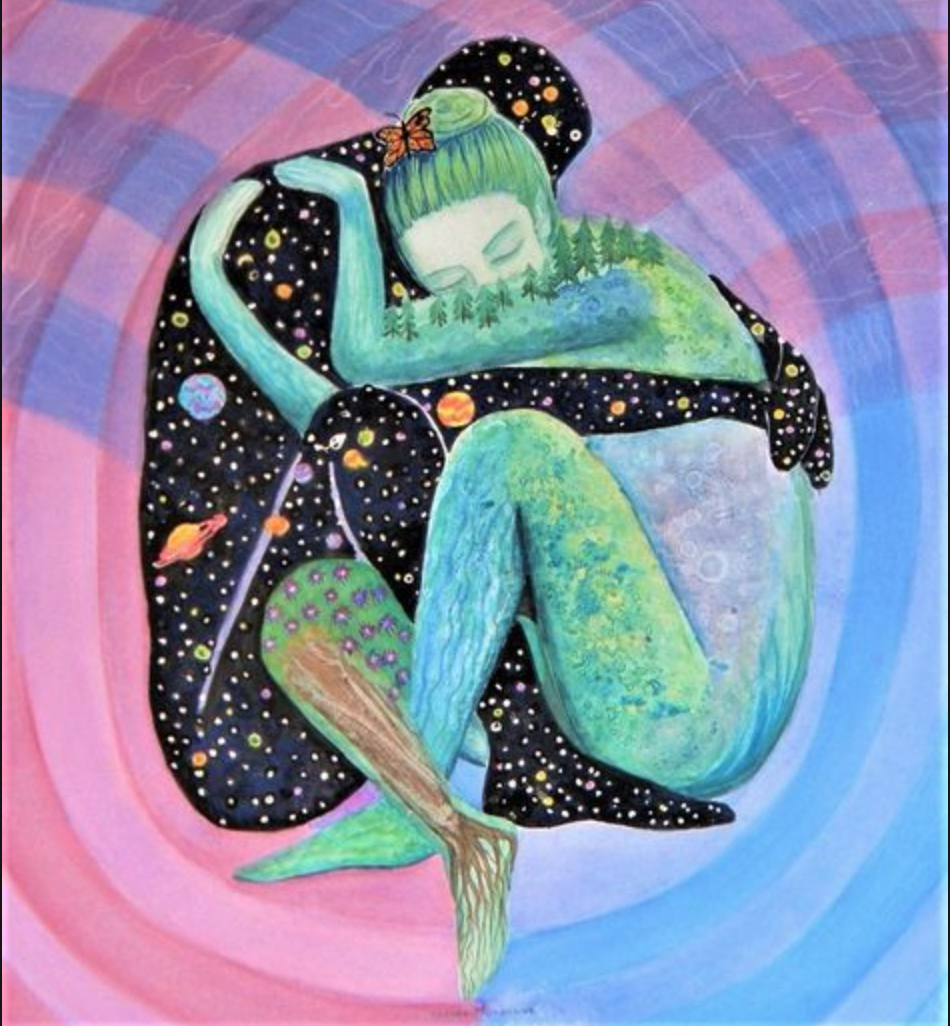
There’s a good chance that each of us has been infected by heteronormativity, and hopes to fall in love. That’s true whether we are lesbians, feminists, or anarchists, and holds even if we’re building resistance to various oppressions: racism, colonialism, classism, ableism, speciesism, among others.
I consider my resistance to crush culture as a kind of direct action for self-care. It is also a space for lesbian feminist political practice.
Romantic love and the culture of falling in love relies on a scaffolding of suffering. This is evident in our affects and also in how we fail to relate to each other. It is a story full of uncertainty, of constant yielding on the part of the feminine (almost always—but not exclusively—embodied in women) to the expectations of the person with whom we have fallen in love. It is as if we have no free will or capacity to exercise it.
We have to overcome imaginary and material obstacles in order to be part of a successful couple. But this is not the only way to rejoice in love. My own desire to disobey the mandate of romance arises from my search for different modes of existence as a lesbian feminist.
My search is shared by many others.
It took me years of exploration before I could see that I had blindly suffered from heteronormativity.
Heteronormativity is a network of values, figures and beliefs that make up a symbolic universe that sustains couple relationships in relation to the patriarchal system. It interacts with and relies upon other oppressions in a way that undermines broader amorous possibilities.
To do so, it employs strategies and tools to expropriate the vital energy born of love. And it does so for the benefit of a system of oppression.
To understand and explain how our affects can serve the system, I envision a machine that extracts vital energy. It operates in what appear to be our most intimate moments—impacting our erotic, amorous and vital desires—and creates a flow that extracts our energy in favor of the patriarchal system.
Affective ties between people generate a lot of energy; bodies experience constant movement and heat when they feel love. The experience is physical, energetic, mental, emotional and spiritual. When we love one another, we can do things that would be impossible as individuals. Loving ourselves [amorándonos], an expression that I borrow from Selene Luna, is another way to name the experience of giving and receiving love through care and affection among women, which may or may not include sexual relations.
Love is a vital resource that the patriarchal and capitalist system seeks to use in its favor. By embedding heteronormativity into affective relationships, the system expropriates our energy.
Hierarchy for control
Heteronormativity organizes relationships into a hierarchy in which some have more value than others. This hierarchy, which leads us to participate in inequitable and unfair exchanges, produces material benefits.
This leads to the control of bodies, labor, and care in exchange for an ideal of love. It reproduces domination and violence as a way of organizing society, community and desire. It erases the many ways that we can experience love and restricts the possibilities of exploring them.
A first function of the hierarchy of affects is to attach greater value to affective relationships that seem to suggest future union and the reproduction and the expansion of the group in question. The family (the surname), a people, tribe or nation is placed above others and its reproduction is prioritized and given greater value.
Or the opposite takes place: the reproduction of groups read as antagonistic is controlled, leading to exterminations, eugenics and genocides that have taken place in different times and places.
Rape as a weapon of war focuses on the extinction of the “enemy” at its source, which is executed on women’s bodies. Feminist researcher Amandine Fulchiron discusses this in her book La Ley de Mujeres (The Law of Women).
Sexual violation is the domination of the capacity for life that has been expropriated from women in mixed settings in which decision-makers are predominantly men. The hierarchization of relationships leads to authoritarian control over life.
A second function enabled by the hierarchization of relationships is control over reproduction, in its material dimension, which is to say, regarding inheritance and lineage. This is connected to the capitalist need for labor, consumers and spectators, and accumulation.
The material world perpetuated around the couple that is in love (stereotypically heterosexual, middle class property owners) connects us with the capitalist objective of accumulation. A family business, an inheritance, or other forms of patrimony may enter the picture. Other unions are excluded from these systems of property, inheritance and familial lineages.
It is understandable that the LGBTIQA+ community has challenged this approach to lineage, although such efforts do not challenge the patriarchal model as such. The need to have a close group is vital, even if we do not call it “family” or to create it via blood relation.
Historically, marriage agreements arose according to the convenience of the family group so as to increase status and inheritance. Gayle Rubin explored this in her 1975 text, The Traffic in Women: Notes on the “Political Economy” of Sex.
The waters became even more muddled with the arrival, two centuries ago, of the idea of passionate, romantic love, or what Brigitte Vasallo calls “Disney love.”
The idea of passionate love resonates in a society that privileges individualism and fits well with economic neoliberalism. Romantic love and Disney love coexist in the modern world and they are always intertwined with other oppressions.
A third function of the hierarchy of affects is that it enables the dominant class to obtain free services.
In order to obtain these benefits, the illusion of an exchange is created: an unequal exchange that trades the material for the intangible, including intangible mental and emotional experiences of wellbeing and accompaniment.
I refer to sexual, emotional, mental and other forms of domestic work necessary for the reproduction of daily life. The food is prepared and the clothes are washed in exchange for the idea of being loved, as Silvia Federici suggests in The Patriarchy of the Wage.
Control of love as control of reproduction
Coupleocracy and heterosexuality suggest the union of two biologically different humans is a natural fact, beyond the social, and insist that it is the only possible union.
Controlling reproduction is about controlling the body and time—what a person can do with their life.
Monogamous thought, to use Vasallo’s phrase, promotes affective exclusivity to create harmony under capitalism. In its construction, exclusivity possesses an affect that makes it a passive, inert object. It is the origin of so much suffering, and I want to share some ideas as to why.
We are beings with expansive souls and it is restrictive to confine ourselves to the possibility of receiving, giving and experiencing a single affect in the context of love’s vastness.
This is the foundation of the false idea of competition among affects. It is a capitalist idea: whoever wins the competition is the best option.
It also affirms and reproduces the idea that the possibility of alternative bonds be perceived as a threat to existing love relationships. This creates a relentless anxiety that makes us want to buy security at any cost.
Monogamy provokes disadvantageous emotions. It is in this context that romantic propaganda arises. Overwhelming, its purpose is to convince women, above all, that the ideal man will eventually appear.
Disobeying heteronormativity
Relationships that rest on heteronormativity invalidate our will to share our love among all the many people and entities that we can and do love.
In contexts where patriarchy predominates, coercion and violence are used to legitimize heterosexual unions only. Other possible unions are criminalized, erased and even violently eliminated.
It is shocking to think that only 70 countries offer some recognition of equal marriage or civil union (out of the 193 countries monitored by the International Lesbian, Gay, Bisexual, Trans and Intersex Association, ILGA). In more than 100 countries, you can be imprisoned, physically punished and even killed for being affectively linked to people outside of heterosexuality, according to ILGA data.
Less control means more authenticity in loving each other. Feminist lesbianism, and lesbian existence, from Adrienne Rich’s perspective, position us before the unceasing task of questioning the threads of domination and of creating new types of relationships. These paths are uncertain, and are still being created.
Loving women in a society built on the domination, hatred and exploitation of women is a tremendous form of subversion. We become activated by anything that allows us to crack the scaffolding of violence.
Our subversion aims to break these bonds, to detach ourselves and unlearn the anxiety of exclusivity in our affects, to move desire away from the culture of the crush and male approval.
Instead, we share ourselves in multiple ways with multiple people. We take into account the care of emotions, bodies and minds in every bond we experience. We cultivate the dual relation of loving each other and practicing women’s politics.
Libertad García Sanabria
Mujer, lesbiana, feminista nacida en la CdMx, con actual residencia en el estado de Oaxaca. Es Licenciada en Sociología por la UAM-Xochimilco, Maestra en Ciencia Política por El Colegio de México y, actualmente, doctorante en Estudios Latinoamericanos de la UNAM. Es co-creadora del espacio cultural feminista La Gozadera, que abrió sus puertas en el centro de la CdMx de 2015 a 2020.
ZNetwork is funded solely through the generosity of its readers.
Donate




