


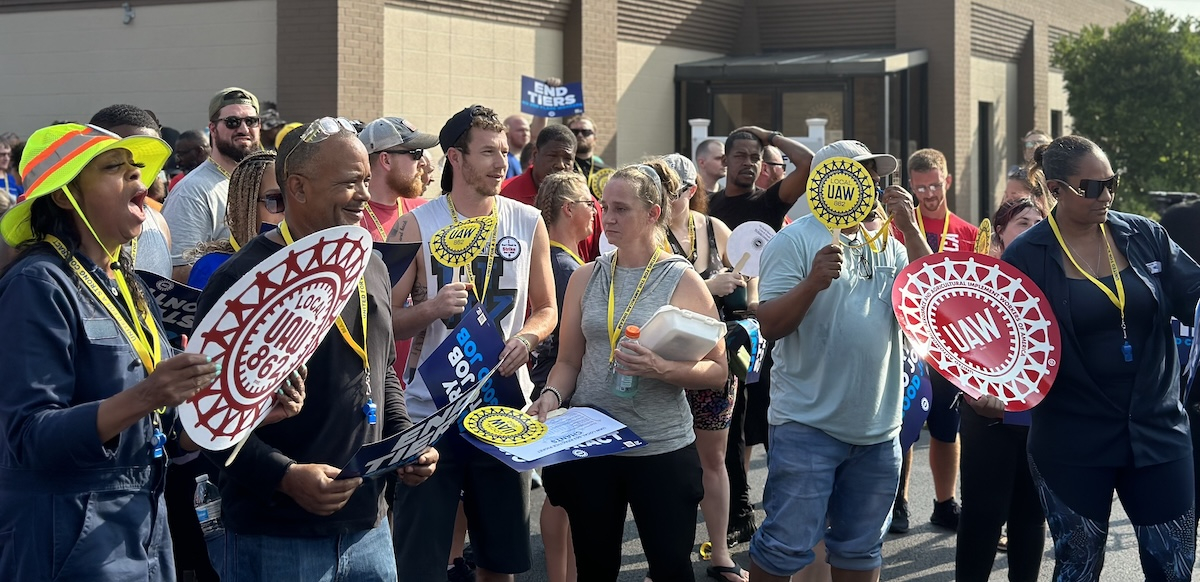
United Auto Workers President Shawn Fain recently laid out four priorities he says should form the nucleus of a workers’ political program. And he said that a broad strike in May 2028 is one way to fight for those priorities.
Fain spoke on September 30 at the release of a new report by the Center for Working Class Politics and allied groups. The report, titled “Democrats’ Rust Belt Struggles and the Promise of Independent Politics,” is based on a new survey showing that workers in four states battered by decades of mass layoffs—Pennsylvania, Ohio, Michigan, and Wisconsin—are eager to see their basic issues addressed in the political arena.
The 3,000 people surveyed supported policies that addressed “corporate greed and political corruption while correcting inequities in ways that felt immediate and tangible for working families,” the report found. Respondents included people of all political affiliations and classes, and were representative of the states’ populations.
Fain said UAW polling has found that union auto workers have similar priorities. He named these four: wages, health care, retirement, and winning back control of time—no more 12-hour days, or working two jobs.
“Among our members, Republican, Democrat, independent, young, old, Black, white, every part of the country, over 90 percent say that those four issues are their top issues,” said Fain. “It’s not the border. It’s not bathrooms. It’s not religious beliefs. It’s the four core issues.”
Fain suggested that more working-class people need to run for office, like independent U.S. Senate candidate Dan Osborn in Nebraska—a mechanic and leader in the 2021 Kellogg’s strike—and Democratic Senate candidate Graham Platner in Maine, an oyster farmer.
But it’s not just who the candidates are that matters, he said. “We’ve really got to really focus on working-class issues, get the working class rallied around those issues, and quit falling for the divide-and-conquer tactics.”
NOTHING ELSE MATTERS
In 2024, a lot of working-class people voted for Trump, including 56 percent of voters without a college degree. Fain recalled a similar situation back in 1992, when he was an apprentice in his early 20s, watching a presidential election debate between Bill Clinton, George H.W. Bush, and self-funded business tycoon Ross Perot. Clinton and Bush were promoting the North American Free Trade Agreement, while Perot, Fain said, talked about the “the threat of NAFTA and the giant sucking sound,” as jobs moved out of the U.S.
That one statement made Fain vote for Perot. “And I don’t proudly say that, because it wasn’t like I wanted to vote for a billionaire to represent my interests,” Fain said. “But [free trade] was an issue that spoke to me and many people in the same predicament as me that were in factories and working hard and trying to stay ahead—because we knew it would be a massive threat.
“That vote wasn’t because me and my co-workers were obsessed with trade, it’s because we knew if we didn’t have a job, nothing else mattered,” he said.
Like Perot, Trump likely attracted many votes with his anti-free trade statements, but has instead used tariffs to bully other countries rather than as part of a coherent industrial policy. He has undermined working-class priorities at every turn, tearing up collective bargaining agreements in the federal sector while paralyzing the National Labor Relations Board and the Occupational Safety and Health Administration, and trying to stop wind projects that employ tens of thousands of union building trades workers, among many other anti-worker actions.
POPULISM LITE?
Jared Abbott of the Center for Working Class Politics said the report shows that the “populism lite” espoused by some in the Democratic Party is not particularly appealing to the voters they surveyed. More appealing is an “in-your-face populism that calls out corporations and all the ways they’ve been undermining our lives for decades.” Such populists (for example, Bernie Sanders) see the problem as systemic, not due to a few bad actors.
An example of “populism lite,” Abbott said, would be presidential candidate Kamala Harris when she said during the 2024 campaign that “most businesses are creating jobs and playing by the rules. But there’s a few who aren’t, and that’s just not right.”
Many centrist Democrats say populism lite is best, Abbott said, “because working people actually get scared away when you attack corporations in general.” But that’s not what the survey found. Instead, “strong populism” was 11 percent more appealing than “weak populism,” and 23 percent more popular among working-class respondents.
Respondents were also surprisingly positive about a bold measure to deter mass layoffs that is not yet on the table in the U.S.: People supported by 30 percentage points a law barring companies that receive tax dollars from laying off workers. Most also supported taxing the rich, capping prescription drug costs, and stopping corporate price-gouging. Eliminating taxes on Social Security income and banning congressional stock trading also scored well.
DEMOCRATS DISMISSED
The survey found that running as a Democrat now hurts candidates, even those who are robust economic populists. Abbott called it the “Sherrod Brown tax” after the Democratic Ohio senator who lost his re-election bid in 2024, despite being much more pro-union and pro-worker than the Democratic Party as a whole. According to the survey, the Democratic label dragged him down. The survey found that the penalty for running as a Democrat was around nine percentage points, but Abbott said that varied among the states surveyed. Even habitual Democratic voters had unfavorable opinions of the party.
The survey also found that 57 percent of respondents felt positively about a hypothetical new political party that the surveyors called the “Independent Workers Political Association.” IWPA got a thumbs up for its promise to raise the minimum wage, guarantee decent jobs, end drug and food price-gouging, and stop mass layoffs.
Fain expressed support for independent runs like Osborn’s (Nebraska Democrats didn’t field a candidate), or running in the Democratic primary on a working-class platform like Platner. However, he said it isn’t time to start a “labor party.” “A lot of people talk to me about forming a labor party,” Fain said. “And while I think it’s a great idea and I’d love to do it, I think if we just say ‘labor party,’ a lot of people equate labor with ‘it’s a union thing.’ And [they think] ‘I’m not a union member. So that’s not my thing.’
“We need more than a party,” Fain added. “We need a movement for the American dream for everybody.”
MAY 2028
Fain said that this is why the UAW has asked other unions to align their contracts with the Big 3 automakers contracts that expire May 1, 2028, and to consider other actions they can take in May 2028. This, he said, would be an opportunity to put working-class issues “front and center and fight like hell for those issues.”
“We can’t make this about one union. We can’t make it about one company,” Fain said. “It can’t just be one union or one sector. It’s got to be a bigger working-class fight.
“As much as I’d love to just have a general strike next week, we have to have time to plan this, to build it. And to get people aligned with it and get working-class people aligned with it, if we’re going to effect real change.”


Jenny Brown is an assistant editor at Labor Notes.
ZNetwork is funded solely through the generosity of its readers.
Donate




