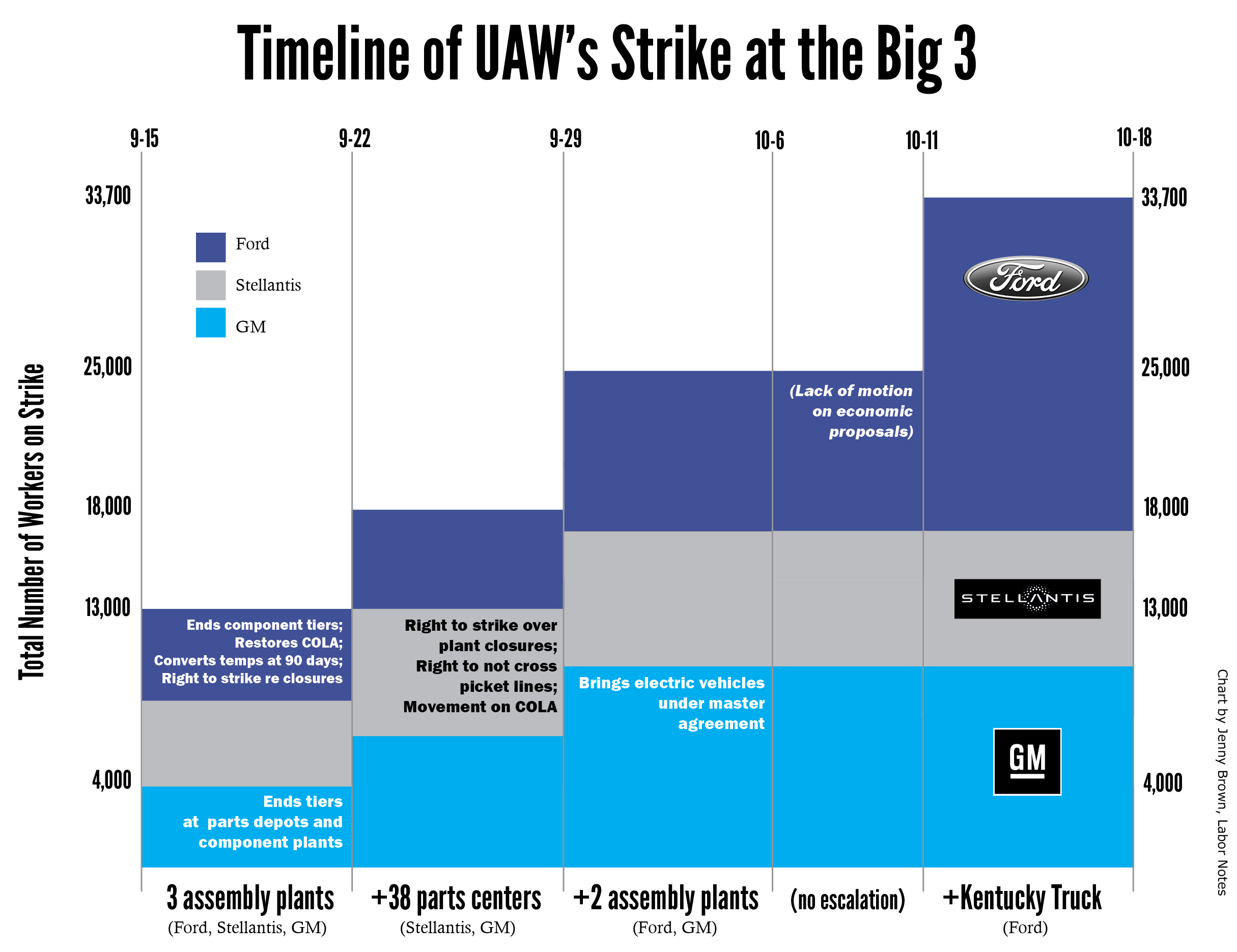
Source: Labor Notes

The Auto Workers (UAW) have thrown the Big 3 on the back foot.

For the first time in recent history, the union is playing the automakers against each other—departing from its tradition of choosing one target company and patterning an agreement at the other two.

And its gradually escalating Stand-Up Strike strategy has multiplied the pressure that can move the companies off the dime.

Every Friday for four weeks, the CEOs waited with bated breath for UAW President Shawn Fain to announce strike targets.

Two Fridays in a row, one company moved on major bargaining issues just minutes before workers were scheduled to walk out.

On September 29, Stellantis was spared—after frantically calling the union with a new offer.

And on October 6, the UAW was in gear to tap 5,000 members at the General Motors assembly plant in Arlington, Texas. At the eleventh hour, GM agreed to put battery manufacturing facilities for electric vehicles into its national union contract. The plant stayed unstruck.

CHANGED THE RULES

The Stand-Up Strike strategy draws inspiration from an approach known as CHAOS (Create Havoc Around Our System), first deployed in 1993 when Alaska Airlines flight attendants announced they would be striking random flights. The unpredictability drew enormous media attention and drove management up the wall. Meanwhile the union was able to conserve its strength and minimize risk; it only actually struck seven flights over a two-month period, but Alaska had to send scabs for every plane, just in case.

This year, the auto companies miscalculated where the UAW was going to strike first, stockpiling engines and shipping them cross-country to the wrong facilities. Auto workers relished the self-inflicted supply chain chaos.

Now, lest the companies get settled into the every-Friday routine, the union has switched it up again.

Without warning on a Wednesday afternoon, October 11, after Ford failed to move on its economic proposal, the UAW shut down Ford’s vast Kentucky Truck Plant, which generates $48,000 in revenue per minute.

“They thought they figured out the so-called rules of the game,” said Fain on Facebook Live. “So we changed the rules. Now there’s only one rule: Pony up!”

Fain has made a point of wearing camo on the picket line, a nod to guerrilla tactics the union is deploying. Members at the not-yet-struck plants are standing up at work by refusing voluntary overtime.

GO THE DISTANCE

The union is winning the P.R. war too. A CNN poll found that 76 percent of Americans stand with auto workers, while just 23 percent support the car companies.

“The workers win,” whimpered Jim Cramer, the corporate mouthpiece who hosts CNBC’s “Mad Money.”

The companies are eager to bring the strike to a close. “We can stop this now,” said Bill Ford, the company’s executive chairman, in a news briefing on October 16. “We need to come together to bring an end to this acrimonious round of talks.”

He called for the union to partner up against nonunion competitors, throwing in a note of national chauvinism for good measure: “It should be Ford and the UAW vs. Toyota and Honda, Tesla, and all the Chinese companies that want to enter our home.”

“It’s not the UAW and Ford against foreign automakers,” Fain retorted in a reply statement. “It’s autoworkers everywhere against corporate greed… Workers at Tesla, Toyota, Honda, and others are not the enemy—they’re the UAW members of the future.”

Unlike their employers, the strikers are in no hurry; they’re ready to go the distance.

“We’ll be out here deep-frying turkeys if we need to be,” said Sean Farnan at Ford Assembly in Wayne, Michigan. “We’ll be singing Christmas carols if we have to be out here then.”


This article was originally published by Labor Notes; please consider supporting the original publication, and read the original version at the link above.

Luis Feliz Leon is a staff writer and organizer with Labor Notes.


ZNetwork is funded solely through the generosity of its readers.

Donate
Donate
Leave A Reply

Subscribe

All the latest from Z, directly to your inbox.

Institute for Social and Cultural Communications, Inc. is a 501(c)3 non-profit.

Our EIN# is #22-2959506. Your donation is tax-deductible to the extent allowable by law.

We do not accept funding from advertising or corporate sponsors.  We rely on donors like you to do our work.

ZNetwork: Left News, Analysis, Vision & Strategy

Subscribe

All the latest from Z, directly to your inbox.

THE WIND CRIES FREEDOM

The Wind Cries Freedom, the new book from Z co-founder Michael Albert, is a sweeping oral history of a future American revolution.

Through thirty interconnected chapters, it draws out the strategies, failures, turning points, and hard-won wisdom of a movement that called itself the Revolutionary Participatory Society. These are not the polished memoirs of politicians: they are the unfiltered accounts of people who organized in neighborhoods, hospitals, universities, stadiums, courthouses, and places of worship, and kept a shared vision alive through cynicism and exhaustion.

The result is speculative political fiction that reads like history: messy, human, and quietly hopeful in the way that only real experience and long thought can produce.

Get your copy and peruse more features on the book’s website below.

“Read it, argue with it, but don’t look away. The future it recalls is one we must still fight to deserve.”

Yanis Varoufakis

“The most unusual and intriguing combination of prophecy, manifesto, and movement building manual that I have ever encountered.”

Bill Fletcher Junior

“This work fills a huge gap in our social movement literature.”

Cynthia Peters

You've just read your article on Z this month.

DOES Z'S SURVIVAL MATTER?

You keep coming back for a reason: serious political analysis, movement reporting, and debate beyond the priorities of corporate media. Today, Z is in a precarious financial position. If Z is part of how you understand the world, help keep it going. The readers who give monthly are the reason this work survives between fundraisers.

Z is in a precarious financial position. If it’s part of how you understand the world, help keep it going.

Number of donors704
Our goal1,000

Sustainers at $9/month or more receive the digital Z Magazine.

Already a sustainer? Click here and we won’t ask again. Thank you!

Your reading count is stored only in your browser and is never sent to us.

Sound is muted by default.  Tap 🔊 for the full experience

CRITICAL ACTION

Critical Action is a longtime friend of Z and a music and storytelling project grounded in liberation, solidarity, and resistance to authoritarian power. Through music, narrative, and multimedia, the project engages the same political realities and movement traditions that guide and motivate Z’s work.

If this project resonates with you, you can learn more about it and find ways to support the work using the link below.

Z is in the most precarious financial position in its history.

Z is a place to think beyond the limits of the present.

For decades, Z has brought together political analysis, movement reporting, debate, and visions of a different future from writers and activists around the world. That work is more than journalism. It is movement infrastructure: movements need places to develop ideas, test arguments, learn from experience, and imagine what comes next.

In the first two days of this fundraiser, 19 donors and 8 new monthly sustainers stepped up. Help us reach 1,000 donors who keep Z independent, for everyone.

For decades, Z has published the analysis, debate, and visions movements need, free of paywalls, ads, and billionaire owners. If that work should continue, Z needs your support now.

Number of donors704
Our goal1,000

Sustainers at $9/month or more receive the digital Z Magazine.

Subscribe

Join the Z Community – receive event invites, announcements, a Weekly Digest, and opportunities to engage.

Exit mobile version