

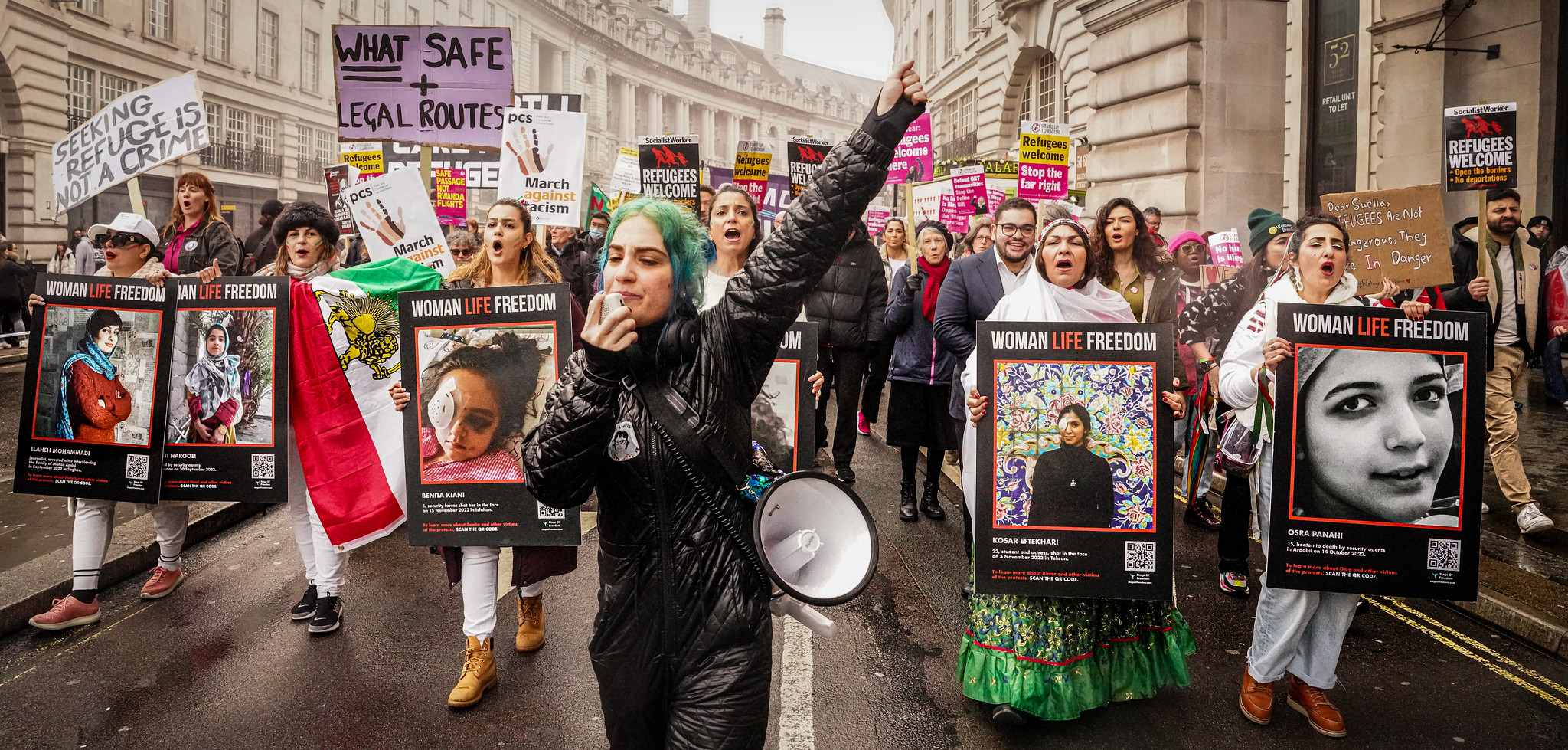
Amidst the sham or state-orchestrated presidential election in Iran, a grim reality unfolds. Women are being violently arrested by the Morality Police for refusing to comply with mandatory hijab rules or wearing “improper” hijab, dubbed “Bad Hijab.” This misogynistic backlash follows the historic 2022 Woman Life Freedom uprising, led by Iranian women. Despite severe punishments, fearless women persist in their resistance, marking a turning point in the fight against the mandatory hijab.
As the presidential election proceeds, following the death of Ebrahim Raisi, a review of the candidates’ views reveals that none is likely to bring meaningful change to women’s rights and freedom of choice in clothing. Only one candidate refrains from openly supporting the current crackdown. The state’s war on women extends beyond the mandatory hijab crackdown. It encompasses unjust court sentences and violations of women’s rights in prisons.
The imprisonment of Nobel Peace laureate Narges Mohammadi and the harsh 21-year sentence imposed on Kurdish women’s rights activist Zhina Modares Gorgi demonstrate the regime’s unyielding stance. The enforcement of mandatory hijab has reached a point of no return, and Iran’s government has already lost the battle in the war on women and girls.
The current crackdown in Iran, following the inspiring Woman Life Freedom movement, has unleashed a wave of violence and repression as harsh as one can imagine. The reality is that those in power in Iran have not only ignored the demands of women and youth, but have responded with even greater brutality, consistent with historical patterns: When governments face instability or weakness, they often resort to more repressive measures to maintain control. Iran’s rulers are no exception. The combination of corruption, polycrisis and popular discontent has led to a harsher crackdown aimed at preserving their grip on power.
Over two months ago, in the early morning of Sunday April 14, the Islamic Republic of Iran launched an unprecedented attack on Israel, deploying over three hundred cruise missiles, ballistic missiles, and drones. This marked the first direct military engagement between the Iranian government and Israel. Coinciding with this military escalation, the Islamic Republic announced the implementation of the so-called “Light” or “Noor” Plan or Campaign aimed at intensifying measures against opponents of mandatory hijab. The Iranian government justified this plan as a response to citizen complaints about the increasing number of women not wearing the mandatory hijab in public spaces. However, Iranian civil and political activists suggest that the true purpose of the Noor Plan is to preempt potential protests and opposition amidst the government’s current vulnerability. The plan aims to enforce Islamic Sharia laws, and the compulsory Hijab, in Iran, which mandate women to cover their hair and wear modest clothing, with non-compliance punishable by public reprimand, fines, or arrest. This development highlights the complex interplay between geopolitical tensions and domestic policies in Iran, warranting further academic, journalistic, and activist scrutiny and analysis.
The recent wave of suppression against women not adhering to the mandatory Hijab has revived the 45-year history of repression, harassment, and denial of women’s rights for their presence in public spaces, particularly in the streets. The Noor campaign implemented to enforce the mandatory hijab and disregard women’s share of the public space and safe streets, is repeating previous unsuccessful attempts since the establishment of the Islamic Republic of Iran. The desire of the majority of Iranian society is freedom to choose one’s clothing, and hijab by choice!
For 45 years, the story of imposing the mandatory hijab and resistance against it has continued. The disturbing sounds of the slogan “either a headscarf or get hit on your head” still linger in the memories of those who protested during the first protest against the Islamic Republic on March 8, 1979. While prior to the 1979 revolution women faced harassment and sexual harassment in public places, they were not being systematically arrested, beaten and detained.
For 45 years ago, the mandatory hijab has been enforced through various plans, including the “Hijab and Chastity Plan” and the “Moral Security Plan,” using tools like green vans and Irshad (enlightenment) patrols to control public spaces, and create a gendered, tense, and unsafe environment for women. These plans have wasted significant funds on creating an atmosphere detrimental to safety and security, instead of empowering and improving people’s lives.
The mental and physical well-being of half of society — women and girls — should not be bound by the obligatory hijab. History reminds us that wherever there is oppression, struggle is inevitable. As Langston Hughes poetically asked, “What happens to dreams deferred? Do they dry like a raisin in the sun? Or will they explode?”
The struggle against oppression is a perennial phenomenon in human societies, as eloquently captured by Langston Hughes’ poignant query, “What happens to dreams deferred?” Do they wither like a raisin in the sun or explode in a burst of resistance? The Iranian women’s movement embodies this struggle. They have continuously contested the imposition of mandatory hijab and the erasure of their presence in public spaces since the inception of the Islamic Republic.
The first wave of protests erupted on March 8, 1979, as women took to the streets in various cities, defying the authoritarian regime’s attempts to silence them. The revolutionary uprising in 2022, dubbed “Woman, Life, Freedom,” was the culmination of decades of suppressed anger and aspirations, as women and girls reclaimed their rightful place in public spaces and streets.
Young women, in particular, have played a pivotal role in this struggle, courageously occupying public spaces and asserting their agency in the face of systemic repression. The Noor Plan is the latest iteration of this oppression, aiming to enforce the mandatory hijab and curtail women’s autonomy over their bodies and choice of clothing. However, this plan has been met with widespread domestic and international condemnation, with scholars like Tahira Taleghani (daughter of the deceased Ayatollah Taleghani) emphasizing that the compulsory hijab violates women’s freedom and dignity. Even some members of parliament have opposed the plan, recognizing its illegality and futility.
Despite the regime’s efforts to suppress dissent through plainclothes police, facial recognition cameras, and security charges, the will of the majority of Iranians remains unbroken. The Noor Plan has only exacerbated social tensions and crises, deepening the chasm between the people and the government.
In reality, the street belongs to the citizens. Women and girls, as half of Iranian society, demand their share of public space and safety. They seek a secure environment where their human rights, including voluntary hijab, gender equality, and social justice, are respected and protected by the government’s political will. Today, the street has become a platform for women’s agency, as they creatively and innovatively assert their presence, multiplying courage and planting seeds of hope in hearts.
As Arundhati Roy remind us, “Another world is not only possible, she is on her way. On a quiet day, I can hear her breathing.”
Elahe Amani is Chair, Women’s Intercultural Network; board member, National Association for Community Mediation, Emerita, California State University; and editor of the women’s section of the monthly journal, Peace Mark, a publication of the Human Rights Activists in Iran (HRA).
ZNetwork is funded solely through the generosity of its readers.
Donate




