

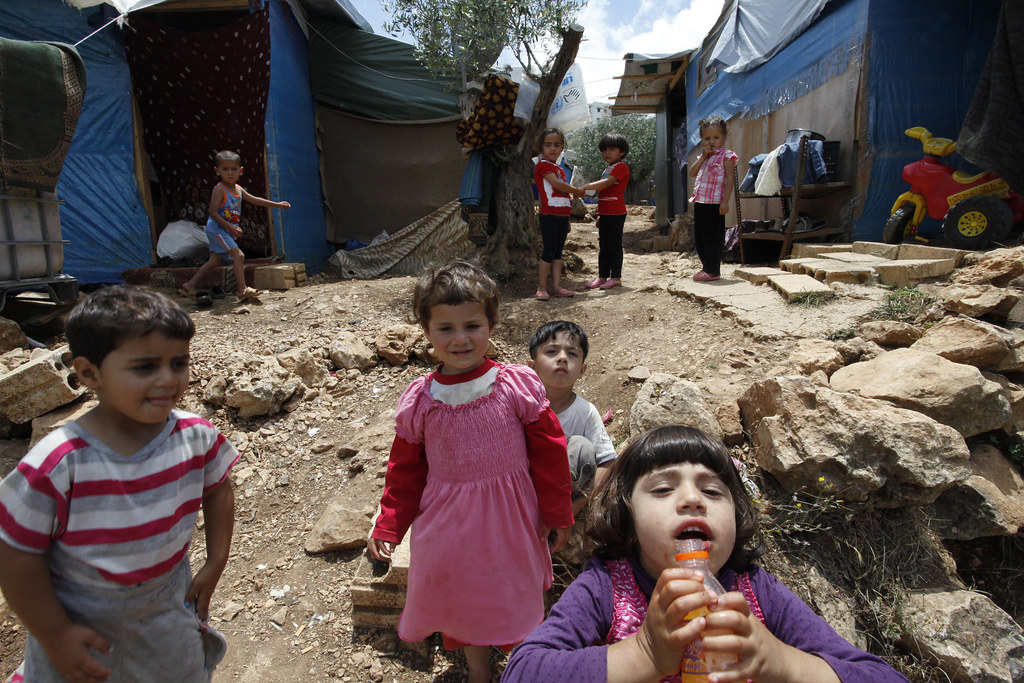
After the International Court of Justice ruled that Palestinians in Gaza faced a “credible risk” of genocide due to Israel’s war against Hamas, the Irish barrister prosecuting South Africa’s case suggested “the very reputation of international law … to protect all peoples equally hangs in the balance.” We are witnessing today, on an unprecedented scale—on almost every continent—the displacement of hundreds of thousands of children due to war, violence, and extreme poverty, but international law and simple human compassion seem to apply selectively. Apparently, the value of the life of one child is not the same as another, depending on that child’s racial identity, religion, or national origin.
The recently released movie, “One Life,” is a dramatic and moving account of the rescue of several hundred children from Czechoslovakia as Europe descended into the chaos and tragedy of World War II. The title is taken from the Talmud: “Save one life, save the world.” The hero of this story is a rather unassuming British stockbroker Nicholas Winton, an intriguing—if contradictory— character. Although of German-Jewish origin, Winton always insisted his commitment was to saving children, not specifically Jewish children, even though around 90 percent of the refugee minors he brought to Britain were indeed Jewish.
How the world responded to the refugee crisis in Europe as it unfolded in the 1930s is instructive. Until Kristallnacht in November 1938, Britain resisted opening its doors to those seeking asylum as fascism gained ascendancy. Moreover, far from facilitating Winton’s child rescue operation, British immigration authorities created numerous obstacles for the organizers. A much larger U.K. government-sponsored scheme that became known as the Kindertransport was similarly hampered by the slow grinding of the wheels of British bureaucracy and the restrictive requirements to find private financial sponsors and a confirmed foster family for each child. Nevertheless, around 10,000 Jewish children from Germany, Austria, and Poland eventually reached Britain with the Kindertransport.
Ironically, once war broke out, as many as one thousand of those same refugee minors who were by then over the age of sixteen in June 1940 were interned as “enemy aliens” by the British government in makeshift camps on the Isle of Man and elsewhere, along with tens of thousands of other recent arrivals from Axis countries.
Across the Atlantic, President Franklin D. Roosevelt saw no electoral advantage in humanitarian gestures toward European Jews, not even children. In 1939, his administration infamously returned the St. Louis to Europe with its 933 passengers on board, most of whom were Jewish refugees.
Earlier that year, U.S. Senator Robert Wagner and Representative Edith Nourse Rogers had proposed a bill that would have admitted 20,000 Jewish and other “non-Aryan” German children over two years. First Lady Eleanor Roosevelt issued a passionate plea, urging her country to open its arms to the refugee children as Britain and others had done. But when the plight of Jewish children was discussed in congressional hearings, it was argued—on “humanitarian” grounds—that children should not be separated from their parents.
There is no doubt that deep-seated anti-Semitism, anti-communism, and virulent anti-immigrant sentiment combined to sink the Wagner-Rogers Bill. One opponent of the Bill warned that “20,000 charming children would all too soon grow into 20,000 ugly adults.” Ultimately, only two to three hundred child refugees from German-occupied parts of Europe made it to U.S. shores, and after the war just 375 European refugee minors were admitted under the Displaced Persons Act of 1948. Of the six million Jews who died in the Holocaust, around one and a half million were children.
It was only during the Cold War that Washington proved to be more welcoming to refugee children. Several hundred young Hungarians were brought to the United States after the 1956 Russian invasion of their country. Then, following the Cuban revolution, an initially covert scheme brought over 14,000 Cuban children to the United States in the early 1960s. No limit was placed on the number of unaccompanied Cuban minors allowed to come. They only required a visa waiver letter signed by Father Bryan Walsh on behalf of Miami’s then very modest Catholic Welfare Bureau accepting responsibility for the children’s care.
This mass airlift, quaintly dubbed “Operation Pedro [or Peter] Pan,” quickly overwhelmed local and federal resources but was justified in highly emotional anti-communist terms: “Each of us can swell with pride,” a Miami lawyer told a U.S. Senate Inquiry, for being “a small but vital part in the drama of taking from the grasp of communism but one little child.”
More recently, in an effort to deter illegal migration, the Trump administration went as far as separating children from their families at the U.S.-Mexico border. Many of those families are yet to be reunited. Now U.S. and European governments desperately seek to erect new, more impenetrable physical and legal barriers to hold back the ever-increasing numbers of migrants arriving at their borders.
As the death toll of Palestinian children in Gaza rises to well over 10,000, Nicholas Winton’s story challenges us to consider the value of a child’s life and our moral, if not legal, obligations toward all refugees, especially children caught up in war zones, without applying any racial, religious, or political criteria.
ZNetwork is funded solely through the generosity of its readers.
Donate




