


When the Constitution of India granted the right of universal adult franchise to citizens, it did not, unlike the American system, require Indians above 18 years of age to register suo motu as voters.
The task of ensuring that every Indian above the age of eighteen cast their vote was entrusted to the Election Commission of India by putting together a voters’ list through house to house enumeration.
The periodic renewal of voters’ lists has thus been carried out ever since the first election of 1952, ensuring that the injunction to “free and fair” elections (held by a 13-judge Bench of the Supreme Court in 1973 to be a founding element of the ‘basic structure’ of the Constitution, un-amendable by parliament) were effected.
Those renewals, clearly, took care that no dead persons remained on the list, nor newly eligible citizens excluded from exercising their all-important fundamental right to express their choice in government formation.
The Special Intensive Revision now underway on behalf of the Election Commission has, unprecedentedly and without warrant, chosen to dub all previous electoral rolls from 2003 onwards as apocryphal and not to be referenced in its rough-shod drive to formulate a wholly new voter’s list for the forthcoming elections to the Bihar legislative assembly.
Contravening the constitutional provision, the Commission has cavalierly sought recourse to the American system by asking citizens to fill out forms justifying their status as voters.
And it has done so not by simply getting forms filled with proof of identity and location, and returning proper receipt of such forms taken from citizens, but by asking them to provide from a choice of some 11 documents to support their applications.
In a recent hearing, the Supreme Court has underscored the constitutional point that the Election Commission of India has no remit to determine the citizenship of Indians – a job that belongs to the Ministry of Home Affairs.
The Commission argues that since only citizens can legally be allowed to vote, it must know who are valid citizens and who are not.
Remarkably, the documents it has sought from likely voters do not constitute any proof of citizenship.
The Commission has refused to accept such documents as the Aadhaar Card (once sold by the state as the be-all and end-all of authentic Indianness, complete with elaborate biometric imprints), its own Voter Identification Card, and the ubiquitous Ration Card (through which the Modi government gives freebies to some 83 crore Indians) as valid documents for its questionable determinations, despite the top court’s suggestion that it do so.
Comically enough, the documents it has sought all require an Aadhaar Card proof for their making and bestowal.
Dystopia, anyone?
At the time of writing, speculation has it that over five million Biharis stand to be excluded from the new voter’s list, although the Commission has not thought it fit yet to speak to these matters openly in its own voice.
Its agents argue that Indians have the right to contest their exclusion in the month to come – a procedure not very ideally suited to a grossly impoverished Bihar, with barely any road access available in the hinterlands.
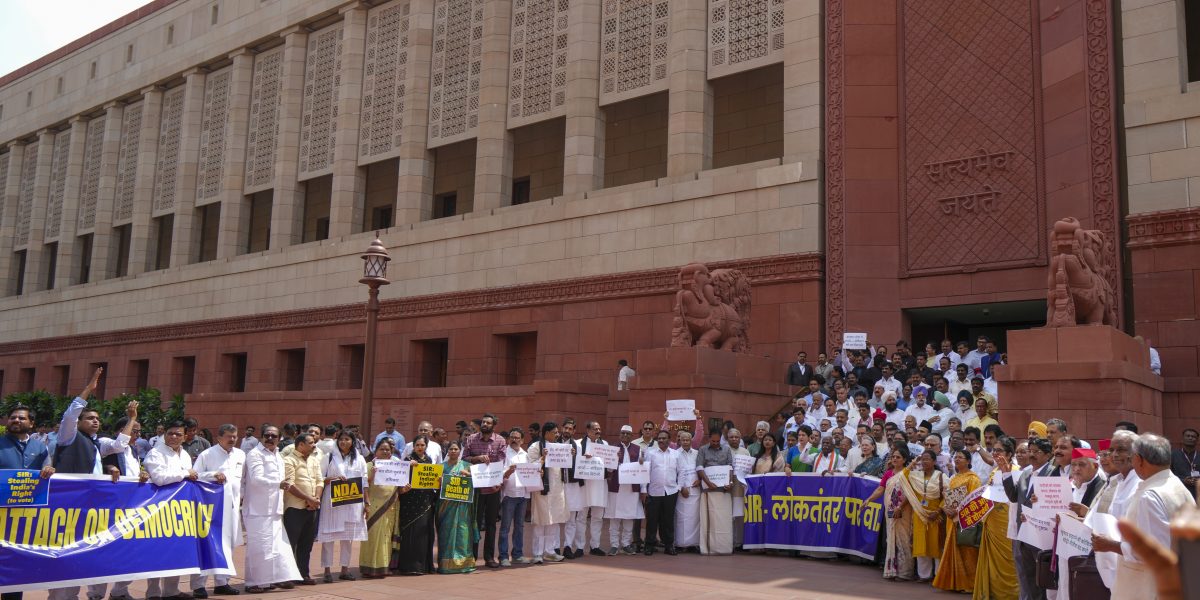
Coming alive to the enormity of the departure that the Commission has sought to make from all previous practices, the political opposition which represents some 60% of the electorate, is up in revolt at the gumption of the EC to play sixes and sevens with citizen’s ‘basic right’ to the expression of democratic choice–one that the poorest Indian cherishes as the greatest gift of the constitutional regime to her/him, however misery-ridden their livelihood circumstances,
Thus the questions:
- will the Supreme Court in its next hearing on the matter on July 28 retrieve the Republic from a looming catastrophe?
- will the Election Commission see right and retrace its deleterious course of action?
- will the protesting opposition tire itself out in the face of a recalcitrance never seen before in Independent India?
- or will it stand its ground to the point of actually boycotting the next election to come in Bihar, and perhaps elections thereafter?
Should the boycott happen, how may the world evaluate the commitment of the Modi-dispensation to democracy in India? Especially since the ruling BJP seems to be the only political faction endorsing the Commission’s course of action?


Badri Raina is a well-known commentator on politics, culture and society. His columns on the Znet have a global following. Raina taught English literature at the University of Delhi for over four decades and is the author of the much acclaimed Dickens and the Dialectic of Growth. He has several collections of poems and translations. His writings have appeared in nearly all major English dailies and journals in India.
ZNetwork is funded solely through the generosity of its readers.
Donate




