A few days before Donald Trump’s stunning upset, the Eiffel Tower and Arc de Triomphe glowed green in Paris.

France was celebrating the Paris Climate Agreement, which came into force on November 4. It was a remarkable achievement.

Less than a year after 196 countries signed the accords, over two-thirds of the world’s countries — including the two biggest greenhouse gas emitters, the U.S. and China — ratified it, agreeing to an upper limit of 2 degrees Celsius in atmospheric warming.

But with Donald Trump’s ascendancy, and his pledge to withdraw from the Paris Agreement, the world is back to an uncertain climate future.

While some mourn the possibility that the Paris Agreement will be undone, it’s important to remember that it was always aspirational.

After all, the deal offers no timetable for ratcheting down consumption of fossil fuels, and no sanctions for countries that fail to meet targets. The deal promises a small amount of assistance to developing countries fighting climate change, but most of that is merely repackaged development aid.

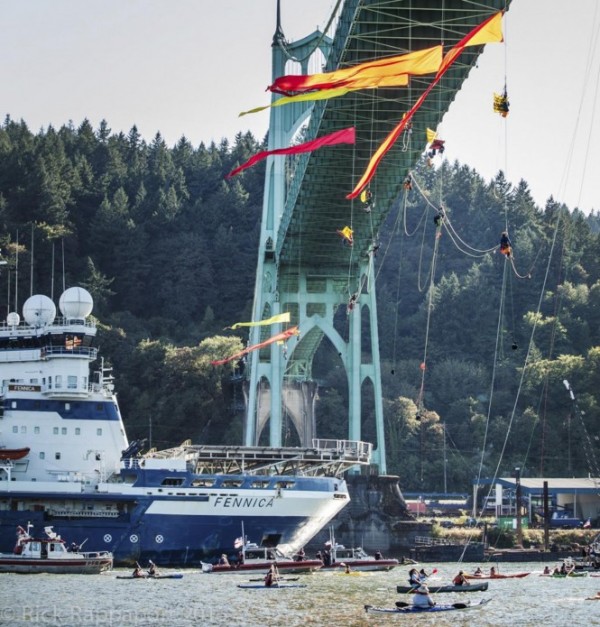
“Kayaktivists” rally against fossil fuel infrastructure in Portland. (Photo by Rick Rappaport)

More frighteningly still, the world’s existing fossil fuel infrastructure and proven wells and mines will sail us right past the 2 degree upper limit if they’re all exploited.

So what’s to be done?

One path forward is emerging from the clear-eyed citizens of Portland, Oregon, who are pioneering a more proactive, locally-led path forward.

A year ago, Portland’s city council unanimously voted to “actively oppose expansion of infrastructure whose primary purpose is transporting or storing fossil fuels in or through Portland or adjacent waterways.”

Its city leaders took this step as much out of a desire to protect their own health and safety as out of a desire to act on climate change.

Much of Portland’s fossil fuel infrastructure lies in an industrial zone that, should an earthquake come, would rapidly turn to Jell-O. And oil train derailments — like the one earlier this year in nearby Mosier, Oregon — can cause out-of-control blazes.

Respect for indigenous communities is another factor. The Standing Rock Sioux’s protest against the Dakota Access Pipeline is a reminder that Native treaty rights are routinely flouted by the fossil fuel industry. It happens here in the Northwest, too.

But climate science is the central piece. A recent study found that if we are to maintain a mere 66 percent chance to avoid passing that 2 degree limit, no more new major fossil fuel infrastructure can be built.

In fact, we must actually leave many proven reserves untapped and begin to dismantle existing fossil fuel infrastructure.

President Obama did the right thing in signing the Paris Agreement. He also took a bold step in issuing guidelines for federal agencies to disclose greenhouse gas emissions associated with major infrastructure projects, like the Dakota Access Pipeline, and consider alternatives should the impact be significant.

But at this moment in time, neither is sufficient.

If Obama takes one final bold action before leaving office, it should be this: He should impose his “climate test” on the Dakota Access Pipeline and ensure that Native American treaty rights are respected.

But in the years to come the real action will be at the local level.

Portland Mayor Charlie Hales is showing the world what a first step might look like. On November 17, Portland’s city council will vote on what is likely the strongest land use code language in the country prohibiting all new fossil fuel export infrastructure.

Should it pass and become binding law, we’ll know who the real world leaders are. Paris — and the rest of the Paris Agreement signatories — would do well to follow Portland’s lead.

And if you do, back home in our evergreen city, we’ll raise a glass of microbrew in your honor.

Daphne Wysham, an Institute for Policy Studies associate fellow, is the director of the Center for Sustainable Economy’s climate and energy program in Portland, Oregon. Distributed by OtherWords.org.


ZNetwork is funded solely through the generosity of its readers.

Donate
Donate
Leave A Reply

Subscribe

All the latest from Z, directly to your inbox.

Institute for Social and Cultural Communications, Inc. is a 501(c)3 non-profit.

Our EIN# is #22-2959506. Your donation is tax-deductible to the extent allowable by law.

We do not accept funding from advertising or corporate sponsors.  We rely on donors like you to do our work.

ZNetwork: Left News, Analysis, Vision & Strategy

Subscribe

All the latest from Z, directly to your inbox.

THE WIND CRIES FREEDOM

The Wind Cries Freedom, the new book from Z co-founder Michael Albert, is a sweeping oral history of a future American revolution.

Through thirty interconnected chapters, it draws out the strategies, failures, turning points, and hard-won wisdom of a movement that called itself the Revolutionary Participatory Society. These are not the polished memoirs of politicians: they are the unfiltered accounts of people who organized in neighborhoods, hospitals, universities, stadiums, courthouses, and places of worship, and kept a shared vision alive through cynicism and exhaustion.

The result is speculative political fiction that reads like history: messy, human, and quietly hopeful in the way that only real experience and long thought can produce.

Get your copy and peruse more features on the book’s website below.

“Read it, argue with it, but don’t look away. The future it recalls is one we must still fight to deserve.”

Yanis Varoufakis

“The most unusual and intriguing combination of prophecy, manifesto, and movement building manual that I have ever encountered.”

Bill Fletcher Junior

“This work fills a huge gap in our social movement literature.”

Cynthia Peters

You've just read your article on Z this month.

DOES Z'S SURVIVAL MATTER?

You keep coming back for a reason: serious political analysis, movement reporting, and debate beyond the priorities of corporate media. Today, Z is in a precarious financial position. If Z is part of how you understand the world, help keep it going. The readers who give monthly are the reason this work survives between fundraisers.

Z is in a precarious financial position. If it’s part of how you understand the world, help keep it going.

Number of donors704
Our goal1,000

Sustainers at $9/month or more receive the digital Z Magazine.

Already a sustainer? Click here and we won’t ask again. Thank you!

Your reading count is stored only in your browser and is never sent to us.

Sound is muted by default.  Tap 🔊 for the full experience

CRITICAL ACTION

Critical Action is a longtime friend of Z and a music and storytelling project grounded in liberation, solidarity, and resistance to authoritarian power. Through music, narrative, and multimedia, the project engages the same political realities and movement traditions that guide and motivate Z’s work.

If this project resonates with you, you can learn more about it and find ways to support the work using the link below.

Z is in the most precarious financial position in its history.

Z is a place to think beyond the limits of the present.

For decades, Z has brought together political analysis, movement reporting, debate, and visions of a different future from writers and activists around the world. That work is more than journalism. It is movement infrastructure: movements need places to develop ideas, test arguments, learn from experience, and imagine what comes next.

In the first two days of this fundraiser, 19 donors and 8 new monthly sustainers stepped up. Help us reach 1,000 donors who keep Z independent, for everyone.

For decades, Z has published the analysis, debate, and visions movements need, free of paywalls, ads, and billionaire owners. If that work should continue, Z needs your support now.

Number of donors704
Our goal1,000

Sustainers at $9/month or more receive the digital Z Magazine.

Subscribe

Join the Z Community – receive event invites, announcements, a Weekly Digest, and opportunities to engage.

Exit mobile version

