


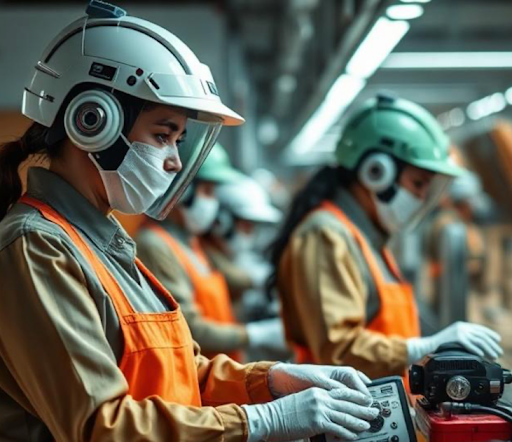
A recent study from Germany shows that those who understand artificial intelligence (AI) are more scared of losing their jobs. So far, experts on Germany’s labor market (a market that sells nothing) and AI had — wrongly — “assumed” that people who know very little about AI were those who most feared losing their jobs because of AI. This assumption was not supported by the recent study.
This is why sociological research is needed. It can correct “assumptions” that many people hold — at times with devastating consequences, as shown by the hallucination that there would be a Corona dictatorship in the wake of Covid-19, or that global warming is a hoax, etc.
Surprisingly, the recent study from Germany shows the exact opposite. Meanwhile, many people in Germany are currently worried about an AI-driven future of their jobs — and these concerns are not unwarranted.
According to a recent “Mercer Survey” conducted at the end of May 2026, 99% — in other words, nearly all — CEOs in Germany expect to lay off workers in the next two years. These jobs will be replaced by AI tools.
Meanwhile, the recent AI study in Germany produced a “disturbing” result. Many observers in Germany had assumed that job losses due to AI would occur mainly as a consequence of a lack of information and knowledge about AI.
Yet a study at TU Darmstadt found the opposite to be the case. This is a valuable, and at the same time rather disturbing, result. The key finding is that the better people in Germany understand how AI works and what the technology is all about, the greater their concern that management will put pressure on them and that they will lose their jobs.
In the survey, around 43% of people in Germany who said they had a very good understanding of AI know-how also expect that AI could soon take over their work. Germany’s tech professionals recognize the explosive power of AI.
In other words, those who understand AI best also recognize — most significantly — the disruptive power of AI. This holds regardless of which sector of the German economy they work in. Rather, the key question is whether their own work can be digitalized and automated by AI.
Unsurprisingly, this is even more true for the production of texts, analyses, reports, presentations, program code, and other digital work. This applies much more to lawyers, software developers, and social media experts than to those less affected by what Germans call the “Gen-AI Revolution.” Less affected, by comparison, are craftspeople and tradespeople [Handwerker] and workers in Germany’s health and care sectors [Krankenpfleger].
Meanwhile, AI has arrived in everyday life, but it is used primarily by Germany’s young, well-educated, and predominantly male users. Beyond that, the researchers also point to what Germans call an “AI training gap.” This is not unusual, as under capitalism, corporate management does not want to spend money on training workers, yet paradoxically still expects a well-trained workforce.
This is one of the more classic contradictions of capitalism — one the state often resolves by providing state-based training. Alternatively, companies prefer to offload this externality onto the individual, particularly in countries defined by rampant neoliberalism.
Tellingly, just 15% of the 2,000 workers surveyed in Germany had received appropriate training within their company. In other words, a whopping 85% received no training on AI at all. And yet managers never tire of claiming that “people are our most important asset.” Perhaps, as Rob Macklin writes in The Morally Decent HR Manager, one should never forget the lies told yesterday.
What makes this even worse is that AI will create new work tasks, but not to an extent that offsets the jobs it cuts. Knowing this, and as free-market ideology continues to prevail, many bosses simultaneously demand that business and politics (the state) respond to these concerns.
In addition to the fear management stokes in German workplaces — aware that fearful people are easier to manipulate — there are two further risks for workers:
- Hallucinations — outcomes generated by AI can appear convincing but be incorrect.
- Data — what happens to the data workers produce, or the data management produces about workers?
Notably, people in Germany expect “digital sovereignty” in AI and related AI policy to move closer to the center of public debate, demanding democratic control over AI. In this, one might recognize that the old narrative no longer holds. The more people understand AI, the less their fears about it fade — quite the opposite.
The greater the understanding of AI, the greater workers’ concerns about their work and their jobs. This means that business leaders, politicians, workers, and trade unions all need to address these concerns, pushing management and companies to give “honest answers” to the questions of tomorrow’s world of work — a world increasingly shaped by AI.
Meanwhile, there are significant differences between generations of workers in Germany in terms of weekly AI use:
- Generation Z (born 1997–2012) leads AI use at 73.7%
- Millennials (born 1981–1996) follow at 62.5%
- Generation X (born 1965–1980) at 38.8%
- Baby Boomers (born 1946–1964) at 26.3%
It is notable that the biggest jump is not at the edges but in the middle of working life: between Millennials and Generation X, regular AI usage drops by almost 24 percentage points.
This suggests that, alongside age, the context in which someone first encounters AI is especially relevant to whether it becomes part of their routine — for example, at school, university, or the start of digitally oriented vocational training and apprenticeships.
In terms of gender, weekly AI use stands at 49.3% for men and 43.9% for women. In terms of education, AI use rises from 40% among those with lower education levels to 44.4% for medium education levels, and to 55.2% for those with higher education.
Still, these differences are smaller than the differences between generations. Wherever a work environment creates contact points with AI, workers are more likely to develop a habit of using it.
At the same time, roughly a quarter of the German population has not yet used AI at all. In other words, AI use is not defined by generation alone but also requires access to AI and a certain affinity and positive attitude toward it.
Looking at actual use, Germans use AI predominantly as a source of information: 71.0% use it for inquiries, answering questions, and learning; 51.9% use it to create, revise, and translate written texts; 38.1% use it for brainstorming and generating media content; and just 16.0% use it for programming and data analysis.
Using AI for programming or data analysis requires both the ability to complete the task and the ability to evaluate the result — and this is exactly where a knowledge gap opens. The higher the barrier to entry for a given AI use case, the more significant prior knowledge becomes in determining whether AI is used at all.
Interestingly, a worker’s profession explains very little about their use of AI. The type of work-related activity makes little difference — with one exception: among workers who create and revise written texts in office and knowledge-work settings, 64.8% use AI, significantly above the overall average of 47.1%.
Overall, proximity to AI explains AI use far better than professional status does. In other words, workers who are familiar with AI use it for more demanding applications, while those who remain distant from it are largely limited to factchecking and having things explained to them.
There are significant differences in AI use, AI competencies, and — most importantly — trust in AI. Many people in Germany use AI regularly, but they have only limited knowledge of how it actually functions.
Particularly noteworthy is the connection between AI knowledge and fear about AI in the workplace. Ironically, those who engage with AI most intensively are also the ones who expect the most profound changes to their working lives — often not for the better.
Most importantly, in-depth knowledge of AI does not lead to greater ease about it — quite the opposite. It sharpens workers’ understanding of coming automation and the fundamental changes AI may bring.
AI competence is not just a skill workers need; it is also a prerequisite for an informed public discourse about AI. Workers’ concerns in Germany are not about speculative scenarios involving superintelligent AI, but about its actual use in German workplaces — how algorithms are applied and how personal data is protected.
For companies and corporate managers, this means that trust in AI can be built mainly through reliable applications, transparency, responsible data handling, worker participation, and the involvement of trade unions.


Thomas Klikauer has over 1200 publications (including 16 books) and writes regularly for Cross Border Talks ( Europe), Countercurrents (India), and ZNet (USA) on global warming, labor relations, and Germany’s far right.
ZNetwork is funded solely through the generosity of its readers.
Donate




