


The 2016 political season is like no other in recent memory. Senator Bernie Sanders led an extraordinary progressive movement while Donald Trump has been leading a populist movement based upon white rage with the status quo; both movements promise to continue well into the future. The campaigns have raised new questions about race relations, media, campaign funding and the future of democracy itself. In this moment it’s worth thinking back to the unforgettable presidential campaign of 1968 in which Senator Eugene McCarthy led a progressive anti-Vietnam war campaign, but (unlike Sanders) abandoned the cause when he failed to receive the Democratic nomination.
New York City teachers Saul Isaacson and Daniel Falcone recently interviewed Professor Noam Chomsky in his MIT office to discuss the characteristics of this political season and the prospects for a future progressive movement.
Saul Isaacson: When I think of how Bernie Sanders is relating to Hillary Clinton, I compare it with a very different situation: the 1968 presidential race between then Vice President Hubert Humphrey and Richard Nixon. I don’t think Minnesota Senator Eugene McCarthy ever came out for Humphrey after having run against him on an anti-war platform in the primaries.
Noam Chomsky: [McCarthy] was a total fraud [when he did not support the candidacy of Hubert Humphrey after failing to get the Democratic nomination in 1968]. Just take a look at what he did. He had no background in opposition to the war. He was not one of the senators who took a stand on anything. There were some, but he wasn’t one. When he saw that there was a political opportunity, he jumped in and tried to make something of it for himself. He had these young people supporting him, that when they came out in the streets of Chicago and were beaten bloody by the police, he didn’t do anything. And as soon as he didn’t get the nomination, he just disappeared.
He went home and decided to write poetry. He had a lot of prestige at the time — undeserved — but he had it. He could’ve had a voice. He could’ve had an influence, but he didn’t give a damn. He was just out for himself. He was, I think, one of the worst figures in US political history.
He could, theoretically, be responsible for the election of Nixon?
Partly, but then he didn’t do what he could’ve done. He was in a position kind of like Bernie Sanders, but Sanders is continuing. He’s not saying, “OK, I’ll go home and write poetry.”
You feel Sanders is doing the right thing?
Pretty much, I think. People said he was depicted — and he depicted himself — as a political revolutionary, but he’s not. He’s a decent, honest New Dealer. He wouldn’t have surprised Eisenhower very much. It’s just the country has gone so far to the right, that when he takes sort of New Deal positions, he looks like he’s from outer space. But he never pretended to be anything else. I think he’s an honest guy. He says what he believes. Always [said] he would support the Democratic candidate. He’s doing it. And I think it makes sense.
Will we survive this election? It’s hard to believe.
Hard to believe…. I thought the [first presidential] debate was horrible…. No [discussion of] substantial policy issues. And I’m not surprised. The same for the media coverage; there is simply no discussion of policy issues. There are only discussions of style, did you look presidential, that kind of thing. Did you not have an answer to something? Who cares?
What happened to our ability to discuss issues?
Mainstream ideology is never going to want to discuss issues, because it’s too threatening, so if others don’t do it, it’ll disappear. Tell me, why should they? They want things supportive of power systems — it’s kind of like getting people hooked on television, or [consuming], or on sports or something. If you can get the public out of your hair, it’s fine. If you start discussing issues, people get involved. So you certainly don’t want to do that. So it’s up to the rest of us. But it’s always been like that.
Did the media have an interest in Trump other than ratings?
The CEO of CBS said it straight out. He said [Trump’s] the best thing for [CBS] that’s ever happened, and they’re a business, you know. They’re not in the business of providing support for radical political change. They want to make money and maintain the status quo. So does Donald Trump. It’s good. It’s kind of like running his television program.
Is racism behind the Trump campaign and behind Trump’s popularity?
There’s no doubt. Take a look at the poll analyses. The Trump voters are pretty racist. But I think that there are things about the United States that aren’t really recognized sufficiently, so it’s important to remember that until 1945, the United States was a cultural backwater. It wasn’t part of the modern world…. So, a good part of the country is still [adhering to] what’s been traditional. It’s just not part of the modern world. Just take a look at the statistics. The religious fanaticism, there’s just nothing like it in the world. I mean, one of the problems with getting people interested in global warming is that about 40 percent of the population thinks that Jesus is coming in 2050, so who cares, you know.
I think that’s a large part of what we see in the Trump phenomenon. There’s a front-page story in The New York Times which is kind of interesting … it’s about a couple — [from] some Midwestern town — who are super ultra-religious, and had a small chapel behind their home … a gay couple wanted to be married there, and they refused, and then they are forced to accept it by the law. But for them, that means the whole world is collapsing. Their entire world is collapsing. They lived in a Christian 19th-century world where these things didn’t exist, and now all of a sudden, they’re in a world in which they’re forced to accept gay couples. I’m almost sure they’re considering voting for Trump.
Daniel Falcone: Could you touch on how the current situation in the US differs from the current situation in Europe?
Right now [the British are] kind of destroying themselves with economic policies that are much worse than those here. By comparison, the US looks progressive. Europe is worse. Now, European democracy is just being completely undermined by the troika. And the decisions — they’re just taken away from nation-states where at least people had some kind of voice — and now placed in the hands of Belgian bureaucrats with the northern banks looking over their shoulders. It’s pretty scary. I’m old enough to feel some shivers when I see some neo-Nazi parties taking over in Austria and gaining strength in Germany. Those are not good memories. I can remember their speeches. I don’t think it’s going there — but it’s not pretty.
Isaacson: Is there a place in the world where you’re hopeful about democracy?
There are strong possibilities here in the United States. I mean, almost everywhere, there’s something — how much will it develop? It’s up to us. Like the Sanders phenomenon, I think, was completely unexpected. At least, I didn’t expect it. And it could have good consequences. I think it’s an indication that the activism of the last couple of decades is all there somewhere. It just has to be organized. And I think there’s some pretty interesting developments coming out of the Sanders campaign, like the Brand New Congress movement [the movement founded by Sanders supporters to elect an actively progressive Congress], and a couple of others, which made some sense.
These are opportunities that the Greens never exploited. The Greens never made an effort to become an alternative political movement. That’s Jill Stein’s fault, among others. So there are almost no Green legislators or city council members or school board members. They just show up every four years for the extravaganza. But now some of the Sanders people are trying to change that, which makes sense.
Note: This interview has been edited for clarity, readability and concision.

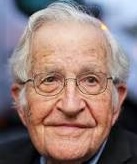
Noam Chomsky (born on December 7, 1928, in Philadelphia, Pennsylvania) is an American linguist, philosopher, cognitive scientist, historical essayist, social critic, and political activist. Sometimes called "the father of modern linguistics", Chomsky is also a major figure in analytic philosophy and one of the founders of the field of cognitive science. He is a Laureate Professor of Linguistics at the University of Arizona and an Institute Professor Emeritus at the Massachusetts Institute of Technology (MIT), and is the author of more than 150 books. He has written and lectured widely on linguistics, philosophy, intellectual history, contemporary issues, and particularly international affairs and U.S. foreign policy. Chomsky has been a writer for Z projects since their earliest inception, and is a tireless supporter of our operations.
ZNetwork is funded solely through the generosity of its readers.
Donate




