


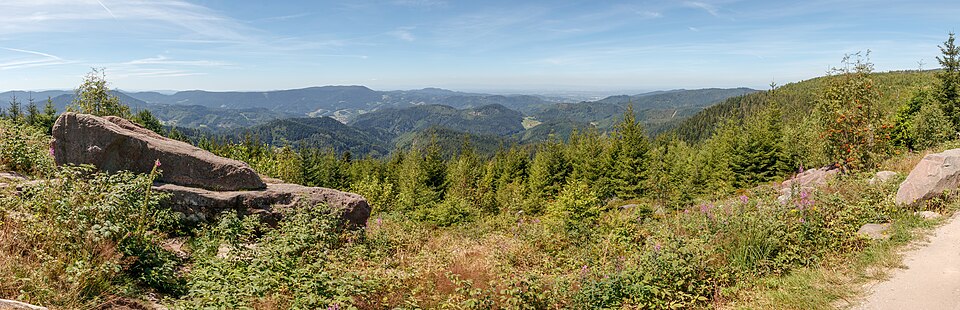
Long before Little Red Riding Hood — or Rotkäppchen — and even before Tacitus’s Germania (98 AD), Germans had a quasi-mythical relationship to their forests.
About 150 years ago, the German forest became very important. At that time, a young lawyer by the name of Karl Marx wrote a series of articles published in 1842 in the famous Rheinische Zeitung, or Rhineland News. In English, it is known as “Debates on the Law on Thefts of Wood.”
Marx’s articles are about the criminalization of a traditional practice carried out by local peasants for decades: gathering fallen branches, deadwood, and berries from forests that had once been considered common land. Under capitalism’s changing property laws, forest owners were converting these customary rights into strict private-property claims — disused fallen wood suddenly became a commodity.
Gathering wood that had previously been treated as a communal resource was being redefined as theft. This might have helped the young Karl look at capitalism in a way that led to what is today known as Das Kapital — still the best analysis of capitalism ever written.
One hundred and twenty years after that, Alexandra sang “Mein Freund der Baum ist tot. Er fiel im frühen Morgenrot” [“My friend the tree is dead. It fell in the early dawn light”] in the late 1960s.
Since then, things have not gotten better for Germany’s beloved forests — a country that, despite rampant industrialization, massive “concretization,” endless miles of the Autobahn, land clearing, and the best efforts neoliberal capitalism can muster to exploit and vandalize Germany’s natural environment, still has forest cover of about one-third.
Instead of preserving Germany’s forests, German capitalism displays true hubris — true arrogance toward the Earth and the environment.
As has been predicted many times over, this will inevitably lead to the downfall of a people addicted to hubris. As The NewYorker once put it, “Yes, the planet got destroyed. But for a beautiful moment in time, we created a lot of value for shareholders.”
It will play out exactly as the UN’s Guterres said: “We are playing Russian roulette with our planet. We need an exit ramp off the highway to climate hell, and the truth is we have control of the wheel.”
This is exactly where capitalism, greed, the free market, and profit have driven humanity: to a fatal crossing of the border between profit and survival, reflected today in the corporate-made climate crisis known as global warming.
The people of Europe have felt the direct consequences of that — well, many died — across the whole continent during last summer’s fire season, which grows ever longer and more severe.
It featured heat waves that caused mass death, massive droughts that halted shipping, and, of course, extended forest fires from Greece to Spain and from France to Sweden. It is as if nature has taken revenge with divine wrath. The tormented environment has reacted with physical precision to its destructive exploitation by corporate greed.
In past centuries, a robust mix of forests filled Germany. But it was soon replaced with “resilient” — the crypto-official codeword for “profitable” — softwood plantations. These are the dreaded, sterile, and stale monocultures that create dead zones for plant and animal life.
Meanwhile, the ever-increasing droughts of recent years have even attacked these carefully crafted and cultivated monocultures. Weakened by heat and drought, trees fall easy prey to the bark beetle, dealing them ever more severe blows. Now substantially weakened, these dry forests are not only defenseless — they also burn almost every year, with cumulative intensity.
Germany’s southern neighbors are even worse off. They fight eternal battles against the forces that global warming brings every summer. They fight seas of flame. Nevertheless, far too little is happening on the political side to deal not only with this homemade climate crisis but also to make Germany’s — and indeed Europe’s — forests nature-friendly, sustainable, and, ultimately, survivable.
Corporate Europe has sown the seeds of destruction. Now others reap the harvest of ashes. This is not unique to Germany or Europe. Sadly, forest fires are setting records worldwide, and frequently.
There are record-breaking temperatures, droughts, dried-up soil (with “peak soil” now behind us), and forest fires announced year after year. This is now the recurring headline that defines each year’s “world news” — a marker not just of global warming but of the “Capitalocene.”
It follows from the human- and corporate-made climate crisis. Drought, dry soil, and forest management driven by profit rather than sustainability increase the risk of forest fires and their spread around the world. The lack of political action on forest protection and climate protection only pours — almost literally — oil on the fire.
Tellingly, the conservative German government of Helmut Kohl (1982–1998) renamed the country’s official Waldsterbensbericht (forest-death report) to Waldzustandsbericht (forest-condition report) — from “dying forests” to forests that merely have a “condition” (Zustand).
With this reality-denying, anti-environmental sleight of hand, Kohl’s government could suddenly declare that all was fine in Germany’s forests. Despite Kohl’s media manipulation, the forests continued to die.
According to the European Space Agency’s Earth observation program, Copernicus, Europe had the highest emissions from forest fires in 2025 since ESA‘s records began 23 years ago.
The extent of the destruction is shown in detail. Approximately 47.3 million tons of CO₂ (equivalent to roughly 13 megatons of carbon) were released — equal to the total annual carbon emissions of a country like Portugal, from fires alone.
In everyday life, such quantities are almost impossible to grasp, but a comparison helps: it is the equivalent of the annual output of 10.5 million gasoline cars, or of running twelve coal-fired power plants — one of the most polluting sources of energy — around the clock, all year.
It gets worse. Particularly alarming is what is known as the “catch-up dilemma.” To filter these 47 million tons of CO₂ out of the atmosphere within a single year, Europe would need 22 million hectares of healthy forest — twenty times the area that burned in 2025.
It gets worse still: there is a “double damage.” In addition to the direct emissions from the destroyed forest, that forest is also lost as an active carbon store in the fight against the climate crisis.
According to preliminary evaluations from Germany’s national weather service (Deutscher Wetterdienst), spring 2026 in Germany was exceptionally mild, dry, and sunny. Nationwide, only 68% of normal precipitation fell — a third was missing. Regional differences made this worse still: some parts of Germany saw heavy rain, while southern Germany suffered historic drought.
According to the European Forest Fire Information System (EFFIS), 580,000 hectares of forest had burned as of mid-August — significantly more than the long-term average of about 243,000 hectares.
This was especially severe in France, which experienced a historic extreme during July; Portugal, Spain, Germany, and parts of the Balkans were also hit hard.
Intensive commercial forestry with monocultures makes forests far more vulnerable to drought and pests. What is needed is a significant change in forestry: a close-to-nature forest, with cool, moist mixed habitats that conserve more water, can survive prolonged, global-warming-induced droughts while also capturing CO₂.
Meanwhile, there are plenty of current examples of forest fires and the danger they pose. In France, Spain, and several other Mediterranean regions, locals were fighting the flames even as Germany itself was burning.
- France: The area burned was five times that of a “normal” year — though under global warming’s drive toward climate hell, there are no more “normal” years. Two firefighters died. In the Département of Gironde, in and around Bordeaux, up to 220,000 people had to be evacuated from the flames.
- Spain: Fires were eventually brought under control after a long, hard battle. At the beginning of August 2026, no fewer than 40 large-scale fires had burned 250,000 acres of forest — compared with 15 simultaneous fires the previous year. Global warming and fires are accelerating together.
- Germany: Soil moisture levels had already fallen to levels as threatening as those seen in 2018 and 2022. Less moisture means drier forests and more intense fires. Germany’s forest-fire danger index (Waldbrandgefahrenindex) has been ringing alarm bells: by August 2, 2026, the index had reached 22 days at extreme warning levels — more than twice the average for 1991–2020. The consequences are visible, especially in southern Germany, where an unusually high number of trees were already shedding their leaves by midsummer; with the foliage gone, sunlight hits the ground directly and the forest heats up further.
- South and East Germany: Germany’s coniferous forests in the hotter southern and eastern regions are particularly sensitive.
- Unexploded Ordnance: In some remote, mountainous areas of eastern Germany, there is an added risk from old, slowly decaying ammunition — grenades and shells left behind from former military training grounds. Some can self-ignite in extreme summer heat and start fires.
- Lower Saxony: The water needed to fight forest fires in the Lüneburg Heath area (Main-Kinzig-Kreis) led local authorities to ask residents to stop showering. Alongside the risk to forests, grassland fires are also becoming more frequent.
- Canada: Europe is by no means alone in this. Other continents are also suffering forests in flames. In the Canadian province of British Columbia, for example, 20,000 people fled a runaway forest fire.
- Brazil: Amid all the bad news, there is one bright spot. Brazil — no longer run by the “clerico-neo-fascist” Jair “Messias”(!) Bolsonaro but by Lula — has had notable success with its forest conservation policy. Under President Lula, deforestation has declined to a ten-year low, and 80% less of Brazil’s forest area burned compared with the previous year.
On the obvious question of what causes forest fires, natural events like lightning strikes are among the least common causes. Data from Germany’s Federal Office for Agriculture and Food (Bundesanstalt für Landwirtschaft und Ernährung, BLE) show that in Germany in 2025, no more than 3% of such fires were caused by natural events.
By far the single greatest cause of forest fires is people. High on the list is carelessness — a discarded cigarette, for example. In some countries, it is slash-and-burn agriculture.
Compounding this is the human-made climate crisis, which intensifies the frequency and spread of forest fires, producing a fatal downward spiral:
- global warming leads to
- more frequent heat waves, which lead to more droughts, which cause
- crops, forest plants, and trees to become dehydrated, while soil and forest floors grow ever drier, and as a result,
- more forest fires occur.
On the inevitable question of what can be done: recent data confirms that drought alone does not cause forest fires. Rather, poor forest management (Forstwirtschaft) plays a crucial role, particularly when profit-seeking weakens ecosystems:
- Monoculture: Planting predominantly, or even exclusively, one species of tree brings serious disadvantages. Such monoculture plantations are no longer natural habitats for many animals, fungi, and plants. Trees become more vulnerable than they would be in their natural setting, soil becomes more acidic, and the natural water balance is disrupted. Rewilding a forest can reverse all of this.
- Non-native species: For example, highly profitable conifers such as pines grow naturally in colder regions like Scandinavia and at higher altitudes. Across much of Germany, many of them would not grow naturally at all. For decades, profit-driven forestry has relied on fast-growing conifers to maximize profits. This needs to change, in a shift that puts nature and our common survival ahead of profit.
- Heavy machinery: To make forestry even more profitable, heavy machinery is run through the forest — no longer Little Red Riding Hood’s woods, but the domain of diesel-powered bulldozers and trucks. This equipment is highly damaging to Germany’s sensitive forest floors. So-called full-harvesting machines (harvesters) can fell a tree, strip its branches, and trim it within minutes — processing over 100 trees a day. Efficient (the magic word of all management) and profitable, yes, but deadly to nature: machines weighing 40 to 100 tons compact the forest floor, rendering it uninhabitable for microorganisms and plant life. The damage is permanent and must stop.
- Reforestation: Reforestation is expensive and labor-intensive, even though nature itself — through rewilding — would do it far better. Worse, commercial reforestation for profit, using fast-growing monocultures, erodes the genetic diversity of parent trees. Left alone, forests develop a natural diversity that is stable — something forests have achieved over millions of years.
- Pesticides: Commercial (that is, for-profit) forestry relies on the heavy use of pesticides to secure short-term profits and compensate for the weaknesses of monocultures. Worse, in the effort to combat the much-feared bark beetle, the forest is turned into a zone of chemical warfare.
- Land clearing: Hard to believe, but still true: Germany continues to practice land clearing and so-called “clear-cutting.” This happens most often in forests already heavily damaged by bark beetle infestations and storms, but it also occurs in other forests — even in protected areas. Rather than allowing the forest to regenerate, heavy machinery cuts down the trees and hauls them away, destroying the delicate forest floor in the process.
- Protected areas: Although 67% of all forest in Germany lies within protected areas, only a minuscule 2.8% is actually protected from logging. In short, “protected areas do not protect.” This is no accident — it gives politicians a double advantage: they can claim to protect the environment while logging and land clearing continue, largely unhindered, across 97.2% of all protected areas, much as they do in unprotected ones.
What is needed is a radically different forest policy in Germany. Built on decades of conservative-neoliberal forest policy — under Kohl (1982–1998), Merkel (2005–2021), and Merz (since May 2025), spanning, with only a few brief interruptions, the better part of the last 40 years — Germany’s forestry policy has promoted intensive, for-profit forest management, with next to no incentive for its woods to return to a natural state.
If German forests are to remain allies in the fight against global warming, forest management in its current form cannot continue. Germany, Europe, and the world need an urgent turnaround in how we — humanity, or more precisely the profit-driven businesses that act on our behalf — use, misuse, and abuse forests.
What is needed is a sustainable forest policy, grounded in an ecosystem approach that ensures our planet’s survival, today and into the future.

Thomas Klikauer has over 1200 publications (including 16 books) and writes regularly for Cross Border Talks ( Europe), Countercurrents (India), and ZNet (USA) on global warming, labor relations, and Germany’s far right.
ZNetwork is funded solely through the generosity of its readers.
Donate




