

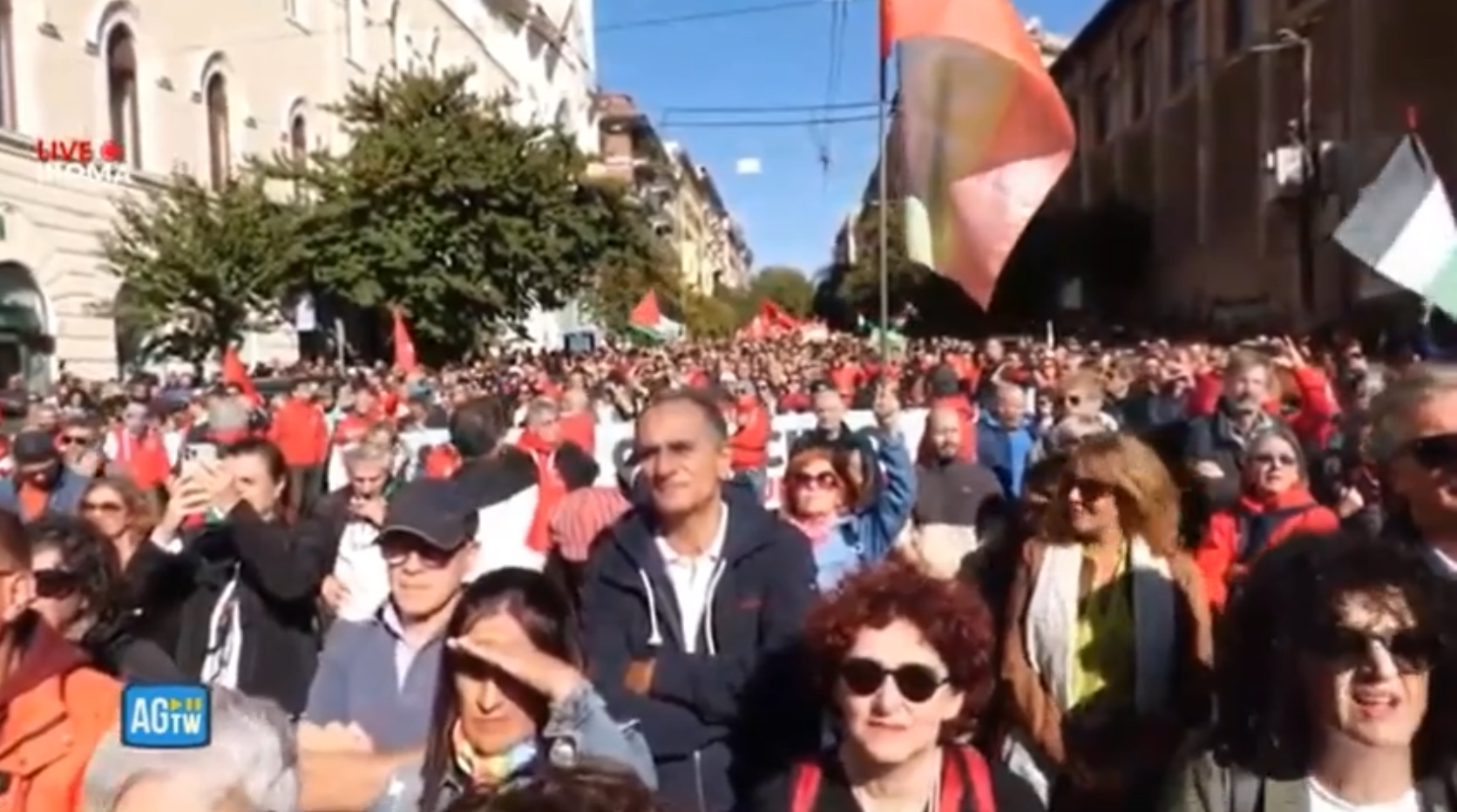
“The Italian people made us smile in Gaza.” With these words, Eman Abu Zayed, a Palestinian writer in the bombarded strip, described how Italy’s growing mass mobilizations for Palestine were resonating there. She wrote these words a few days after the twenty-four-hour general strike on September 22, called by the grassroots USB (Unione Sindacale di Base) “in response to the ongoing genocide in the Gaza Strip, the Israeli army’s blockade of humanitarian aid, and the threats against the international Global Sumud Flotilla mission.”
Turnout far exceeded USB’s customary mobilizing capacity — and protests have only grown in size and spread since then. This reached the highest point yet today as the CGIL (Confederazione Generale Italiana del Lavoro, the country’s largest union) joined the call for a twenty-four-hour general strike alongside the grassroots unions. Yet the strike’s success also owed much to two years of sustained organizing by associations, social movements, students, and Italy’s Arab communities.
Changing the Debate
Already this Wednesday night, when Israeli forces illegally boarded the Global Sumud Flotilla and arrested its participants in clear violation of international law, spontaneous rallies and improvised marches erupted in hundreds of Italian cities. The next day, large crowds again took to the streets nationwide, with occupations of railway stations, universities, and ports. Today, once more, massive demonstrations swept Italy from north to south, with over two million people in the streets, coinciding with another twenty-four-hour general strike — this time called by USB together with CGIL.
The unions had pledged to call a twenty-four-hour strike if Israel stopped the flotilla, and they kept their word. Deputy Prime Minister Matteo Salvini — arguably the government’s most overtly pro-Israel and anti-union figure — tried his best to block it, first by declaring it illegal and then by threatening that “those who strike risk personal sanctions” — a claim that is flatly false under Italian law.
Even if the strike were ultimately deemed unlawful (a point the unions contest), any liability would fall on the organizations, not on individual workers. In any case, Salvini’s angry threats had little effect, as the strike was widely supported, with participation in many metalworking plants reportedly exceeding 80 percent.
In recent weeks the flotilla has become a central issue in Italy’s public debate — more so than in other European countries. On board its ships were lawmakers from all three major opposition parties: the Democrats, the Movimento Cinque Stelle (Five Star Movement), and the green-left Alleanza Verdi e Sinistra. The key point is that solidarity with Gaza and with the Global Sumud Flotilla’s humanitarian mission enjoys broad support among Italians. There is deep dissatisfaction with the government’s foreign policy — overly servile toward Israel (so much for its much-vaunted “sovereigntism”) and silent on the ongoing genocide in Palestine.
Two recent polls, by SWG and Izi, found that open support for the flotilla stands at 62 percent and 72 percent, respectively. The data also show that nearly one in two right-leaning voters support it. This is despite Prime Minister Giorgia Meloni’s frequent attacks, accusing flotilla activists of being “irresponsible,” of acting solely to undermine the Italian government (a claim that borders on the absurd, given that Italians made up only about 10 percent of participants), and of being enemies of peace because their actions would threaten Donald Trump’s “peace plan.”
That narrative has had limited effect, even among parts of Meloni’s own electorate. It has pushed her government to shift strategy in recent days: move the conversation away from Gaza, Israel, and the flotilla (where the government is clearly in the minority) and instead hammer relentlessly on how “disruptive” the demonstrations and strikes are.
The script is familiar and comes from the Right’s classic playbook: protesters as “spoiled kids” from social centers; idlers striking on Fridays just to get a long weekend; vandals inconveniencing workers and commuters. The move seeks to resonate with a substantial share of Italians who despise Israel’s actions yet harbor contempt for the Left — especially in its most stereotyped forms.
It is this latter hostility that Meloni has stoked and exploited in recent years, but it failed to work in her attacks on the flotilla in the preceding weeks: its ethic of direct solidarity carried credibility, and sympathy for Palestine runs deep in Italian public opinion, dating back to a time when Rome’s foreign policy was more open to Arab countries and less deferential to US diktats. If the debate can be pulled back to the trope of “spoiled leftists” inconveniencing ordinary people, the government can regain control of the narrative — or this is what Meloni is betting.
Rebuilding Mobilization
The outcome is still in play. Large demonstrations are becoming a near-daily occurrence. Much now hinges on whether Meloni’s wager — to stoke hostility toward the mobilizations by equating them with caricatures of left-wing militants — succeeds. That is far from certain, as the protests reach well beyond the Left’s traditional constituencies.
A great deal will depend on protesters’ ability to present themselves as an expression of the Italian public’s will, rather than be boxed into ideological niches, as Meloni would prefer. Another question is whether Italy’s current wave can energize mobilizations elsewhere in Europe. If so, it could help sustain momentum at home, prolong the cycle of contention, and further squeeze the government over its support for Israel — rhetorically more fragile than ever thanks to mass demonstrations, yet still firm in practice.
After years as Southern Europe’s laggard on mass mobilization and social ferment, Italy is back on the front lines. That a population trapped in a genocidal campaign in Gaza takes heart from Italy’s renewed activism underscores the stakes of this mobilization. It adds powerful emotional impetus to the urgency of pressuring Western governments to end support for Israel and reestablish the basic tenets of international law. Without that support, the Israeli regime’s genocidal campaign would crumble. That is why the mobilization of the Italian people is a concrete source of hope.
ZNetwork is funded solely through the generosity of its readers.
Donate




