

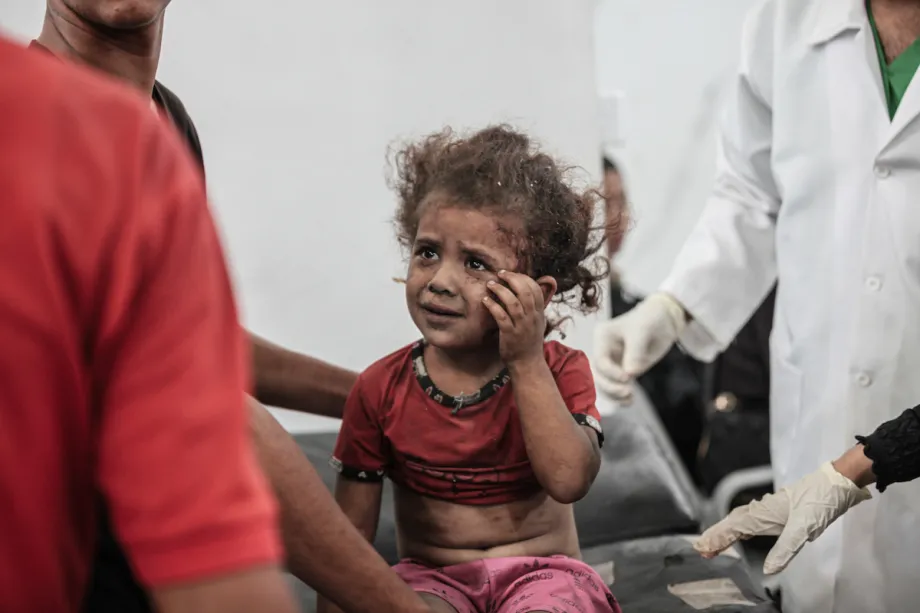
There are moments in history that strip away every illusion we carry about ourselves. Gaza is one such moment. For nearly two years, the world has witnessed a genocide live on its screens. We have seen children pulled from rubble, families starving in tents, hospitals turned to dust. We cannot say we did not know. Every image, every cry, every number has reached us in real time. And yet the killing goes on, the silence goes on, life goes on.
The truth is unbearable but undeniable: we have failed Gaza, and in doing so, we have failed ourselves as human beings.
Frantz Fanon once wrote that colonialism is not a machine but a human reality, and when confronted, it responds with naked violence. Gaza is the purest proof of this truth in our own time. Israel’s colonial war does not speak the language of justice or dialogue; it speaks through bombs, siege, and starvation. Genocide today does not come only with the slogans of hatred but with the bureaucratic jargon of “security,” “collateral damage,” “military necessity.” Western governments supply the bombs while speaking of peace. The United Nations counts the dead while doing nothing to stop the dying. Media outlets repeat official lines while children are buried under rubble.
As Talal Asad reminds us, secular modernity has perfected this art: to kill massively while convincing itself it remains moral. To dress violence in legality, to turn blood into statistics, to make atrocity look like policy. Gaza has become the stage where this moral corruption plays out openly.
Edward Said wrote that Palestine was never just about land, it was about narrative, about who gets to tell the story of suffering. For decades, Palestinians have been denied the right to narrate their own lives, their own deaths. Their pain has always been doubted, reframed, explained away by others. Today, even when Palestinians livestream their own slaughter, the same pattern continues. Their testimony is dismissed, their grief recast as someone else’s security.
Said called this a form of cultural erasure, a silencing that prepares the ground for political violence. Gaza is the ultimate proof of his prophecy: even in their extermination, Palestinians are told their voices are not enough.
Perhaps nothing is more damning than the silence of those who call themselves progressive. The liberal democracies of the West, who preach human rights, tolerance, and justice—are the very powers arming the genocide. Their intellectuals, who fill bookshelves with critiques of racism and climate collapse, suddenly discover “complexity” when asked about Gaza. Universities that issue statements on every global tragedy fall silent when the word “Palestine” is uttered.
This is not an oversight, it is a mask pulled away. Liberal progressivism has always been selective in its empathy, generous to the powerful and cruel to the colonized. Gaza has torn that mask to shreds. What stands revealed is not neutrality but complicity.
The lesson is bitter: liberal progressives were never the guardians of conscience they claimed to be.
But the betrayal is not Western alone. Arab rulers, who built their legitimacy on the cause of Palestine, have abandoned it in full daylight. They sign deals, trade intelligence, buy weapons, and call it “modernization.” They pose with American presidents while Palestinian mothers bury their children. They normalize with Israel while Gaza burns.
Their betrayal cuts deep because it wears the clothes of kinship. They sell it as pragmatism, as necessity, as the future. In truth, it is cowardice, it is profit bought with bloodnd history will remember that while Palestinians starved, Arab leaders signed contracts.
Even the so-called Global South, those nations that wrap themselves in the language of anti-colonial resistance, have too often used Palestine as a symbol while doing little in practice. Statements are made, flags waved, conferences held—but when the time comes to cut trade, boycott, or risk sanctions, silence returns.
Thus, Gaza has exposed not just Western hypocrisy but a global one. North and South, East and West—all are implicated in this moral collapse.
The most unbearable truth is this: Gaza is not only a war on a people but a war on the very idea of innocence. When schools turned into shelters are bombed, when babies die in incubators with no electricity, when thousands of children are buried nameless in shallow graves—something larger than Palestine is being murdered.
Children are the last boundary of humanity, the proof that some values remain sacred. To kill them, knowingly and systematically, is to declare that nothing is sacred anymore. If innocence itself can be destroyed with impunity, then humanity has already destroyed itself.
And yet, amid this horror, Gaza’s children still write poems, still draw pictures in rubble, still dream of tomorrow. Their very survival is an act of defiance. As Mahmoud Darwish wrote, “We suffer from an incurable malady: hope.” That hope itself is resistance, proof that dignity cannot be erased, even under rubble.
There is something grotesque about our time. Billionaires spend fortunes dreaming of colonies on Mars while life on Earth is abandoned. Rockets are designed to explore other planets, drones to deliver packages across cities—yet bread cannot reach starving families in Gaza. We speak of progress, innovation, human genius. But what is progress worth if it coexists with mass graves? What is civilization if it tolerates genocide?
We search for life on Mars while killing life in Gaza. That single sentence captures the sickness of our age.
Conscience is not a possession. It is not something we keep in speeches, laws, or institutions. It is a choice renewed in action. Gaza has been that test, and the world has failed.
To stay silent is to stand with the siege, to weigh words while children starve is to share in the crime, to claim neutrality is to side with power against the powerless, for Gaza has already stripped away every excuse. There is no complexity in bombing hospitals, no neutrality in starving children, no balance in burying entire families.
Gaza is not only a tragedy; it is a teacher. It teaches us that evil no longer hides, it wears the clothes of democracy, speaks the language of law, and is applauded by those who claim to be progressive. It teaches us that conscience can collapse globally, under the weight of profit and power. It teaches us that Palestinians, through their sumud, their steadfast refusal to disappear, remain the last keepers of dignity in an age that has lost all shame.
Their endurance is not only a resistance to occupation. It is a resistance to the death of humanity itself.
One day, the bombs will stop, the rubble will be cleared, the dead will be counted. And history will ask us a question more terrifying than any image we have seen: Where were you when Gaza was erased? What did you do?
There will be no excuses left—not silence, not complexity, not neutrality.
The ruins of Gaza will hold the answer: we saw, and we failed.
But perhaps there is still time to understand what Gaza has been telling us all along: Palestine is not only about Palestinians; it is about us. It is about whether the word human still has meaning. To defend Gaza is not charity, it is not politics, it is survival—of conscience, of dignity, of whatever remains of humanity.
The views expressed in this article belong to the author and do not necessarily reflect the editorial policy of Middle East Monitor or Informed Comment.
ZNetwork is funded solely through the generosity of its readers.
Donate




