


Juan Forero’s front page article for the Wall Street Journal (“Venezuelans Suffer Amid Crumbling Health System”, March 13) did not say that Venezuela’s health care system was amazingly efficient, quite the contrary, but if an outrageous claim he made about public health care spending were true, that is the only logical conclusion.
Forero provided a chart claiming Venezuela’s government spent a mere 1.6% of GDP on health care in 2012. The chart listed Venezuela far below eighteen other Latin American and Caribbean countries. You can obtain his numbers by using data reported on the World Bank’s website (which the World Bank took from the WHO). Multiply the percentage of health expenditure which is public (found here) by total health expenditures as a share of GDP (here). The result is government health expenditures as a percentage of GDP. The approach yields a value of 1.6% for Venezuela which would rank Venezuela barely above Haiti, 1.5%, and well below the Democratic Republic of the Congo (DRC), 2.9%, one of the poorest, war-ravaged countries in Africa. Juan Forero and his editors should have seen that the figure for Venezuela was wildly implausible. It would have been even more obvious had they considered UNICEF’s child mortality data for Venezuela and other Latin American Countries.
UNICEF says the uncertainty level in child mortality data is only about plus or minus 5% for Latin American countries (download its data here). Child mortality is therefore a very accurate and revealing measure of a health care system and of a country’s overall state of development. The table below lists several countries that have higher child mortality rates than Venezuela – all of whom, according to Forero, spend a much higher share of GDP on public health care. The average child mortality rate for Latin America and the Caribbean is also shown.
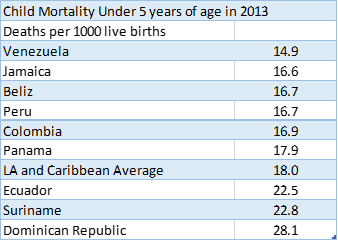
Venezuela’s child mortality rate is significantly better than the regional average. It is also better than Colombia’s and Panama’s even though, according to Forero, Venezuela’s government spent less than a third of what both those countries spend on health care in 2012 – pointing to astonishing efficiency if it were true.
Forero simply failed to include health care spending done through the Venezuela’s state-owned oil company, PDVSA, rather than through the central government.
Under the late Hugo Chavez (the mentor of Venezuela’s current president Nicolas Maduro), who first took office in 1999, Venezuela developed a parallel health care system for the poor that relied heavily on tens of thousands Cuban doctors (not just “thousands” as Forero wrote) working in what are called missions set up in the poorest areas. The system has largely been paid for by PDVSA. Venezuela’s public spending on health care in 2012 was about 4.6% of GDP if PDVSA’s contribution is considered. That is higher than most of the countries listed by Forero. He mentioned the missions but said nothing about the Venezuelan medical establishment’s legal efforts to prevent Cuban doctors from practicing. The medical establishment has been battling Chavista governments for over a decade. Forero makes it appear that the hostility only started under Maduro who took office in 2013. The medical establishment’s hostility is what drove the government to set up Cuban-staffed missions in the first place. That’s quite an important thing to leave out of an article that relied heavily on doctors and companies servicing private hospitals.
Forero also included a graph showing an increase in maternal mortality in Venezuela since 1990. It’s true that UNICEF says maternal mortality has increased in Venezuela by 16% from 1990 to 2013. However, UNICEF also says that data for maternal mortality is extremely uncertain – by about plus or minus 35% for Venezuela. Canada, for example, shows an 81% increase in maternal mortality since 1990, but the numbers are so uncertain that there may only have been a 12% increase. Similar remarks apply to the USA where a 136% increase is reported since 1990. To honestly track trends, Forero would have used the most accurate data. He did not even tell readers about the huge uncertainty levels in the maternal mortality data that he presented. Child mortality, which Forero ignored, has fallen by 33% in Venezuela since 1999 (from 22.1 to 14.9 deaths per thousand live births) which is far greater than any uncertainty in that data.
He wrote that today the “situation marks a sharp departure from the golden era, from the 1950s to the 1970s, when Venezuela was Latin America’s richest nation.” Again, according to UNCIEF’s data, by 1980 Venezuela had a better than average, but nowhere near exceptional, child mortality rate by regional standards. The same is true of Venezuela today. [1] In other words, there were very serious problems with Venezuela’s health care system during what Forero calls the “golden era” though they would not have made the Wall Street Journal’s front page. The problems would have taken a different form than today’s but had an equally serious impact. The “sharp departure” is in how the US government now regards Venezuela – and the corporate press follows the US government’s lead.

Forero provided another chart showing that reported cases of Malaria have been on the increase since 2001. He doesn’t say that deaths from malaria have been steadily declining over that period according to the sources he cited. He doesn’t say that malaria is concentrated near the border Venezuela shares with Guyana, which has a much higher incidence of Malaria than Venezuela. Guyana’s already high incidence of Malaria has also been on the rise in recent years and has been linked to climate change and to a surge in gold mining.
So Just Dismiss Everything Forero said?
To the extent Forero’s claims can be checked, it is easy to show that his reporting is often lousy and (probably by intent) extremely misleading. What about the claims that can’t be easily checked by his readers – the various disturbing anecdotes that depict a system struggling with an inexcusable shortages that puts lives at risk? Unfortunately, people in Venezuela, who cannot be dismissed as anti-government, will say that some of it rings true.
Cuba does not have Venezuela’s oil wealth. It has been under ferocious attack from the USA for several decades, and yet has a child mortality rate today that is lower than the USA’s, and less than half of Venezuela’s. Cuba has achieved that and has still been able to contribute massively to Venezuela’s health care system. That takes all of Venezuela’s excuses away for not doing better, but it also takes them away from the rest of Latin America and even the USA. Don’t expect Juan Forero to report that truism any time soon.
***
[1] In this blog post, Mark Weisbrot explains a sensible way to evaluate Venezuela’s progress in health care outcomes in the Chavista era.


Joe Emersberger is co-author of “Extraordinary Threat: The US Empire, the Media, and Twenty Years of Coup Attempts in Venezuela.”
ZNetwork is funded solely through the generosity of its readers.
Donate




