


Courageous and/or Calculating? For Real Change From Obama, Popular Pressure Required
April 12
10:52 am

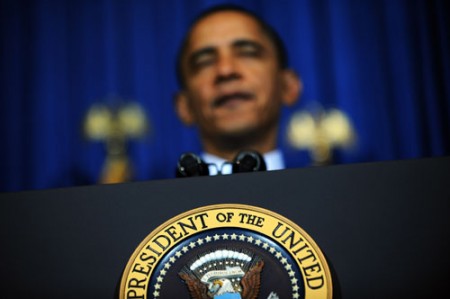
President Barack Obama speaks during a Washington D.C. rally celebrating the passage and signing into law of the Patient Protection and Affordable Care Act health insurance reform bill, on March 23, 2010. (Photo by JEWEL SAMAD/AFP/Getty Images)
By Roger Bybee
It was a truly remarkable moment, symbolizing the contradictions of Obama presidency’s thus far. Signing legislation at a ceremony March 30 in Arlington, Va., President Obama showed both his courageous Rooseveltian side and his calculating Clintonian side.
With a single signature, Obama simultaneously finalized Republican-inspired healthcare reform, and approved an unrelated but attached provision that reformed the student loan program by booting parasitic bankers out of the picture.
In that instant, Obama exemplified why so many people in labor and among progressives feel confused, impatient or even demoralized. Obama at some moments confronts the greed and arrogance driving Corporate America, but at other times–seemingly inexplicably–he capitulates to these forces. But perhaps we ought to be focusing less on Obama’s psyche and more on the degree of mobilization of popular sentiment relative to the highly-developed and sophisticated corporate efforts. Thus far into the Great Recession, the emergence of mass movements has been much less than most progressives expected, as many Americans seem to have lost any sense of their economic rights and the ability to exert power through collective action.
With progressives unable to mobilize popular forces in huge numbers against bank bailouts, home foreclosures and plant closings or for a single-payer healthcare plan, Obama faces substantial pressure only from the corporate side, as social-movements scholar Frances Fox Piven argues in an interview in my forthcoming In These Times piece on healthcare reform.
Sometimes Obama’s ambivalence toward the needs of working America has been visible in his treatment of a single issue, like the "bailouts" of GM and Chrysler. Yes, Obama preserved two corporations central to the life of Midwest factory towns, but he also allowed his economic advisors to force the closing of dozens of U.S. plants. Moreover, Chrysler used bailout money to transfer work from Wisconsin to Mexico. As the result of the bailout’s terms, both auto firms will now rely on more cars produced offshore by cheap, repressed labor in China and Mexico rather than in the United States.
MIDDLEMEN OUSTED ON STUDENT AID, BUT NOT ON HEALTHCARE
But on the student loan issue, Obama boldly expelled bankers as useless middlemen and enacted a "single-payer" student loan system. Such a system will increase the effectiveness of every federal dollar given out in student, as well as reduce the bureaucratic hurdles families face in applying for loans.
On student loans, Obama showed his more populist face in fighting for the public interest against the concentrated power of the banking industry. He clearly laid out the need for having the federal government directly channel aid money to students rather than allowing bankers to skim off easy profits by unnecessarily getting a cut of the federal money before it reaches those in need.
"By cutting out the middleman, we’ll save American taxpayers $68 billion in the coming years," Obama told his audience in Arlington, Va.
The practical impact: Obama is holding down interest rates for students, providing aid to help more kids of low or moderate incomes to get an education, and easing the debt burden that they will face after graduation. As noted in these pages, there has been a burgeoning movement among students and unionized teaching assistants against the higher tuitions that are part of the increasingly "neo-liberal" university system.
Obama’s action on student aid will make a significant difference for poor and working class students, argues Jeff Cohen: "Direct lending by the government will cut out the middleman and save taxpayers, according to the Congressional Budget Office, $61 billion over 10 years – with $40 billion in savings being redirected to higher education in the form of more Pell grants, more aid to minority-serving colleges and more aid to lower-income graduates for paying off their student debt."
But as Cohen noted, the application of these same single-payer principles of maximizing the value obtained by public spending and minimizing bureaucracy were somehow unacceptable when it came to the healthcare system. Thus in healthcare reform, Obama maintained the dominance of the for-profit insurers at the center of a system that is supposed ensure access to needed healthcare. While some significant (but loophole-riddled) insurance regulations were approved, funding for healthcare still gets funneled through the insurers whose inherent self-interest lies in minimizing care in order to maximize profits.
The fundamental problem is neatly summarized by Dr. Marcia Angell of Harvard Medical School: "Private insurers maximize profits mainly by limiting benefits or by not covering people with health problems. The United States is the only advanced country in the world with a health care system based on avoiding sick people."
But Obama chose to accept and obscure this central reality, by insisting on the "individual mandate" without any effective controls over premium increases. Obama’s plan wraps up 34 million new government-subsidized consumers for the insurance industry, as Dr. Angell describes it.
Contrary to his stance on student aid, Obama insisted that when it came to healthcare, the middleman must be retained at all costs. While concerned with saving money on student loans, Obama abandoned the potential savings gained from cutting out the insurance bureaucracy, which would have been about $350 billion to $400 billion each year. He abandoned his former support for a single-payer or "Medicare for all" system he advocated as an Illinois state senator. He claimed that uprooting the insurers–whose basic motive is to maximize profit by minimizing care–must be kept in the system or too much disruption would result.
Dr. Angell correctly labeled this as a call for throwing at least $447 billion into a system that was a proven failure, yet expecting a successful outcome.
CONSERVATIVE ROOTS OF DEMOCRATIC HEALTH PLAN
Obama remained impervious to this virtual certainty of a deteriorating healthcare system, instead relying on the comforting assurances of insurers, Big Pharma, and elite political figures in both parties. However, congressional Republicans unanimously voted against Obama’s health plan, acting on a purely political basis and showing an extremely uncharacteristic degree of independence from their corporate sponsors in insurance and Big Pharma (the U.S. Chamber of Commerce and other more rightist business groups opposed healthcare reform.)
In fact, the Obama plan was largely shaped by a former Wellpoint insurance executive, contained many of the principles proposed by the insurance industry in 1992
, and is similar to the Mitt Romney plan in Massachusetts. According to Nancy Pelosi, the Democrats’ healthcare bill actually drew on the far-Right Heritage Foundation for the basic principles.
Still, despite this strongly Republican-flavored bill, Obama hailed the Patient Protection and Affordability Act on Marcy 20 as "centrist: "This piece of historic legislation is built on the private insurance system that we have now and runs straight down the center of American political thought."
While labor and progressives may be divided on how much value the new healthcare reform will have, there should be no confusion about Obama’s claim that it was geared "straight down the center." Obama is correct only if one pays attention to elite corporate and media opinion and utterly discounts popular sentiment, as I have previously reported:
A January, 2009 CBS/NY Times poll showed 59 percent for a single-payer system described in vague terms. Business Week reported on a more specifically-worded question in a 2005 poll, which found "67 percent of all Americans think it’s a good idea to guarantee health care for all U.S. citizens, as Canada and Britain do, with just 27 percent dissenting." The Annals of Internal Medicine reported on a survey showing 59 percent backing among physicians for single-payer.
But the public’s pro-single-payer sentiment, fueled by an ever-growing awareness of the insurance industry’s uncaring denial of treatments in order to enhance their profits, went largely untapped and was not registered by the mobilization of a mass movement. In contrast, insurers were portrayed by Obama as actual allies of reform, until late in the legislative process, when rhetorically pounding them became necessary for passing the Patient Protection and Affordability Act.
However, labor and progressives might best learn from the first 15 months of Obama’s presidency by spending less time analyzing Obama’s psychological makeup or campaign contributions, and instead figuring out why we’ve been unable to generate vibrant movements to channel public anger over growing inequality and corporate bailouts.


I'm teaching in Labor Studies at Penn State and the University of Illinois in on-line classes. I've been continuing with my work as freelance writer, with my immediate aim to complete a book on corporate media coverage of globalization (tentatively titled The Giant Sucking Sound: How Corporate Media Swallowed the Myth of Free Trade.) I write frequently for Z, The Progressive Magazine's on-line site, The Progressive Populist, Madison's Isthmus alternative weekly, and a variety of publications including Yes!, The Progressive, Foreign Policy in Focus, and several websites. I've been writing a blog on labor issues for workinginthesetimes.com, turning out over 300 pieces in the past four years.My work specializes in corporate globalization, labor, and healthcare reform... I've been a progressive activist since the age of about 17, when I became deeply affected by the anti-war and civil rights movements. I entered college at University of Wisconsin Milwaukee just days after watching the Chicago police brutalize anti-war demonstrators at the Democratic Convention of 1968. I was active in a variety of "student power" and anti-war activities, highlighted by the May, 1970 strike after the Nixon's invastion of Cambodia and the massacres at Kent State and Jackson State. My senior year was capped by Nixon's bombing of Haiphong Harbor and the occupation of a university building, all in the same week I needed to finish 5-6 term papers to graduate, which I managed somehow. My wife Carolyn Winter, whom I met in the Wisconsin Alliance, and I have been together since 1975, getting officially married 10/11/81. Carolyn, a native New Yorker, has also been active for social justice since her youth (she attended the famous 1963 Civil Rights march where Dr. King gave his "I have a dream speech"). We have two grown children, Lane (with wife Elaine and 11-year-old grandson Zachary, who introduced poker to his classmates during recess) living in Chicago and Rachel (who with her husband Michael have the amazing Talia Ruth,5, who can define "surreptitious" for you) living in Asbury Park, NJ. My sister Francie lives down the block from me. I'm a native of the once-heavily unionized industrial city of Racine, Wis. (which right-wingers sneeringly labeled "Little Moscow" during the upheavals of the 1930's), and both my grandfathers were industrial workers and Socialists. On my father's side, my grandfather was fired three times for Socialist or union activity. His family lost their home at one point during the Depression. My mom's father was a long-time member of UAW Local 72 at American Motors, where he worked for more than 30 years. Coming from impoverished families, my parents met through a very low-cost form of recreation: Racine's Hiking Club.
ZNetwork is funded solely through the generosity of its readers.
Donate




