

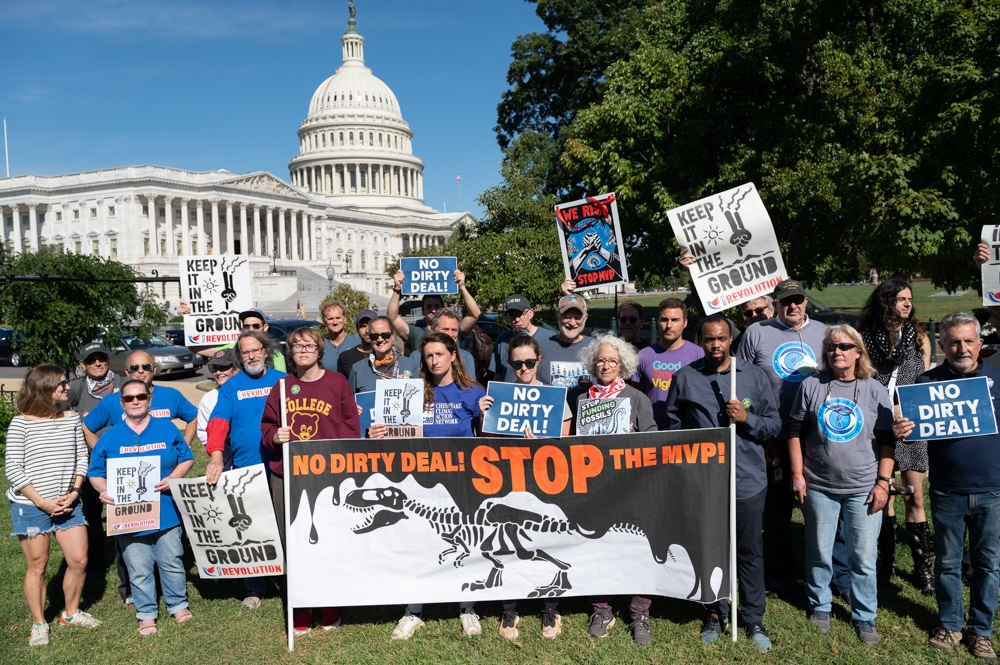
This weekend, only a few hundred activists will come to Appalachia to support the people directly impacted by the still unfinished 303-mile fracked gas Mountain Valley Pipeline (MVP) through their participation in trainings, anti-pipeline actions and a music festival. But in a month, thousands and thousands will descend on New York City to demand that President Joe Biden declare a climate emergency and end all new fossil fuel projects.
Environmental organizations flock to New York City or Washington, D.C. every few years, but for the past century, those in power have ignored their calls to take transformative action on the climate crisis. We’re now out of time to convince rich octogenarians to change course: We can no longer afford to build any new fossil fuel projects. The United Nations secretary general has proclaimed “the era of global boiling has arrived.”
From the front lines of a massive, ongoing fossil fuel buildout in Appalachia, I wonder: Where are the thousands flocking to help us put a direct stop to this project? What would our movement look like if we centered it around the front lines?
Over the past month, I’ve spent every day organizing opportunities to support the MVP front lines through my work with the POWHR Coalition, the leading grassroots group fighting MVP for the past decade. Every day I get messages from non-frontline nonprofit colleagues and climate activists telling me they’re too busy to support this work because they’re organizing elsewhere. Meanwhile, I drive by 42-inch pipes being shoved into the Appalachian Mountains, talk to elderly community members who are sick with grief at the destruction 20 feet from their homes, and hear about pipeline workers harassing young women in town.
Despite spending every day doing the work I love, my heart is heavy with grief at both the injustice on the ground and the reality that our government has allowed this to happen. The regular rejections of support from peers focused on the fossil fuel endorsing, rich, white elected adds insult to injury.
I didn’t always think this way. Two years ago, I too, lived in Washington, D.C., worked at a mid-sized environmental organization and took part in largescale climate organizing. Despite my family being from India, one of the most climate-impacted countries in the world, I didn’t know what it was like to see reckless fossil fuel buildout destroy my own home. But moving to Appalachia and learning its history while struggling on the ground against MVP has opened my eyes to just how frequently this country betrays this region: Industry-extracted Appalachian coal has bolstered the United States economy for a century, yet Appalachia remains one of the poorest regions in the country.
When Biden sacrificed the region to cajole West Virginia Sen. Joe Manchin, no Appalachian was surprised. This is part of a long, and still very much ongoing, trend of rich electeds marginalizing our communities: The coal empire of West Virginia Gov. Jim Justice was just fined $1 billion for oil spills at Virginia mining sites. The MVP has accrued more than 300 water quality violations. The Tennessee Valley Authority is trying to replace two coal plants with fracked gas plants and pipelines.
The fossil fuel industry is extracting every last resource from Appalachia because it’s not counting on people to fight back. The largest labor uprising ever, the Battle of Blair Mountain, and the decade-long fight against the MVP are just two examples of how wrong the industry is. But history forgets the resistance of Appalachians. By ignoring the power of organized Appalachians, D.C.-based environmental activists are missing out on a century of lessons on how to confront injustice, including environmental injustice.
This cycle of marginalization and natural resource extraction is central to colonization and the fossil-fueled dominance of Western powers. Colonization, in turn, is central to capitalism, and its unceasing hunger has led us to our current state of environmental crisis. So, knowing these patterns, why would we continue to turn to the exact leaders and systems that got us here?
The Indigenous-led resistance to the Dakota Access Pipeline and Line 3 are examples of the climate movement convening at the front lines. Thousands traveled to the Midwest for the Sacred Stone Camp and Treaty People Gathering. Both movements expanded our forces and showed those in power our strength.
If well-resourced organizations turned their focus to frontline communities, we could continue to flood stolen lands with our resistance to pipelines. We could train one another in how to take direct action. We could move beyond the “politically possible” toward the future we truly deserve.
Appalachian frontline communities have been navigating systemic injustice for centuries, and there’s still so much to learn from this struggle. We must show up in solidarity when they call because, soon, we’ll all need support — and few of us can count on this government to help. We must shift from throwing the majority of our resources at the feet of rich octogenarians and instead center our movement around the front lines of extraction.
The future of our movement is the frontlines so the next time we plan a mass convening, let’s plan it in our backyards.
ZNetwork is funded solely through the generosity of its readers.
Donate




